
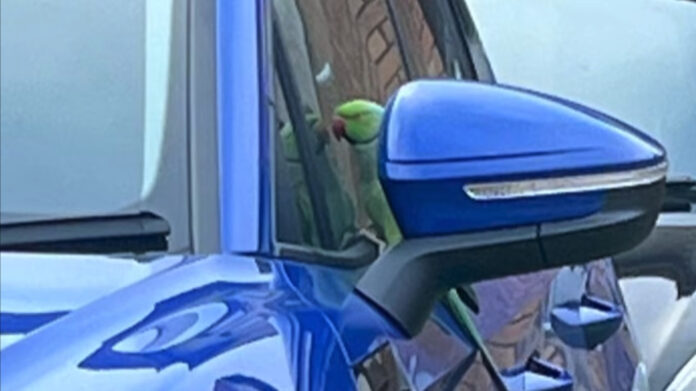
Birds and cars have endured a fairly contentious relationship. We (in the cars) are notorious for blasting big heavy metal windowed machines through their flight paths, and they have the expected (and unappreciated) duty to take a giant sh*t on our newly washed and waxed vehicles. But one bird may be looking to change that dynamic as he terrorizes the vehicles of a Scottish suburb.
Residents of Lochardil, Inverness told the BBC that the little green-feathered menace has been pecking away at window seals and the rubbery parts of windshield wipers on their cars, causing thousands of pounds in estimated damages. The bird allegedly targets cars in the area in stints — disappearing for a couple of weeks before returning. Notably, residents will alert the others via shout that he’s at it again.
His destructive antics have made him a block of enemies. Enough that the word “parakeet” is like a forbidden word in the area, kinda like “Voldermort” or “politics” for other applicable conversations.
Identified by nature experts as a rose-ringed parakeet, these birds are not native to Scotland, according to the bird bible that is the Audubon. Though, due to the attractive nature of keeping these little green parrot-like birds as pets, a growing feral population does exist in the UK, just not seemingly in the far north of Scotland.
Is it just nature?
The Royal Society for the Protection of Birds (RSPB) explained the parakeet is the UK’s only “naturalized parrot” — common to see in London and southeastern parts of the UK, but typically not Scotland. It’s believed the devilish bird is an escaped pet. Desperate residents have reached out to organizations for help handling the bird, but as it’s considered a wild bird, their hands are tied.
NatureScot, Scotland’s nature agency, was unsure why the parrot would be eating or dismantling the rubber parts of car, but offered a few theories as to why. One theory is territorial and it’s reacting to its reflection in windows. The bird could also crave the fats and minerals in the rubber. Or, it’s just bored. Although when the sky is not even your limit, the last one is a little difficult to believe.
There could be something to the fats and minerals in the rubber, though. Manufacturers have made concessions utilizing different natural products to make rubbers and plastics. It’s not uncommon to find soy-based products in your car like the sheathing found on wiring, which is a favorite for mice.
In the meantime, residents are on their own dealing with the bird problem. Some shared their innovative bird-repelling solutions with STV News which included covering the cars with tarps, putting snakes on their dashboards, and even brushing peppermint oil into the rubber. Apparently, the bird is not a fan of peppermint.

