WACKER has presented two new material innovations for EV battery safety: a ceramifying silicone for thermal barrier coatings and a pair of potting compounds engineered to resist filler sedimentation during long-term storage.
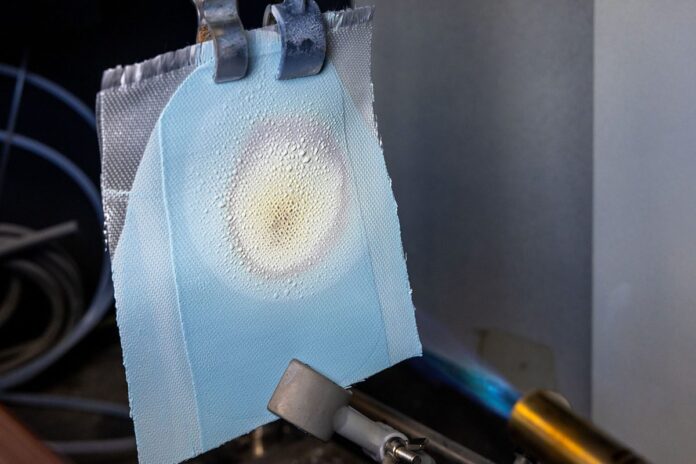
The ceramifying product comes from the ELASTOSIL CM line. Applied as a liquid, it cures to a standard silicone elastomer suited for coating rigid housing components or flexible, fabric-based barrier systems. At temperatures above 600 °C it transforms into a ceramic structure, blocking heat and hot gases from reaching adjacent components. WACKER’s thermal runaway testing shows that a protective fabric coated with ELASTOSIL CM reduces radiant heat from a 1,300 °C flame to below 150 °C. The ceramified layer also physically traps ejected particles from a defective cell—a requirement that’s increasingly relevant, as European regulations mandate five minutes of thermal containment for passenger evacuation.
The new potting compounds, ELASTOSIL RT 7616 TC and RT 7624 TC, are both addition-curing silicone elastomers that cure at room temperature. Thermal conductivities are 1.6 W/mK and 2.4 W/mK respectively. Viscosities are 5,500 mPa·s and 8,000 mPa·s (DIN 53019)—low enough to fill gaps in the hundreds-of-micrometers range reliably and bubble-free.
WACKER says the rheology of both formulations has been optimized to prevent the particulate thermal fillers from settling and caking during storage, which has historically required time-consuming redispersion before use. Even if settling occurs after adverse transport conditions, standard mixing equipment is sufficient to restore uniformity. Applications include battery chargers, DC/DC converters and inverters, specifically for discrete components like inductors and coils.
Source: WACKER