
The all-new 2027 Hyundai Elantra, also known as Avante in the local market made its global debut at the 2026 Busan Mobility Show. This is the first full redesign of Hyundai’s compact sedan since the seventh-generation model arrived in 2020. While the sleek fastback profile remains, almost every part of the car has been redesigned, including the exterior sheet metal and lighting, the cabin layout and infotainment system.
After spending time with the car on the show floor, here are the biggest changes we found.
Hyundai’s new H-Edge lighting signature

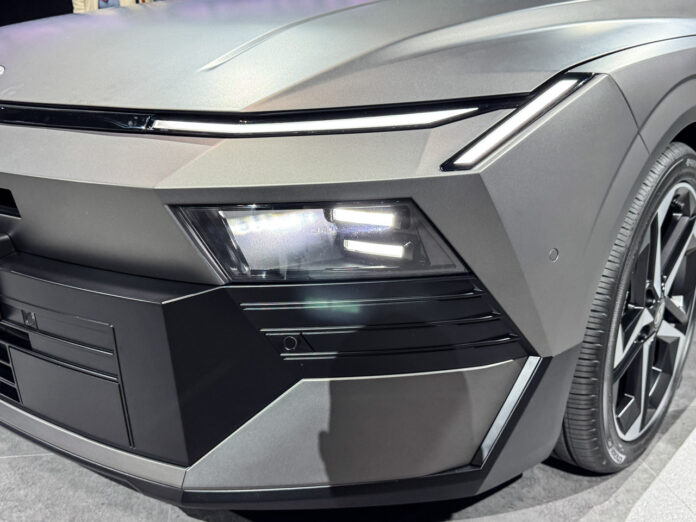
The most obvious change on the 2027 Elantra at the front is the new lighting design. Hyundai’s new H-Edge lighting signature has replaced the outgoing model‘s full-width daytime running light. Slim horizontal DRLs are paired with vertical light elements at both corners, creating an H-shaped appearance.
New rear design
The rear has been redesigned just as extensively as the front.

There are new taillights, a full-width light bar, a reshaped trunk lid with an integrated spoiler lip, and a revised lower bumper featuring diffuser-style detailing.
A completely redesigned front end

Almost every component on the nose has been redesigned. The headlights are slimmer, the grille has a new shape, the bumper features a different lower air intake, and the corner air curtains are now more upright. Although the overall proportions remain similar, the front fascia bears little resemblance to the outgoing Elantra.
Flush door handles replace pull-type

Hyundai has switched to lift-up flush door handles for the new Elantra. It adds a cleaner look to the profile. They replace the traditional pull-type handles used on the outgoing model.
Slimmer side mirrors

Another styling change is the redesigned outside mirrors. Hyundai now uses much thinner mirror stalks, which are intended to improve aerodynamics and reduce wind noise while also giving the mirrors a lighter appearance.
Elantra has become larger

The new model is larger than the previous generation model. Compared with the outgoing Elantra, overall length increases by 2.2 inches (55 mm), width grows by 1.2 inches (30 mm), and wheelbase stretches by another 1.2 inches (30 mm). The longer hood, extended rear doors, and wider stance are noticeable in person.
New alloy wheel design

The available 18-inch wheels feature an entirely new five-spoke geometric design. Unlike the previous wheel designs, these use larger machined surfaces with angular spoke shapes that match the sharper styling of the new body.
An all-new dashboard

The dashboard has been completely redesigned with a clean horizontal layout that stretches across the cabin. The center console flows naturally into the dashboard, while ambient lighting extends into both front doors.
Instrument cluster becomes slimmer

Instead of placing the instrument cluster inside a traditional binnacle, Hyundai now uses a slim horizontal driver display positioned near the base of the windshield. It provides key driving information without dominating the dashboard.
Pleos Connect

The center display now runs Hyundai’s new Android Automotive-based Pleos Connect software. Depending on trim level, buyers get either a 12.9-inch or 14.6-inch touchscreen with split-screen capability, improved graphics, and a redesigned interface.
Gleo AI Joins the Cabin

One of the biggest software additions is Hyundai’s new Gleo AI assistant. Unlike traditional voice commands, Gleo AI is designed for conversational interaction, allowing drivers to search for information, receive destination suggestions, and control vehicle functions using more natural speech.
Hyundai app store
Pleos Connect also introduces the Pleos App Market. Owners can download supported apps directly to the vehicle instead of relying solely on factory-installed software.
Physical controls are retained

While the touchscreen is significantly larger, Hyundai hasn’t removed the physical controls. Climate settings, shortcut buttons, and rotary controls remain below the display, making frequently used functions easier to access without navigating menus.
Gear selector moves to the steering column

One of the biggest changes inside is the relocation of the gear selector. Instead of occupying space on the center console, the electronic shift-by-wire selector is now mounted on the steering column, similar to Hyundai’s more expensive models. The new setup frees up storage space between the front seats.
Center console gets more space

With the gear selector moved, Hyundai has redesigned the floating center console. There’s now a larger open storage area beneath the console, dual cupholders, a wireless charging tray, and a more spacious center armrest compartment than before.
Bang & Olufsen replaces Bose

Premium trims now feature a Bang & Olufsen audio system instead of the Bose setup found in the outgoing Elantra. The new speaker grilles carry B&O branding and feature a revised perforated design.
Faster charging ports

The new Elantra adds 100W USB-C charging ports for both front and rear passengers. That’s ample power to charge laptops, smartphones, and tablets simultaneously.
Ambient lighting
Ambient lighting is no longer limited to small accent areas. A continuous light strip now runs across the dashboard and into the front door panels, giving the cabin a more cohesive appearance after dark.
Trunk

Hyundai hasn’t released the cargo volume yet, but the redesigned trunk opening appears wide with a low loading floor.
The opening itself looks easier to load than before, and the cargo area has a clean, flat floor with minimal intrusion from the wheel wells. We’ll reserve judgment on whether cargo capacity has increased until Hyundai publishes official specifications.
Hybrid models to become more fuel efficient
New features include Smart Regenerative Braking 3.0, Stay Mode, Hybrid Predictive Energy Control, and a more powerful hybrid system producing a combined 155 horsepower and 195 lb.-ft. of torque.
The 2027 Hyundai Elantra will be launched in South Korea in gas and hybrid variants in Q3 2026, and we expect the U.S. launch to follow in early 2027.

An automobile engineer by training, I’ve analyzed the global car market since 2005, with a keen focus on EVs since 2008. My journey in online automotive publishing spans 17 years, during which I have reviewed cutting-edge automotive technologies and interviewed leading global CEOs and vehicle developers.

