
As Mercedes-Benz’s EV range continues to grow into new segments, the brand will reveal its direct competitor to the upcoming BMW i3 sedan and the Polestar 2 in 2026 as the Mercedes C-Class Electric.
While the GLC Electric is heading to the U.S. in the second half of next year, citing dealer sources, Automotive News had reported back in 2021 that the all-electric C-Class will also be sold in America.
Here are our expectations from the C-Class Electric that should be available in the U.S. in 2027:
Design

The C-Class EV looks sportier than the current C-Class, thanks to a faster upswing in the beltline and a sleeker glasshouse. Mercedes-Benz confirmed the more streamlined silhouette through a teaser at the GLC EV’s world premiere.
The teaser also revealed a confident and high-tech front with a prominent upright grille and curvy headlights. Mercedes-Benz will offer the grille with a backlighting option that illuminates a pixel graphic, the horizontal slots inside the grille, the surrounding contour, and the central three-pointed star logo.

The curvy headlights feature the iconic star logo and “visor” look DRLs that bring out the assertive look of the C-Class Electric’s front. Similarly, at the back, we expect two-part tail lights featuring an eye-catching star motif. Both headlights and taillights should feature animated welcome/leaving functions.
Interior
Seamless MBUX Hyperscreen
The Mercedes C-Class Electric should feature the new MBUX Hyperscreen, a floating 39.1-inch dashboard display that beautifully integrates sections of a conventional driver information display, infotainment touchscreen, and passenger touchscreen.

Lower configurations should settle for the MBUX Superscreen, combining a 10.3-inch driver information display, a 14-inch infotainment touchscreen, and a 14-inch passenger display under a large glass surface.
Software and Connectivity
The “Hey Mercedes” voice assistant should feature improved natural language processing and wider language support. Over-the-air software updates will allow new functions and refinements to be added after delivery, including time-limited or subscription-based features.
Seating and Space
The C-Class EV, designed around the MB.EA-M platform, should offer a flat-floor rear cabin with more footwell space than the combustion C-Class. Focusing on sustainability, Mercedes-Benz should use recycled and renewable materials for the seat fabrics, door trims, and carpeting.
Over-the-air technology
The all-electric C-Class is expected with many new and improved features over its life with updates pushed over the air. Moreover, customers will likely be able to enable features with permanent/time-limited activations or subscriptions anytime during the ownership, days, months, and even years after the car leaves the factory and reaches them.
Active Ambient Lighting
Another optional extra in the C-Class Electric could be Active Ambient Lighting, which can visually support warnings of the car’s driving assistance systems with color feedback. This new mood lighting system may give color feedback even when operating the climate control system, “Hey Mercedes,” and the Energizing Comfort programs.
Frunk
Similar to the GLC Electric, the C-Class Electric should have a front trunk. This will make it competitive with its rivals, including the Tesla Model 3. Customers will be able to use the additional storage space to keep the car’s charging cable and maybe even a gym bag, a cabin bag, or a golf bag.
Specifications
Platform
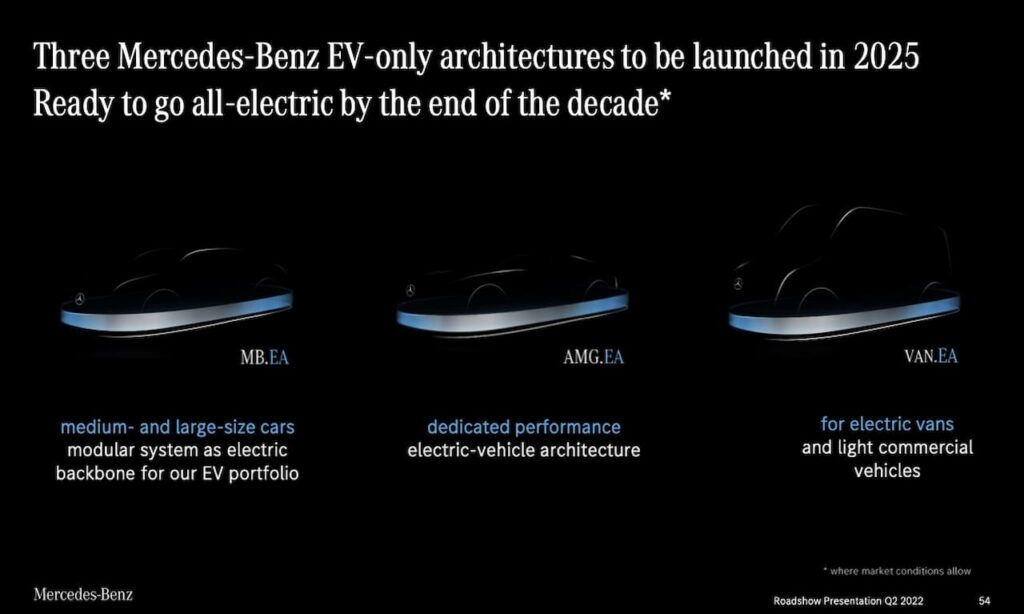
Mercedes-Benz is developing the C-Class Electric on the MB.EA-M platform, which it engineered specially for mid-size EVs. The all-electric GLC is the first model based on this new platform, with big gains in range, efficiency, space, and other key aspects over the EQC SUV.
Next-gen Batteries
Mercedes-Benz is standardizing its battery packs across model lines. The C-Class EV is expected to use an NMC battery pack for long range, with an LFP battery pack positioned as an entry option. The GLC Electric offers a 94 kWh (net) battery comprising NMC cells with an energy density of 680 Wh/L, and the sedan could adopt a similar capacity given its shared architecture.
Performance
The C-Class Electric will adopt the company’s new eATS 2.0 electric drive units. These use radial permanent magnet motors and a silicon carbide inverter as part of an 800-volt system. Rear-wheel drive and dual-motor all-wheel drive variants are expected, mirroring the GLC Electric lineup.


At launch, the top configuration will likely combine two motors producing 483 hp of system power and providing all-wheel drive capability. A 0-60 mph sprint should take just around 4 seconds, with the top speed electronically limited to 130 mph.
Charging and Range
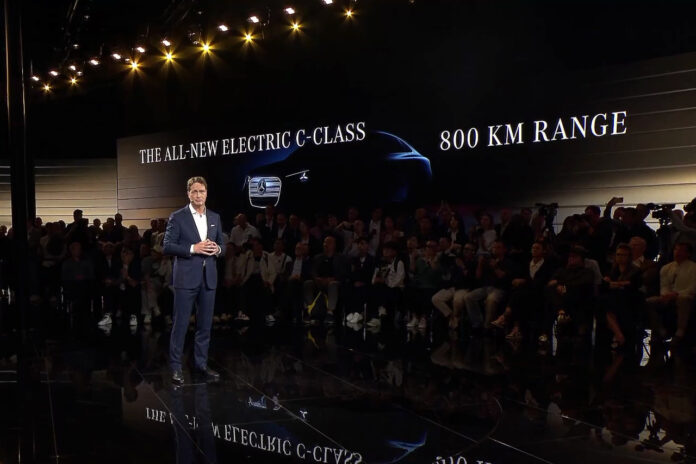
One example: with the future electric C-Class, we’re looking at 800 kilometres (497 miles WLTP) of range, thanks to outstanding efficiency.
Ola Källenius, CEO, Mercedes-Benz Group (Mercedes GLC Electric world premiere on September 7, 2025)
The sedan should support up to 350 kW DC charging on its 800-volt system. A 10-80% charge in about 20 minutes is expected. In terms of range, the smaller frontal area and more aerodynamic profile compared with the GLC Electric could allow the sedan to approach or exceed 350 miles EPA, competing with the Tesla Model 3 Long Range.
Multi-source Heat Pump
The C-Class Electric is set to feature a multi-source heat pump that recovers waste heat from the electric drive unit, the high-voltage battery, and ambient air and reduces energy consumed to heat the cabin.
Bi-directional Charging
Expect the C-Class Electric to support bi-directional charging in some markets. When connected to a compatible DC charging station, the sedan can store renewable energy, such as solar power, for later use. It can also supply electricity externally, including Vehicle-to-Home (V2H) and Vehicle-to-Grid (V2G) functions, or recharge another EV.
Air Suspension
Available AIRMATIC air suspension system should swiftly iron out bumps and vibrations, enhancing comfort on rough patches of roads or the last few unpaved miles on the way to an adventure destination. Combining Google Maps data with driving speed, it will likely intelligently keep the ride height at the lowest possible level as long as possible, improving driving dynamics and reducing energy consumption.
Rear-axle Steering
The Mercedes C-Class EV should also come with a rear-axle steering option that enables the rear wheels to turn for improved maneuverability and agility. At speeds of up to 37 mph, the rear wheels should turn by up to 4.5º in the opposite direction to the front wheels, significantly reducing the turning circle to make parking in tight spaces and taking U-turns in narrow streets easier.
Above 37 mph, the rear wheels should turn by up to 2.5º in the same direction as the front wheels, increasing stability, especially during quick lane changes or sudden evasive maneuvers.
Production & Release Date
We’re also closing a gap with new electric cars in the core segment, starting with the electric GLC tonight and C-Class later next year.
Ola Källenius, CEO, Mercedes-Benz Group (Mercedes GLC Electric world premiere on September 7, 2025)
Production of the Mercedes C-Class Electric is expected to take place in Bremen, Germany. At the GLC Electric’s world premiere, Källenius confirmed the model is on track to arrive globally in 2026.
Mercedes C-Class Electric FAQs
Which are the future C-Class Electric’s rivals?
What is the Mercedes C-Class Electric’s release date?
The Mercedes C-Class Electric will be launched globally in 2026.
What is the expected C-Class Electric’s price & range?
Expect the high-spec C-Class EV with 350 miles of range (EPA). Prices should start at around $55,000.
Featured Image Source: Mercedes-Benz

An automobile engineer by training, I’ve analyzed the global car market since 2005, with a keen focus on EVs since 2008. My journey in online automotive publishing spans 17 years, during which I have reviewed cutting-edge automotive technologies and interviewed leading global CEOs and vehicle developers.

