
Update (September 20, 2025): ‘Apple CarPlay Ultra’ added; ‘New 1.6L TMED-II Hybrid System,’ ‘Quieter, Smoother Drive,’ and ”N’ Performance Variant’ updated.
On October 20, 2024, ET News reported that Hyundai began developing the next-gen Tucson (codename NX5), due for its launch in South Korea in the first half of 2026.
Based on that report, recent trends in the compact SUV segment, and Hyundai’s latest announcements, here are the features likely in the upcoming Tucson Hybrid, which could either be the 2027 or 2028 model year in U.S. and Canada.
1. ‘Art of Steel’ Design Language

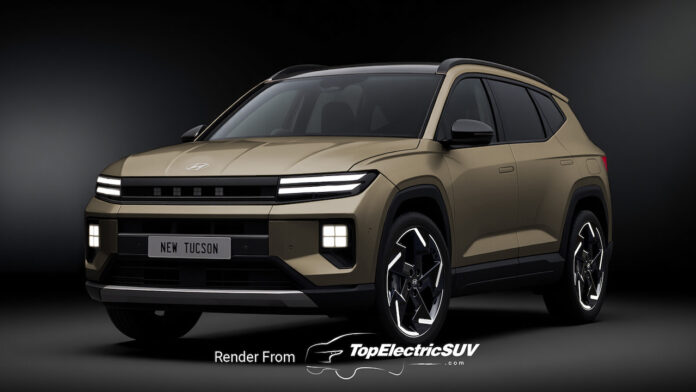
Hyundai’s new ‘Art of Steel’ design language, previewed in the Initium Concept and introduced in the new Nexo, should influence the next-gen Tucson’s appearance. We expect sharper lines, a more angular grille, pixel-inspired headlights, and rugged body panels. Early test prototypes, including those captured by Shorts Car channel, reveal a boxier look compared to the current model.
We expect Hyundai to continue with the Blue, SEL, N Line, and Limited variants in the incoming Tucson Hybrid, and later, could add a performance-spec N variant.
2. New 1.6L TMED-II Hybrid System

While the current model uses the TMED-I system (Transmission Mounted Electric Device I system), the next-gen Tucson Hybrid should adopt a smaller version of Hyundai’s latest TMED-II hybrid powertrain which debuted in the new Palisade. This system pairs a smaller 1.6L turbocharged engine with a refined electric motor setup.
A new, next-generation gasoline 1.6-liter turbo hybrid powertrain will also be available.
Hyundai Motor Group’s announcement during the ‘Next-Gen Hybrid System Tech Day’, on April 21, 2025
We expect around 235 hp, and an EPA-est. combined rating of 38-40 mpg in the next-gen compact SUV. The company offered a glimpse at the specs, stating that torque is expected to increase from 367 Nm to 380 Nm (from 270 to 280 lb-ft). Hyundai claims a fuel economy improvement of over 4% in mid-size SUVs.
3. Quieter, Smoother Drive
We are more than doubling the number of hybrid vehicles that we are offering from now to 2030. We’ll prioritize hybrid driven markets like the U.S. We want to ensure we can offer everything our customers are looking for.
Jose Munoz, President and CEO of Hyundai Motor Company, at the 2025 CEO Investor Day on September 18, 2025
With a new P1 motor, the hybrid will likely offer reduced idle vibration, faster shifts, and better low-speed smoothness. In TMED-II, the clutch control system has been upgraded to minimize transition lag between electric and engine drive. These refinements should lead to quieter cabin operation and more responsive acceleration.
4. Smart Regenerative Braking
The TMED-II system supports smart regenerative braking. It automatically adjusts based on traffic, navigation, and incline data. This should offer drivers of the next-gen Tucson better stopping comfort and better energy recovery.
5. ‘Stay Mode’ Function
As seen in the Palisade Hybrid, ‘Stay Mode’ is a big feature in TMED-II which draws supply from the traction battery. This allows the use of the infotainment, HVAC, and other systems without turning on the engine, and is ideal for parked rest or waiting, up to one hour.
6. Pleos Connect Infotainment

Hyundai’s next-gen Pleos Connect infotainment system is expected to power the next-gen Tucson. Built on Android Automotive OS, it offers app support, multi-window layout, and Gleo AI voice assistant. It supports profiles and preferences using a Pleos ID login.
7. Apple CarPlay Ultra
As per TopGear, Pleos in the upcoming Ioniq 3 offers optional Apple CarPlay Ultra, a feature that could also make its way into the next-gen Tucson in many markets.
Currently available on Aston Martin vehicles in North America, it extends across all driver displays, including the instrument cluster, combining maps, media, and widgets from the iPhone with vehicle data such as gauges, tire pressure, driver assistance functions, climate, and media controls.

It supports touch, physical buttons, or voice, and introduces customizable themes with changeable colors and wallpapers, along with widgets designed to blend into the car’s screens.
8. More Comfortable Seating
Spy shots of early test prototypes in South Korea show the NX5 with revised seats, door armrest, and console armrest. The front seats, with a vertical upholstery pattern, have visibly more side bolstering, and the power seat adjustment switches are relocated to the outboard side.
The headrests have been upgraded with an integrated design, and both armrests look more sculpted and chunkier. The speaker has been repositioned to the A-pillar which allows for a proper quarter glass section, improving natural light inside the cabin.
9. Comprehensive Features
Expect a full suite of features: digital key, head-up display, panoramic sunroof, ventilated seats, wireless phone charger, fingerprint scanner, and premium audio system. Physical buttons will remain for critical controls.
10. Vehicle-to-Load (V2L) and e-AWD

The Tucson Hybrid should support V2L at up to 3.6 kW, allowing power to external devices. Hyundai’s HTRAC all-wheel drive will be offered, with newer features likely including E-Ride to smooth out rough surfaces, E-Handling to improve cornering response, and e-DTVC (Electric Dynamic Torque Vectoring Control) to enhance traction.
It may also include E-EHA (Electrically Evasive Handling Assist) to help stabilize the vehicle during sudden avoidance maneuvers using motor torque.
11. ‘N’ Performance Variant
By 2030, we will have more than seven N models available. We started this with our ICE and HEV models and then our EVs. We expect end sales by 2030 of over 100,000 vehicles, primarily in the U.S., Europe, and Korea, but also in growing markets in Australia, United Kingdom, and Canada.
Jose Munoz, President and CEO of Hyundai Motor Company, at the 2025 CEO Investor Day on September 18, 2025
Hyundai N will expand beyond EVs and gas models, with hybrid performance models joining the lineup. As per Auto Express, a Hyundai Tucson N is likely, using the new 1.6-liter hybrid making around 300 hp, possibly with a potent all-wheel drive system, and an electric rear axle.
Unlike the standard hybrid variants, the N’s hybrid tech is expected to be developed to deliver power and agility rather than efficiency.
12. Dual Wheelbase Strategy
Hyundai is expected to continue offering two body lengths with the fifth-generation Tucson worldwide. The long-wheelbase version, aimed at markets like the U.S. and South Korea, stretches the wheelbase by about 3% compared to the European model. This design brings larger rear doors, easier ingress and egress, more knee room, and improves comfort for back-seat passengers.

An automobile engineer by training, I’ve analyzed the global car market since 2005, with a keen focus on EVs since 2008. My journey in online automotive publishing spans 17 years, during which I have reviewed cutting-edge automotive technologies and interviewed leading global CEOs and vehicle developers.

