
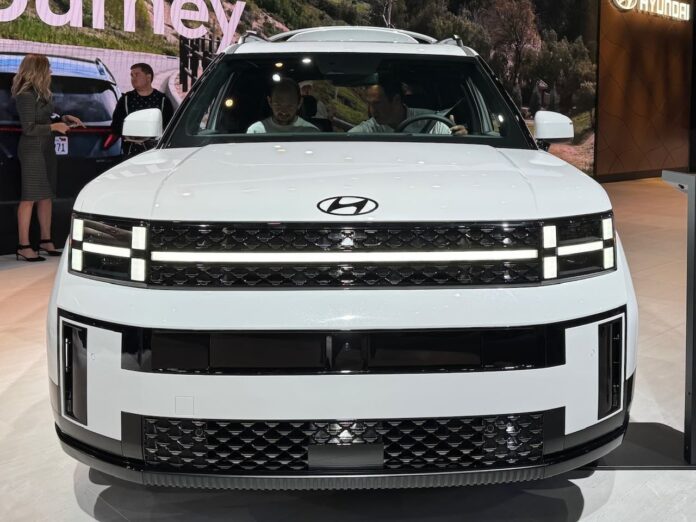
The fifth-generation Hyundai Santa Fe, which was a radical departure, is about two years old. However, going by test prototypes in South Korea, the company has already begun preparing a facelift.
The updated SUV is expected to debut in the second half of 2026 with revised styling, new features, and a first-ever extended-range electric vehicle (EREV) variant. Here’s everything we know and expect from the new Santa Fe.
Design
Seeing it in person for the first time, we felt that the fifth-generation Santa Fe stands out among mainstream midsize SUVs with its monolithic design, drawing comparisons to the more expensive Range Rover. Spy shots (via Naver) indicate that the facelift will preserve the silhouette, but introduce more striking styling.
The front fascia is likely to adopt a split headlamp setup, with tall DRLs positioned at the extreme ends of the upper section and the low- and high-beam modules placed in a horizontal housing further inboard. An EV-style closed upper grille could give the SUV a cleaner appearance.

On the sides, new 21-inch alloy wheels are expected, including both a classic thick-spoke design and a contemporary multi-spoke option. At the rear, the refreshed Santa Fe is expected to feature two vertical light bars flanking the ends of the tailgate, connected by a slim horizontal light bar, creating a more pronounced H-shaped signature.
Interior
Pleos Connect
Inside, the most significant update should be Hyundai’s next-generation infotainment system, Pleos Connect, based on Android Automotive OS. The system will support multi-window functionality, user profile-based personalization, and third-party app downloads. Hyundai has confirmed that Pleos Connect will roll out starting in Q2 2026, and the new Santa Fe should be among the first models equipped with it.

Features
The current Santa Fe offers a spacious cabin with premium materials and sustainable finishes. Key features include a flat, upright H-shaped dashboard, twin 12.3-inch displays, a steering-column gear selector, and a center console with dual wireless charging pads and touch-based climate controls.
Premium Nappa leather, soft-touch wood trim, recycled plastics, and eco-leatherette enhance the interior. Practicality highlights include hollowed-out storage beneath the console, generous second-row space, and availability in 5- (not in the U.S.), 6-, and 7-seat layouts.
Space & Practicality
In our time with the hybrid variant, we observed that the current Santa Fe delivers an upscale SUV-like cabin with quality materials, intuitive tech, and useful storage. The first two rows offer ample space and comfort, while the third row is tighter but benefits from the model’s tall, boxy shape. Cargo capacity with the third row seats folded reaches 40.5 cu. ft., marking a notable improvement over the previous generation, and we expect no changes to these attributes in the facelift.

Specifications
Hybrid
Hyundai should continue offering the fifth-gen Santa Fe in the familiar gas and hybrid variants with 2.5- and 1.6-liter with a 60 hp motor, respectively. The regular hybrid variant should deliver an EPA-estimated fuel economy of ~35 MPG (combined), about 50% higher than the gas model.
Range Extender (EREV)
According to a report from The Korea Economic Daily, Hyundai will likely offer the facelifted Santa Fe with an EREV option.
During the CEO Investor Day 2024, Hyundai confirmed a D-Segment model with an EREV powertrain for the U.S. market, going into production in 2026, and available for sale in 2027. This variant is expected to pair a 2.5-liter turbocharged gasoline engine, used solely as a generator, with a large traction battery that powers a high-output electric motor.

The battery pack will also support plug-in charging. The Santa Fe EREV is projected to deliver more than 500 miles of range. Hyundai has stated that its EREV models in general will achieve over 559 miles of combined range.
Release Date
While we await confirmation, the facelifted Santa Fe could be announced for the U.S. as the 2027 model in the second half of next year, priced from around USD 35,000 in the gas variant, and around USD 37,000 in the hybrid variant. The Santa Fe EREV variant, arriving in 2027, should round out the U.S. lineup, priced from over USD 45,000.
Featured image: Current-gen Santa Fe

International Automotive News Editor since 2014, covering global motor shows, industry events, and test-driving various vehicles, with a focus on hybrid and electric cars in recent years.

