
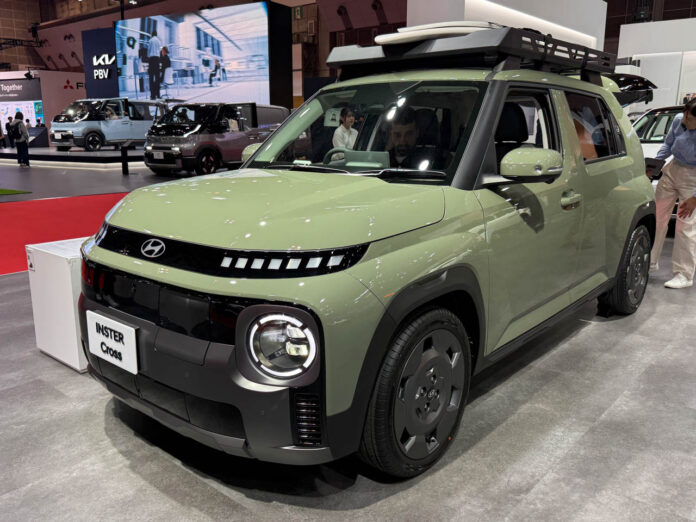
Soon after the all-new Nexo, Hyundai’s priciest and technologically most sophisticated zero-emission model, we got to experience the Inster Cross, one of its most affordable EVs, at the 2025 Japan Mobility Show. From our time with the entry-level model, we found it cleverly engineered and full of character for a vehicle of its size.
Design
The Hyundai Inster Cross presents the city-focused Inster with a tough personality aimed at shoppers who want a small EV that’s outdoorsy. Straddling the A and B segments, it maintains the short footprint to tackle bumper-to-bumper traffic while offering a slightly broader stance and plenty of road presence.


Compared with the basic Inster, the Cross variant features rectangular bumpers at both ends, embossed black claddings, and skid plates. Side rocker panels and unique 17-inch alloy wheels complete the protective look suited to light gravel. Roof rails come standard, and buyers can add a roof basket for carrying sports or camping gear.
Hyundai offers the Inster Cross in an exclusive Amazonas Green Matte finish along with Atlas White, Unbleached Ivory, Aero Silver Matte, Abyss Black Pearl, and Tomboy Khaki (pictured). A black two-tone roof is optional.
Interior


Inside, this particular Hyundai Inster Cross features a dual-tone scheme of grey cloth and lime-yellow accents on the dashboard and trim. The materials feel durable and modern, and the layout is easy to use.
All seats can fold flat to maximize cargo space, and there is walk-through access between the front seats. The rear bench splits 50:50 and slides and reclines, offering flexibility for both passenger and luggage needs.
Hyundai’s efficient interior packaging creates a sense of space unusual for this size of vehicle. The upright dashboard and large glass area contribute to a clear forward view, while the low beltline is practical for city driving.
Experience in the Hyundai Inster Cross


At 5’7″, I had no trouble getting into the Hyundai Inster Cross. The driving position felt natural, and I had good under-thigh support along with roughly seven inches of headroom in my preferred seating posture. Outward visibility was clear in all directions, including the rear.
Rear-seat access was even easier, thanks to the pillar-mounted door handles and a wide opening. The backrest provided solid support, and the reclining function added noticeable comfort. Legroom and knee room were generous for a vehicle of this size.
However, the rear seat cushion felt short, resulting in limited under-thigh support. Aside from that, the rear felt surprisingly spacious and comfortable for a city car.
Specifications


The Hyundai Inster Cross is powered by a single front-mounted permanent magnet synchronous motor that produces 114 hp and 108 lb.-ft. of torque. It accelerates from 0 to 62 mph in 10.6 seconds and reaches a top speed of 93 mph.
Power comes from a 49 kWh NMC battery pack, which provides a WLTC range of 244 miles, about 40 miles less than the standard Inster with the same setup but still more than sufficient for city use. We noticed that the Japanese-spec car features a CHAdeMO port instead of a CCS2 port like in other markets for DC charging.

The Inster Cross supports i-Pedal driving, allowing the driver to accelerate, decelerate, and bring the car to a full stop using only the accelerator pedal. For those who prefer more control, the steering-wheel mounted paddle shifters can adjust the level of regenerative braking.
The Inster Cross rides on 17-inch alloy wheels wrapped in 205/45 R17 tires. This wheel size is uncommon in its segment and gives it a more rugged stance. Its compact footprint and tight 5.3-meter turning circle make it easy to maneuver in narrow lanes, parking lots, and crowded urban environments.
Price

The Hyundai Inster Cross is priced at JPY 3,729,000 (about USD 25,000). With its small dimensions, outdoor-oriented styling, and excellent interior packaging, it is currently the most versatile model in the Hyundai lineup globally.

International Automotive News Editor since 2014, covering global motor shows, industry events, and test-driving various vehicles, with a focus on hybrid and electric cars in recent years.

