
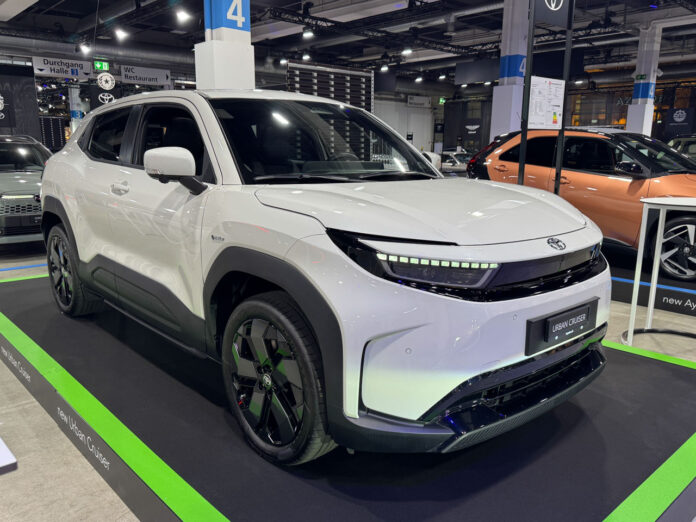
Toyota launched the all-electric Urban Cruiser this year, offering a pint-sized SUV for European shoppers. We got to spend some time with the corporate cousin of the Suzuki eVitara in Zurich recently, and here’s what we found.
Design


The Toyota Urban Cruiser Electric is based on the Urban SUV Concept which was unveiled in December 2021. The front takes on the brand’s “hammerhead” look, interpreted differently with slim headlights and gloss black flourishes.
Other elements that we noted were functional air inlets, a horizontal light bar spanning the rear, and muscular haunches which make it seem wider than it is. On the sides, the rugged body cladding, indented doors, muscular rear fender, optional 19-inch alloy wheels, and hidden door handle complete the chiseled look.
At the rear, the thick body cladding wraps around the vehicle, a C-pillar garnish maintains a clean look, and connected taillights with individual light pixels present a techy look to the rear fascia.
Interior


The interior design follows a horizontal layout, and materials include black and dark-gray upholstery. Ambient lighting with 12 selectable colors adds personalization to the cabin.
Features include a 10.25-inch digital instrument cluster integrated with a 10.1-inch multimedia display in a single housing, with the infotainment system supporting Apple CarPlay and Android Auto.
A 360-degree camera system is present, and depending on trim, features include a JBL premium audio system, a fixed sunroof, and power driver’s seat adjustment are available. Rear seats have a 40:20:40 split-fold and can recline, allowing different layout combinations for luggage or passenger comfort.
Experience in the Toyota Urban Cruiser Electric
The Toyota Urban Cruiser BEV is an entry-level electric crossover designed mainly for Europe, and that’s evident when you approach the vehicle. It’s slightly larger than a Yaris Cross but still compact and easy to get in and out of.
The old-school front door handle is simple, and once inside, the front seats offer good back support and a solid headrest.


Even at six feet tall, I fit comfortably, though I’d have liked a bit more under-thigh support. The steering wheel has a flat top and bottom, which looks sporty, and visibility up front is fine. Rearward visibility isn’t great because of the thick C-pillars and the upward-swooping window line.
The cabin uses a mix of materials, including soft-touch panels on the dashboard, metallic-effect trim around the vents, and shiny finishes on the doors. These keep the cabin interesting, but there’s nothing premium about this space. There’s a bit too much piano black on the center console, which looks nice but shows fingerprints quickly. That said, the touchscreen is large and easy to reach.
In the back, the C-pillar-mounted handles make the side profile look clean, but I would have preferred regular units. With the front seat adjusted to my position, my knees just clear the seatback, and headroom is decent. The rear seat reclines in three steps, though only the final one feels comfortable. The middle seatback folds out to become an armrest with small cup holders.
Two adults fit well; three is not recommended. There are USB ports but no rear AC vents. For city driving, it’s a well-packaged EV that feels surprisingly spacious for its size.
Specifications


The SUV is built on Toyota’s new dedicated battery-electric platform, which supports both front- and all-wheel-drive configurations.
The Urban Cruiser is available with two lithium-iron-phosphate (LFP) battery options. The base front-wheel-drive variant pairs a 49 kWh pack with a 106 kW (144 hp) motor producing 189 Nm (139 lb-ft) of torque. A higher-capacity 61 kWh battery increases output to 128 kW (174 hp) while maintaining 189 Nm (139 lb-ft).
An all-wheel-drive version combines the 61 kWh pack with a dual-motor setup, raising total system power to 135 kW (184 hp) and torque to 300 Nm (221 lb-ft). The rear motor contributes 48 kW, improving traction on wet surfaces.
Drive assistance systems include a pre-collision system, adaptive cruise control, lane departure alert, and lane keep assist. Downhill Assist Control and Trail Mode should enhance control on rough terrain, while a Snow Mode in FWD versions is designed to limit wheel slip on icy roads.
Pricing


The Urban Cruiser Electric is available in the Swiss market at a starting price of CHF 32,900 (USD 40,877). The vehicle will soon be available in more regions including the UK, where it is expected to give Suzuki a competitive model to challenge the Kia EV3, Skoda Elroq, and the upcoming Hyundai Ioniq 3.

An automobile engineer by training, I’ve analyzed the global car market since 2005, with a keen focus on EVs since 2008. My journey in online automotive publishing spans 17 years, during which I have reviewed cutting-edge automotive technologies and interviewed leading global CEOs and vehicle developers.

