
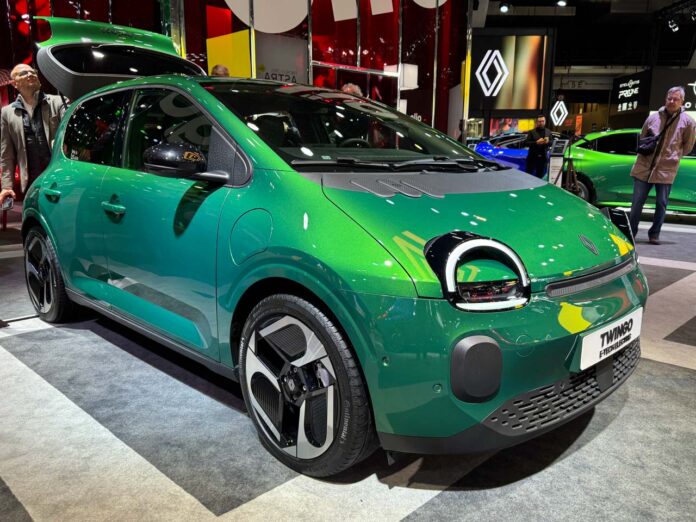
Renault has confirmed that the next-generation Renault Twingo E-Tech electric, the new A-segment battery-electric city car, will have a starting price below GBP 20,000 and is scheduled to launch in the UK in 2027.
Following our time with the Twingo E-Tech concept model in 2024, we recently got up close with the reborn Twingo electric production car, and here’s what we observed.
Design
The Twingo E-Tech electric carries over key cues from the original first-generation Twingo, including a one-box profile and recognizable headlamp and grille shapes. The car measures 149.2 in (3,789 mm) long, and the wheelbase is extended to 98.1 in (2,493 mm).


The wheels are enlarged to a 25.2 in (640 mm) diameter and can take tires up to 18 inches. Lighting details include arched daytime running lights and half-moon rear lamps, and the lights remain on to support recognition.
At a time when sporty and aggressive looks crowd every segment, we love the new Twingo’s subtle “smile” grille. Three new exterior colors listed are Absolute Red, Absolute Green, and Mango Yellow.
Interior


The new Twingo electric uses a five-door layout and includes two independent sliding rear seats as standard across versions, with each seat sliding 6.7 in (17 cm). Rear knee room is quoted at up to 6.3 in (160 mm).
Cargo capacity is listed at up to 12.7 cu ft (360 L, 305 dm3 VDA), and the load capacity exceeds 35.3 cu ft (1,000+ L) with the rear backrests folded.
A 1.8 cu ft (50 L) underfloor storage area for the charging cable and total open-cubby storage of up to 0.7 cu ft (19 L) are available. All versions use a dual-screen layout with a 7-inch driver display and a 10-inch infotainment screen.
Experience in the Renault Twingo Electric

Getting into the Renault Twingo Electric as a six-footer takes a bit of effort because the manually adjustable steering wheel gets in the way of my thighs. Once inside, I notice that the front door feels quite long for a car of this size.
Outward visibility is excellent. The pedal box feels comfortable even for someone with a 10 shoe size. The seat offers decent back support, while under-thigh support is only average. Headroom is still surprisingly good for someone of my height.
Once settled in, everything feels where it should be. The climate control uses three physical dials for temperature, fan speed, and airflow direction. There are also physical buttons for lock and unlock, the power function, and the electric parking brake, so this car relies heavily on physical controls.


There is a fixed touchscreen in the dashboard and a small digital instrument cluster. The drive selector is mounted on the steering column, which frees up space between the front seats. That space is used for small cubbies and a cup holder. The interior uses hard, grainy, textured plastics throughout. Even so, it does not feel cheap to me and has some character. The layout feels thoughtfully done.
Moving to the rear, with the front seat set for my driving position, ingress is a little difficult because of the low roof. Once inside, the seats can be adjusted, but there is hardly any room for someone my height. My knees brush against the seatback.

There are headrests in the rear, but there is no glass roof. The rear feels slightly claustrophobic, especially because the windows do not roll down and only crack open. Headroom at the back is just about enough.
The rear floor is flat, but there is not much space for large feet. The rear seat feels more suitable for children or shorter passengers and only for short trips. A lot of cost-cutting is evident. For the price, I still feel this car has a personality. It is not for everyone, and most buyers would be better off in a Renault 5.
Specifications
The Twingo E-Tech electric is based on the AmpR Small platform. The front axle is shared with Renault 5 and Renault 4 E-Tech electric, while the multi-link rear axle is replaced by a flexible axle based on Captur.

The vehicle develops 60 kW (82 hp), with the Evolution version coming in at 2,646 lb (1,200 kg) and does 0-31 mph (0-50 km/h) in 3.85 seconds. Usable battery capacity is 27.5 kWh and a WLTP range of up to 163 miles is possible. The battery uses LFP chemistry and a cell-to-pack design.
A 6.6 kW AC charger is standard, with a 10%-100% SoC achieved in 4 hours 15 minutes using a 5 m Mode 3 cable. An 11 kW AC setup with a 50 kW DC charger is also available, with a 10%-100% SoC in 2 hours 35 minutes on AC, and 10%-80% SoC possible in 30 minutes on DC. An 11 kW AC bidirectional charger is standard, including V2L up to 3,700 W.
Price & Release Date
Also Read: First Look Review: Dacia Hipster is ultra-compact, ultra-basic, ultra-cool!
Renault targets a starting price below GBP 20,000 (excluding subsidies) in the UK. The Twingo E-Tech electric will launch in 2027, built at Novo Mesto in Slovenia. The model, which will go on sale in Europe in early 2026, is the first vehicle developed under Renault’s “Leap 100” program, which Renault says reduced development time to 100 weeks.

An automobile engineer by training, I’ve analyzed the global car market since 2005, with a keen focus on EVs since 2008. My journey in online automotive publishing spans 17 years, during which I have reviewed cutting-edge automotive technologies and interviewed leading global CEOs and vehicle developers.

