
Update: ‘Design,’ ‘Interior,’ and ‘Price & Release Date’ sections revised.
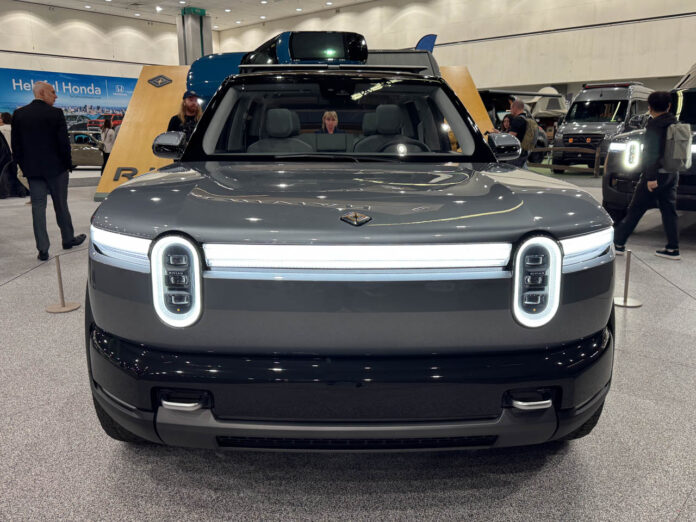
Rivian is preparing to conduct a dedicated event in early 2026 to release detailed information on the R2, which enters production in the spring. Weeks ahead of this program, we got to see the R2 in the flesh and made a few observations. Here’s what we found during our time with Rivian’s upcoming midsize SUV.
Design
The Rivian R2 carries a silhouette similar to the R1S, and while photos can make them appear alike, the size difference becomes clear when viewed in person. The front fascia uses Rivian’s trademark vertical stadium-style lamps connected by a full-width light bar.


In person, what stands out are its short overhangs, the boxy cabin, and black lower cladding, which present both a clean and adventurous look. The powered rear glass drops fully into the liftgate, creating an open-air experience not commonly found in electric SUVs.
The rear quarter windows vent outward to increase airflow, and we feel that the combined effect should provide better outward visibility and a more open cabin than the Model Y. The rear features a horizontal red light bar and simple RIVIAN script. Roof rails, flush door handles, and aerodynamic wheels complete the design.
Interior


We got to see the R2’s cabin as well, and the dashboard uses a horizontal theme. The large central touchscreen and the smaller instrument panel integrate into the dashboard, and are tilted backward for easier viewing.
A new steering wheel incorporates two large haptic control dials for primary functions. The seating uses soft-touch materials paired with sustainable textiles that Rivian says are easy to clean.
We could observe that Rivian has made utility and storage solutions a top priority with large open bins, deep door pockets, and a floating center console. The second-row seats can split into three parts and fold completely flat, creating a level cargo surface suitable for larger items or car camping.


The flat floor and generous cabin height should help deliver solid rear-seat comfort, and we see this as an important differentiator from the Model Y.
Rivian Assistant
Rivian has confirmed that the R2 will be developed alongside its new Rivian Unified Intelligence (RUI) software architecture. The platform powers a new Rivian Assistant that lets drivers use natural voice commands to adjust vehicle settings, plan routes, manage calendars, send messages, and control features like the air conditioning, drive modes, and seat heating without touching the screen.
While the Rivian Assistant launches first on R1 models in early 2026, the same AI foundation will extend to future R2 vehicles through software updates.
Specifications
R2 is built on Rivian’s new midsize platform, which uses high-pressure die castings and a structural battery pack. The top of the battery pack doubles as the vehicle floor, improving rigidity and reducing complexity.


Two battery sizes will be available, using the new 4695 cell format for higher energy density. The larger pack is estimated to deliver more than 300 miles of driving range. Three motor configurations will be offered, with a well-appointed dual-motor variant being the launch vehicle.
The single-motor setup drives the rear wheels, the dual-motor setup provides all-wheel drive, and the tri-motor variant pairs two rear motors with one up front. Rivian estimates that the quickest version will accelerate from 0-60 mph in under 3 seconds.
DC fast charging from 10 to 80 percent is expected to take under 30 minutes, and the vehicle supports both NACS and CCS (via adapter).

LIDAR & Autonomous driving features
Rivian has confirmed that LiDAR will be integrated into future R2 models, complementing the existing multi-modal sensor suite to improve redundancy and edge-case detection. The Gen 3 autonomy hardware stack, including ACM3 and LiDAR, is currently undergoing validation and is expected to ship on R2 models starting in late 2026.
You can get into the car, plug in the address and the vehicle will completely drive you there. Now, some of you have already experienced this in our R1 vehicles, and of course it will be embedded into our R2.
Rivian Founder & CEO RJ Scaringe during the company’s Autonomy & AI Day on December 11, 2025
Rivian has also announced Autonomy+, a paid autonomy subscription launching in early 2026, which will apply to future R2 vehicles as capabilities expand. Pricing is set at USD 2,500 as a one-time purchase or USD 49.99 per month, with functionality increasing over time through software updates.
Price & Release Date
Rivian expects R2 to start at about USD 45,000, though the dual-motor Launch Edition is expected to be priced in the mid-USD 50,000s. Reservations are open in the U.S. for USD 100.

RivianTrackr has also speculated about a Performance Launch Edition, which could land in the early USD 60,000s. Once production stabilizes, buyers should be able to get their hands on the USD 45,000 model.
Validation builds have already begun at Rivian’s facility in Normal, Illinois, with series production set to begin this spring, as confirmed by Rivian. As per Rivian Forums, it has an annual capacity of 150,000+ R2 units. International availability will follow the North American rollout.
With respect to the Canadian-spec Rivian R2, it is also slated to arrive in the first half of 2026, with a starting price (excluding fees, taxes, and delivery) of CAD 66,500. Reservations are now open to Canadian customers with a CAD 150 deposit via Rivian’s website.

An automobile engineer by training, I’ve analyzed the global car market since 2005, with a keen focus on EVs since 2008. My journey in online automotive publishing spans 17 years, during which I have reviewed cutting-edge automotive technologies and interviewed leading global CEOs and vehicle developers.

