
Update: The story has been updated with the new specs, availability, and pricing of the two models.
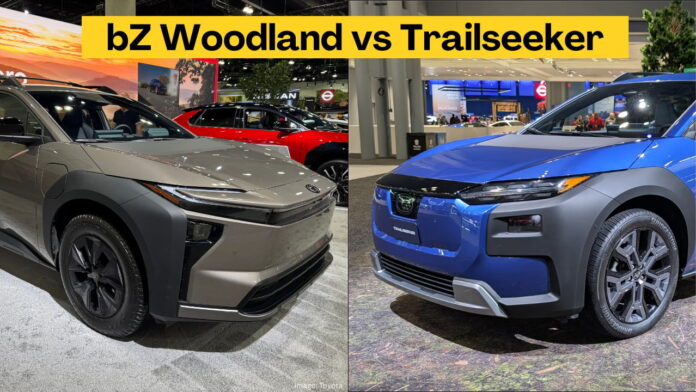
The 2026 Subaru Trailseeker and 2026 Toyota bZ Woodland are nearly identical wagon-like SUVs built on the same electric platform for the U.S. and Canadian markets. They are stretched versions of the current electric midsize SUVs, the Solterra and the bZ4X, respectively, and much like their donors, subtle visual differences set them apart.
Having spent some time around both vehicles, here’s a comparison of these two future five-seat electric all-roaders, which is the second shared electric model following the Toyota bZ4X and the Subaru Solterra.
External Differences


Both vehicles offer rugged appeal, featuring standard all-wheel drive. Up front, the Toyota bZ Woodland looks cleaner, sporting the familiar ‘hammerhead’ LED lighting. Black wheel arch cladding adds visual width, matched by unique 18-inch aluminum wheels with removable covers.
Subaru’s Trailseeker, meanwhile, brings in a fresh EV lighting signature highlighted by a six-star illuminated logo. Its headlamps and bumper armor are distinctively Subaru, presenting a more adventurous, trail-ready look.
Subaru offers two wheel sizes: newly designed 18- and optional 20-inch wheels, offering U.S. buyers more choice. While the 2026 Solterra comes with painted body panels, the Trailseeker maintains the contrasting wheel arches and body cladding.


On to the profile, both SUVs extend roughly 6 inches longer and nearly an inch taller than their siblings. Raised roof rails are also standard on both vehicles, enhancing their practicality, and differentiating them from the smaller midsize siblings. Subaru has confirmed a 700-pound static load capacity for the Trailseeker’s roof rails.
At the rear, we feel that the Toyota’s design is cleaner, emphasizing width with horizontal lines, whereas the Subaru looks outdoorsy with a prominent three-dimensional ‘Subaru’ badge, and contrasting plastic ‘hooks’ on the bumper. These do well to differentiate the Trailseeker from the bZ Woodland.
Interior Differences
Inside, both vehicles share spacious, modern cabins centered around a 14-inch touchscreen with wireless Apple CarPlay and Android Auto. Toyota’s interior leans slightly toward the premium side, featuring standard SofTex-trimmed seats in Stone Brown and Black, dual wireless charging pads, and ambient lighting. Premium upgrades include JBL audio, ventilated seats, and a panoramic roof.


The Trailseeker’s cabin also emphasizes functionality, highlighted by metallic accents across the dashboard for a sportier feel. Like the bZ Woodland, the Trailseeker integrates two fast-charging wireless pads up front, additional USB-C ports in the rear, and a 7-inch instrument cluster.
The center console is designed for practical storage, appealing directly to adventure-focused buyers. The notable difference is the flatter steering wheel, which we found offers a more unobstructed view of the gauge cluster in the Trailseeker.
Sitting in the rear seats, we found knee room, headroom, shoulder room, seat cushioning, and overall comfort to be similar to their respective midsize siblings.
Range & Performance
Both vehicles use a 74.7 kWh lithium-ion battery and dual 167 kW motors for a combined 375 hp. Toyota rates the 2026 bZ Woodland at 281 miles (EPA) on the standard tires. Range drops to 260 miles (EPA) with the available 235/65R18 all-terrain tire option.
Subaru lists 281 miles (EPA) for the Trailseeker Premium and 274 miles (EPA) for Limited and Touring trims.
Toyota highlights an “approximately” 30-minute DC fast-charge time from 10-80% (28 minutes in the Trailseeker), while Subaru specifies charging speeds (DC) of up to 150 kW, with a 0-60 mph time of 4.4 seconds for both vehicles. Both vehicles use a 391 V battery system and a NACS charge inlet, allowing them to be charged at Tesla Supercharger stations.


Each SUV offers towing capacities of 3,500 pounds, supported by advanced traction technologies like Toyota’s X-MODE with Grip-Control and Subaru’s X-MODE dual-mode with Downhill Assist Control. These systems optimize off-road capability, which is a big USP for their outdoor-focused customers.
As for ground clearance, it is 8.4 in. (bZ Woodland) and 8.5 in. (Trailseeker). Subaru lists a 36.7-ft turning circle, whereas Toyota lists 40.0 ft.
Pricing & Release Date
The Toyota bZ Woodland reaches U.S. dealers in March, and the Subaru Trailseeker is on track to reach U.S. dealers this Spring. Both models are expected in Canada shortly as well.
Subaru has priced its model quite aggressively, and it ranges between USD 39,995 and USD 46,555 (MSRP). Toyota has priced its product between USD 45,300 and USD 47,400 (MSRP).
TopElectricSUV says
We feel that pet owners, drivers carrying gear, and buyers in snow-belt regions who need all-weather traction would find these models better suited than their respective short-body versions.


If the prices are not considered, we feel that the bZ Woodland appeals with a cleaner look, while the Trailseeker targets the adventure-oriented audience through a different steering wheel, contrasting interior colors, and more rugged exterior styling. Preference for brand identity and loyalty would be the biggest factors influencing the purchase decision.

An automobile engineer by training, I’ve analyzed the global car market since 2005, with a keen focus on EVs since 2008. My journey in online automotive publishing spans 17 years, during which I have reviewed cutting-edge automotive technologies and interviewed leading global CEOs and vehicle developers.

