
Update: ‘Slippery design’ and ‘Maxing out range’ added, and ‘Interior,’ ‘Universal EV Platform’ and ‘Battery’ updated.
In 2022, Ford formed a California-based skunkworks team, headed by former Tesla director Alan Clarke to develop an affordable EV platform. By Q2 2024, Jim Farley, Ford’s CEO, confirmed the team’s progress on a brand-new electric pickup truck.
It is set to debut in 2027, and while some expect it to wear the Ford Ranchero nameplate, we think it could be the Ranger Electric.

The skunkworks team has since moved to the new Advanced Electric Vehicle Development Center in Long Beach, California. It continues to focus on affordable EVs, which will begin with the midsize electric truck, and is likely to be followed by an SUV and a cargo van. The midsize truck will be made at the Louisville Assembly Plant for the U.S. and export markets.
Slippery design
Ford’s midsize electric truck would be its most aerodynamic truck to date across segments and powertrain types. The company says it has designers and engineers working with an internal team of aerodynamicists to make this model extremely efficient.
The upcoming Ford electric truck will have a more futuristic design that departs from the traditional tall, boxy pickup profile. A sketch Ford teased recently indicates a dual-cab layout, a common format among electric pickups, but with proportions that appear lower and more streamlined than many electric trucks, including Ford’s F-150 Lightning.

The future midsize electric truck appears to have a characteristically upright front fascia with vertically-stacked lighting, and sculpted wheel arches. The body surfaces appear largely smooth and enclosed, paired with a short, gently sloping hood. Steeply raked A-pillars and windshield create a fighter canopy effect.
The sketch suggests a relatively low overall height for a pickup truck, while the proportions still imply ample ground clearance. High-set bed rails taper gently toward the rear, creating a teardrop shape.
Minimalist interior
Ford teased the truck’s interior during the “Model T Moment” event in Kentucky in August 2025, confirming that it will use a simplified design. The dashboard has a floating touchscreen with OTA capability, and is expected to support wireless Apple CarPlay and Android Auto.

During the presentation, Ford confirmed that BlueCruise hands-free driving system will be offered.
This new truck, based on this Universal Platform, is going to be more spacious inside than the RAV4, the best selling car in the United States; but it will have a frunk, and it will have a whole pickup truck bed behind it. Tons of room for five adults, bikes, surfboards, work equipment…whatever you need, you don’t have to put it on the top, you don’t have to put it on the tow hitch, it’s all in the vehicle.
Jim Farley, Ford’s CEO, at the “Model T Moment” event in Kentucky on August 11, 2025
The company has confirmed it will launch its first Level 3-capable autonomous vehicle in 2028, based on the same platform. The electric truck could offer this feature as an option later in its lifecycle.
That’s why we’re launching L3 with the UEV. Many of our competitors are launching level three with their luxury brands. We’re going to be doing it with our USD 30,000-35,000 vehicles. That’s a big strategy choice by Ford.
Jim Farley, Ford’s CEO, during the company’s Q4 2025 Earnings Conference Call on February 10, 2026
Universal EV Platform (UEV)


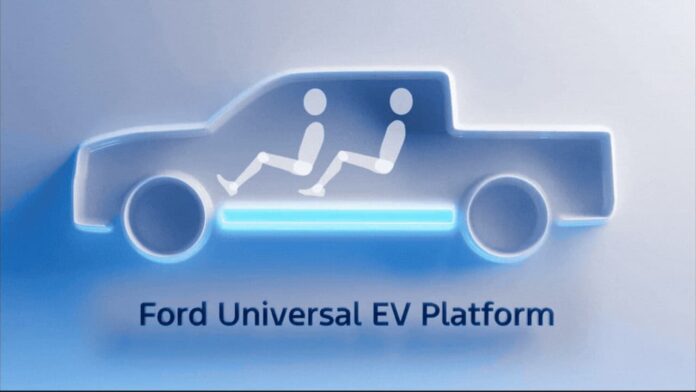
Ford’s midsize four-door electric pickup will ride on a new ‘Universal EV platform’, which will be flexible enough to underpin trucks, cars, and multiple body styles. The platform’s zonal electric architecture will offer new capabilities.
The unicasting process that you saw, that giant, massive piece of aluminum comes from very new machines and new processes.
But when you build a vehicle that way, if you just look at the body and compare it to a traditional pickup, three quarters of the parts are gone. Two thirds of the welds are gone. Half of the fasteners are gone.
In the electrical system, compared to typical Gen I electric SUVs, the team removed 4,000 feet of wiring. Over three quarters of a mile of wiring is gone.
Doug Field, Chief EV, Digital, and Design Officer, elaborating on the upcoming midsize truck’s platform and manufacturing at the “Model T Moment” event in Kentucky, on August 11, 2025
The Blue Oval will adopt gigacasting to make the structure significantly lighter and simpler. The company says the technology will require 25% fewer fasteners, reducing joints and sealing points and improving quality, with the front, middle structural battery, and rear sub-assemblies built separately and joined during final assembly.
0-60 in under 5 seconds

As for the vehicle itself, Ford expects the truck to do the 0–60 mph sprint as quickly as a Mustang EcoBoost, which we estimate at under 5 seconds. It will have a low center of gravity from its structural battery pack, which also serves as the vehicle’s floor, leading to improved handling.
The truck will also generate more downforce than typical models in its class. Moreover, the design includes a frunk and a truck bed designed to lock surfboards/gear without roof/trailer racks.
LFP Battery
On the topic of efficiency, the same obsession with efficiency goes across every part to make the whole. So we can actually, compared to a typical Gen I electric vehicle, we can get the same range with a third less battery. And that’s the kind of ingenuity we need to compete with the Chinese.
Doug Field, Chief EV, Digital, and Design Officer, at the “Model T Moment” event in Kentucky on August 11, 2025
Ford plans to use Lithium iron phosphate (LFP) cells in a prismatic form factor in its midsize electric truck. The company will directly integrate the cells into the structure of the vehicle. This layout would reduce costs, make the cabin quieter, and improve dynamics. The LFP cells will come from an in-house factory in Marshall, Michigan.

The structural battery will have an operating voltage of 400 volts, meaning charging won’t be lightning fast. That said, Ford will use a 48-volt auxiliary battery instead of a typical 12-volt one, which would make the wiring harness significantly shorter and lighter. Bi-directional charging will be possible, which is useful at the job or campsite.
Maxing out range
Ford is paying more attention to the details to squeeze out every last mile of range. For example, at the front, it will make the bolt holes shallower and direct air around the tire and suspension.
The company will also optimize the underbody airflow, such that the front wheels shield the rear wheels from direct high-speed air. Such changes can improve the range by 4.5 miles (internal estimate).

At the rear, Ford will position the drive unit as low as possible to reduce the angle of the half shafts. The company will design the motor case such that the air directed from the front passes under the vehicle uninterrupted.
The specially designed mirrors will have a single actuator for glass adjustment and body folding. They will be more than 20% smaller than a conventional mirror, and their entire body will move. Ford estimates this change will increase the range by 1.5 miles.
Price & Release
It will offer, for the first time, fast charging, it will have amazing range, it can power your house for 6 days…you don’t need a generator, you just buy this truck! And we’re going to start the vehicle at 30,000 dollars.
Jim Farley, Ford’s CEO, at the “Model T Moment” event in Kentucky on August 11, 2025

And we started this Skunkworks team relative to BYD a couple of years ago, and that product will be among our first second generation products to come out. And we know that that is fully competitive with BYD, but it will be focused on North America and our core customers, and it will be a very affordable, our most affordable EV we’ve ever had.
Jim Farley, Ford’s CEO, answering a question on electrification at Ford’s 70th Annual Meeting of Shareholders on May 8, 2025
During the Q3 2024 earnings call on October 28, 2024, Farley called the midsize electric truck one of the most exciting products he’s seen in four decades. He also highlighted that Ford will produce it at a cost comparable to a similar truck from a Chinese automaker made in Mexico.
Featured image: Ford

An automobile engineer by training, I’ve analyzed the global car market since 2005, with a keen focus on EVs since 2008. My journey in online automotive publishing spans 17 years, during which I have reviewed cutting-edge automotive technologies and interviewed leading global CEOs and vehicle developers.

