
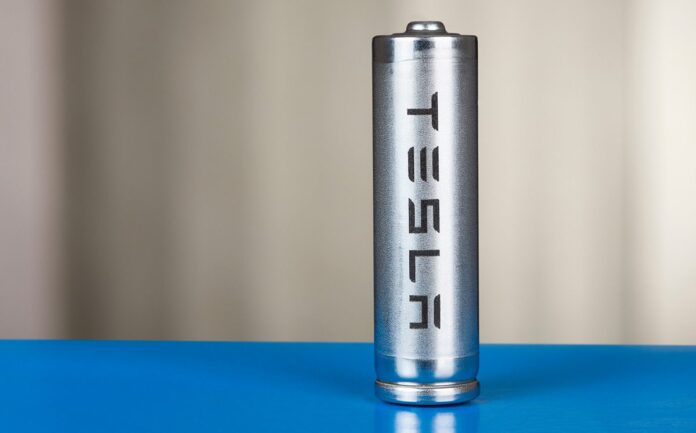
For many a year, a certain California carmaker dominated the headlines in the EV press—so much so that I created a keyboard shortcut for the company’s name. Despite a relentless tide of naysaying, the company went from strength to strength for almost two decades. Then, coincidentally (?) around the time of Covid, the innovation engine seemed to stall, and the company’s leadership turned its attention to other things. In January, an uncharacteristically uninspiring earnings report seemed to confirm that the firm was “pivoting away from its electric car business.” No Master Plan Part Trois, no new vehicles—just some warmed-over talk about AI and robots. Has the company that almost single-handedly invented the modern EV industry lost its mojo, passed the torch on to others, gone over to the dark side?
Not so fast.
Christopher Chico reports, in his excellent Battery Chronicle blog, that “Tesla is quietly building the most complete battery supply chain in the West.” The company operates a lithium refinery, a cathode manufacturing facility, and two cell factories producing two different battery chemistries.
Tesla has been making 4680 cells at Gigafactory Texas since 2022. In 2023, the company filed for a $716-million expansion that included cathode manufacturing facilities. Early cathode production has reportedly begun, at an annual capacity of around 10 GWh.
Tesla is producing anodes and cathodes for its 4680 cells using a dry process that it acquired along with a company called Maxwell Technologies in 2019. Compared to the traditional wet slurry process, the dry process eliminates toxic solvents, cuts energy use, and requires less factory space. (The founding team of Maxwell is now running a company called LiCAP, which is licensing a similar dry electrode process. Read an in-depth interview with LiCAP President Richard Qiu in our Oct-Dec 2025 issue.)
Tesla’s lithium refinery in Texas began operations in January. Mr. Chico says it’s the first spodumene-to-lithium-hydroxide refinery in North America. Tesla uses an acid-free refining process that eliminates some steps traditionally dominated by Chinese firms. The facility is expected to deliver 30 GWh of annual lithium refining capacity.
At Gigafactory Nevada, Tesla has an LFP cell factory that uses manufacturing equipment from Chinese battery behemoth CATL. The company said last July that the facility was nearing completion. Mr. Chico reports that production is scheduled to begin in “early 2026,” at an initial annual capacity of 7 GWh. Most of these prismatic LFP cells are destined for Tesla’s energy storage products, not for EVs.
In fact, it could be argued that the enigmatic automaker is indeed pivoting away from vehicles, and toward stationary storage. Mr. Chico reports that stationary storage products are now the company’s fastest-growing business line, and are delivering nearly double the profit margin of the vehicle business.
Tesla’s battery-building business stands in marked contrast to the Dinosaurs of Detroit, who are, for whatever reasons, gradually retreating from all things electric. GM, Stellantis and Ford have all recently backed out of plans to build or buy stakes in battery plants.
At the other end of the spectrum, China’s BYD manufactures roughly 75% of its vehicle components in-house, including cells, cathode material, electric motors, power electronics and semiconductors. It also owns lithium mining interests in Brazil, Africa and China.
Chico calls Tesla’s vertical integration strategy “the most ambitious in the West,” but it is incomplete, as Tesla owns no semiconductor or mining interests. However, “Tesla is the only Western company even attempting to match the Chinese model of full-chain ownership.”
Automakers spent decades outsourcing virtually everything except engines and vehicle design, but in the EV era, vertical integration makes a lot of sense. Batteries are so expensive that it pays to avoid sharing margin with suppliers, and the technology is changing so fast that OEMs can be more agile if they don’t have to wait for innovations to ripple through a complex supply chain. There are also geopolitical considerations.
Of course, there’s always a downside. Chico points out that when demand drops, vertically integrated companies can get stuck with high fixed costs. The way he sees it, Tesla’s vertical integration is a bet on trade barriers staying up and demand continuing to grow.
In the global game of battery poker, Asians are showing some aces, but at least one US automaker is still sitting at the table.
Source: The Battery Chronicle
Image: grigvovan – stock.adobe.com

