
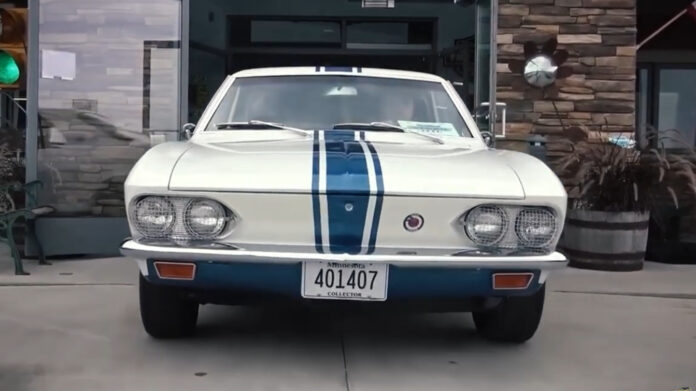
The classic muscle car era of the 1960s certainly saw a fair number of fire-breathing factory-built muscle machines. Cars like the Pontiac Catalina Super Duty, Ford Fairlane Thunderbolt, and the Dodge Charger 426 Hemi, for instance, all qualified as members of of 400/400 club by pumping out more than 400 horsepower from engines displacing more than 400 cubic inches. But folks such as Don Yenko from Yenko Chevrolet in Canonsburg, Pennsylvania, those cars still didn’t provide the race-ready performance he was looking for.
Yenko’s solution began as a DIY effort to prep his Chevrolet Corvair for motorsports competition, but the class in which he wanted to enter was based on production cars. In other words, someone had to produce at least 100 street-ready models before Yenko could qualify his car for the series. This turned into another DIY project, as he had his dealership order 100 “regular” Corvairs from Chevy. The Yenko team then converted them all, calling the result “Yenko Stingers” and putting them up for sale.
A few years later, after he began a similar project with Camaros, Yenko achieved the ultimate connection: He was able to get Chevrolet itself to make the heart of the Yenko Camaro — its 427-cubic-inch big-block V8 — a factory option. This made the conversion process much simpler and started Yenko on his path to becoming a top name for dealer-modified dynamos. This went beyond Camaros, with conversions being made to Chevelles, Novas, and even Pontiac Firebirds for one year. These high performers remain in high demand today, with many having high prices to match.
1969 Prototype Yenko Camaro
Perhaps the rarest and most expensive Yenko car of the time comes with a fantastic provenance, too: It was personally owned by Yenko himself, who used it to both fine-tune his part of the package and to demonstrate to customers. Indeed, the car was actually an early prototype that was among the first cars built after Yenko convinced Chevy to install the L72 V8s right on the assembly line. The outcome was a huge reduction in time and money for Yenko, helping make his dream of offering muscled-up Camaros a reality.
Unfortunately, a trip to Tennessee – where Yenko wanted to drum up excitement for the car at his dealerships — turned into a bit of a nightmare. He ended up crashing the car hard enough to even damage its frame, and it ended up abandoned. It would take until the early 1990s before the car was rediscovered, restored (for the first time), and on the road to being recognized as the very first 1969 Yenko Camaro ever produced.
With all of that finally sorted out by 2025, the car was auctioned through Mecum and didn’t go home until the winning bidder came up with a whopping $1.815 million. Coincidentally, the same auction saw the 1969 Camaro massaged by the Baldwin Auto Company (a Yenko rival) go under the hammer for $1.1 million. (FYI: If you ever want to get in on the auction action on your own, be sure to know the pros and cons of buying a car that way.)
1969 Yenko Nova
Produced in four generations from 1962-1979, with a fifth offered from 1985-1988, the Chevrolet Nova had a long history with the Bowtie brand. But might be best known as the butt of a bilingual urban legend, even though it’s not true that Chevy had to change the car’s name in some countries because “no va” means “it won’t go” in Spanish. But one thing’s for sure: The 1969 Yenko Nova could certainly go, and it was plenty fast, too.
Like the Yenko Camaros, the Yenko Novas carried the L72 427 V8, now pumping out 450 horses and paired to a Muncie M21 four-speed manual transmission. One key difference was that the Yenko team had to do the engine swaps without factory support. On the other hand, Yenko was able to pull off the trick of having Chevrolet add the Nova’s F41 sport suspension on the production line, despite it normally being an option limited to SS models.
The 1969 Yenko Novas were particularly rare, with only 38 examples produced. That includes the one that recently came up for auction at the same Mecum event where the Yenko Prototype Camaro was sold. It didn’t quite match the Camaro’s final price, but as it came from the stable of one of the world’s biggest Yenko collectors, Cliff Ernst, that Nova still cost someone $852,500. That’s not too bad when you consider how more typical Novas, such as a 1976 Chevrolet Nova Concours, tend to command prices under $20,000.
1975 Yenko Pontiac Trans Am
Technically past the expiration date for classic muscle cars, the 1975 Yenko Pontiac Trans Am could nonetheless perform with some of the best after being fully Yenko-fied. A key update, naturally, came under the hood. The car’s original motor was jettisoned for, once again, a 427-cubic-inch big-block V8 — this time the L88 that could belt out an official 430 horses. Unofficial output ratings put that total closer to the 550 mark. For a little context, the most powerful factory Trans Am in 1975 welcomed the 455 cubic inch L88 V8, which looked good on paper but only delivered 200 ponies in real-world driving.
That wouldn’t do for the Trans Am’s original owner, however. One of the many drivers who used their Yenko machines in actual motorsports competition, he brought his car to the Yenko store to help it win on track against the local Pontiac dealer’s son — who was racing a 1974 Trans Am of his own. The results of that race are hard to come by, though, and its auction results are a little bit out of date. The most recent time the car changed hands seems to have been at a Mecum auction in 2014, when the Yenko Trans Am was purchased for $54,000. That’s the equivalent of more than $75,000 in today’s money. The next sale could go even higher, keeping in mind that this is a one-of-a-kind machine you couldn’t even find at the largest collection of Firebirds and Trans Ams for sale.
1969 Yenko Chevelle
1969 must have been a pretty nice time to be a Yenko enthusiast. Along with the Camaro and Nova, you could get your hands on one of the dealership’s Chevrolet Chevelle conversions. The recipe would be familiar to Yenko Camaro fans, with the dealership able to use an option code to get Chevelles straight from the factory with the legendary 425 horsepower L72 V8. Just remember that Chevrolet built 323 Chevelles with the L72 engine option pack, but Yenko only worked its magic on 99 of them.
Moreover, Yenko Chevelle “tribute” cars are a thing, and those can go for more than $50,000 at auction. You have to be careful if you’re shopping for one of these mighty machines — and you have to have some serious coin in your bank account, too. One of the real-deal Yenko Chevelles garnered a top bid of $275,000 at a Barret-Jackson sale in 2021, and another went for $242,000 at a Mecum event one year later. One more example of this car’s value comes from baseball Hall-of-Famer Reggie Jackson, who offered his Yenko Chevelle at auction in 2018 but refused to let it go even after a final bid of $310,000.
1967 Yenko Super Camaro
After the Stingers, but before Chevrolet officially got on board, there was the Yenko Super Camaro. The first Yenko machine based on a traditional muscle car (as opposed to the rear-engined Corvair), the Yenko Super Camaro debuted in 1967 using the original formula of buying a factory-built car, removing its original engine, and installing a separately ordered 427-cubic-inch V8. Also boasting high-flow rectangular port heads, a forged steel crankshaft, and other goodies, the motor could make 425 horsepower and 460 pound-feet of torque right out of the box. If that wasn’t enough output, you could pay to have the engine up-tuned by Yenko’s renowned Dick Harrell for 25 more ponies.
In the end, the Super Camaro was a beast that could reportedly storm through the quarter-mile in under 13 seconds at over 108 mph, making it quicker than any other new car on the road that year. Yenko built just 54 of them for 1967, and that kind of rarity has translated into high demand for these high performers. The most expensive went for $632,500 at a Barrett-Jackson sale in 2022. (If you’re wondering how the Camaro Prototype could come two years after Yenko started selling Super Camaros, remember that the former was a prototype of the car with the new engine installed by Chevy, not Yenko.)

