
At the 2025 Hyundai CEO Investor Day, Hyundai’s José Muñoz confirmed in his presentation that the brand will further expand N variants to its “best-selling ICE and HEV” models.

By 2030, we will have more than seven N models available. We started this with our ICE and HEV models and then our EVs. We expect end sales by 2030 of over 100,000 vehicles primarily in the U.S., Europe, and Korea, but also in growing markets in Australia, the United Kingdom, and Canada.
José Muñoz, CEO of Hyundai Motor Company, at the CEO Investor Day on September 18, 2025
While Muñoz didn’t list out the next N launches, British outlet Auto Express had reported last year about the Hyundai Tucson N with a hybrid powertrain. Considering that it is Hyundai’s top seller, expanding the N lineup to the compact SUV would be a logical move.
Hyundai N boss Joon Park told them that his division would continue with combustion-based performance cars and add lighter hybrid models alongside EVs such as the Ioniq 5 N and Ioniq 6 N.
Design

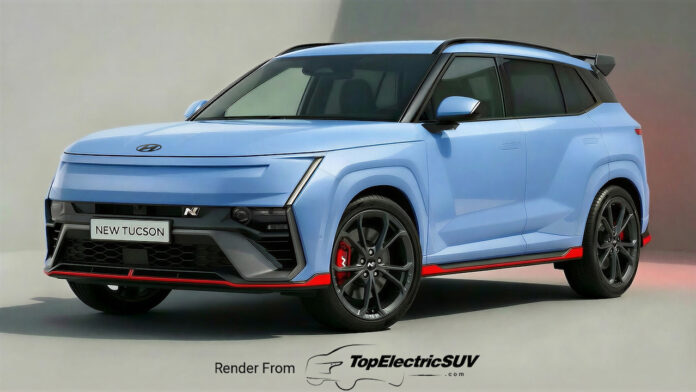
As seen in our exclusive renderings, the Tucson N version would build on a sharp and expressive design of the upcoming 2027 model. We expect to see a darker grille treatment, a prominent N badge, and a sharper bumper design than the standard Tucson.
The performance SUV should sport larger wheels, low-profile tires, red brake calipers, red rocker trim, and black mirror caps. A black roof and rear spoiler should complete the N model’s unique styling.
Interior & Features

The most likely formula for the interior would be a standard 2027 Tucson layout with N-specific upgrades. Hyundai’s existing performance models already use N-branded steering wheels, sport seats, and dedicated performance controls, and that would be a natural fit for a Tucson Hybrid N as well.
A sportier seat design, unique graphics and stitching, metal pedals, and N drive settings in the Pleos Connect software would make sense without compromising the SUV’s everyday practicality.
Specifications
Hyundai has already confirmed a 1.6-liter TMED-II powertrain for future hybrid vehicles. In the Tucson N Hybrid, we could see a more powerful motor on the rear axle for a performance all-wheel drive setup.

Park also said Hyundai is developing two different hybrid strategies, one focused on efficiency and another intended to deliver more intense power, with future N hybrids falling into the latter group.
He described the brand’s direction as lighter, more agile, and more nimble, which suggests Hyundai would prioritize cornering and responsiveness as much as straight-line performance, with unique e-VMC 2.0 (Vehicle Motion Control) tuning.
Price & Release Date
While it may not become the best-selling compact SUV in the U.S., the Tucson N Hybrid would be a lone wolf in its segment, and contribute meaningfully to both brand and sales. The only other competitor we can think of is the 2026 Toyota RAV4 GR Sport, which is a plug-in hybrid.
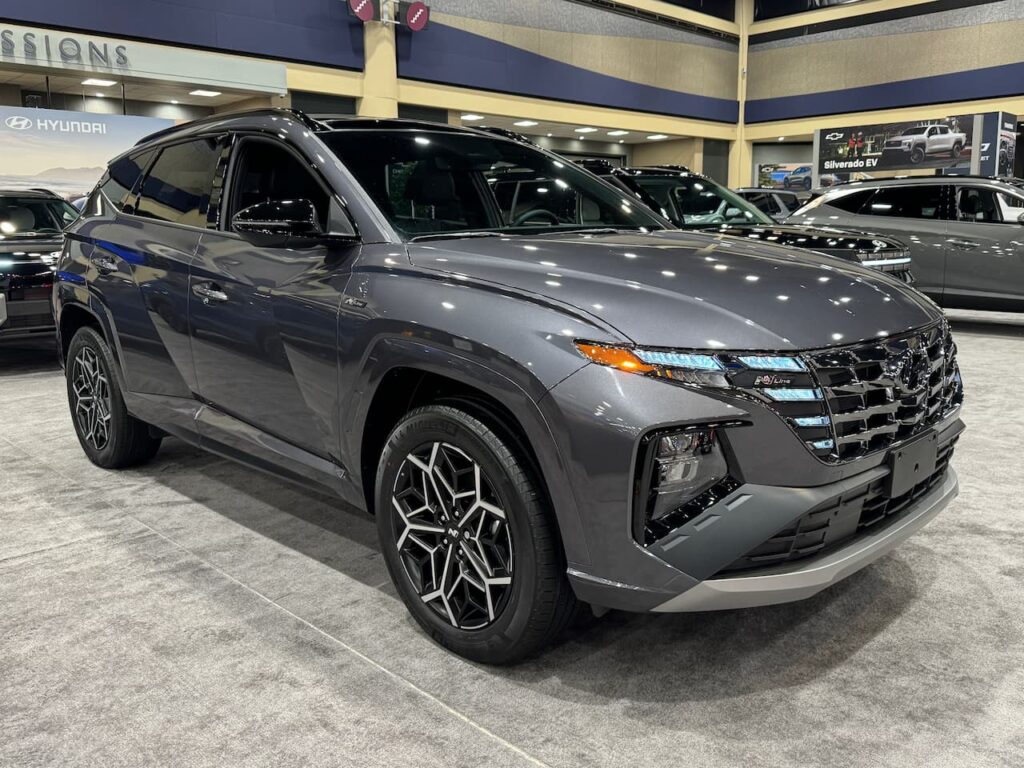
If Hyundai prices it below USD 45,000, it could offer a more performance-focused option for buyers seeking a sporty compact SUV that can still handle family duties without requiring a full shift to an EV.
In a letter to shareholders in March 2026, Munoz confirmed that the next-gen Elantra and Tucson would be launched in South Korea this year. We expect to see additional variants like the Tucson N and XRT included in the lineup over the next two years.
Also Read: 2026 Hyundai Tucson Hybrid Review: Do-it-All Compact SUV Holds Steady
Featured image: TopElectricSUV’s exclusive rendering of the next-gen Tucson N Hybrid

An automobile engineer by training, I’ve analyzed the global car market since 2005, with a keen focus on EVs since 2008. My journey in online automotive publishing spans 17 years, during which I have reviewed cutting-edge automotive technologies and interviewed leading global CEOs and vehicle developers.

