
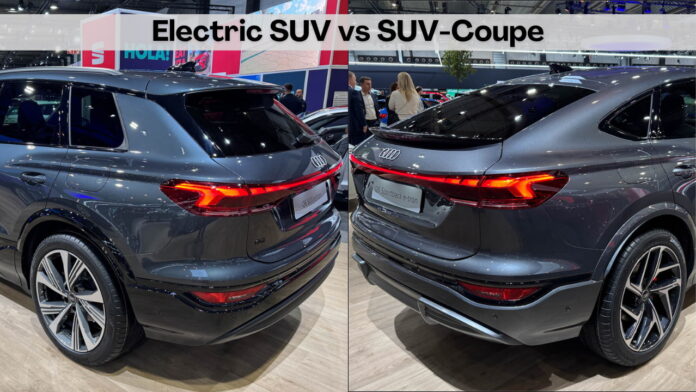
The first batch of 2027 Audi Q6 e-tron and Q6 Sportback e-tron models have arrived at U.S. dealerships, without exterior changes, but with new features. The SUV is priced from USD 64,500, while the SUV-coupe’s prices start at USD 68,300, both excluding a USD 1,295 destination charge.
Recently, we compared the Q6 e-tron and Q6 Sportback e-tron side by side in global specification models, and these are the observations we made between the two body styles, along with the changes in the U.S.-spec 2027 model year vehicles.
Design


The Audi Q6 e-tron and Q6 Sportback e-tron sport a powerful and aggressive exterior that balances German restraint with progressive design touches.
The quad headlight design, for instance, is an Audi-first. The signature Singleframe grille adopts the aero-focused theme first seen on the e-tron GT, featuring a masked design.


Where the Q6 e-tron showcases practical, everyday proportions, the Q6 Sportback e-tron aims for a more dynamic appearance with a fast-sloping roofline, a sleeker greenhouse, and a flat back glass. A low-mounted rear spoiler on the latter incorporates the third brake light.


At 65.1 in. tall, the coupe version sits 1.5 inches lower. Both models are 187.8 in. long and 76.3 in. wide and share a 113.7 in. wheelbase. The more slippery profile of the Q6 Sportback e-tron gives it a drag coefficient of 0.30, 0.03 Cd lower than the Q6 e-tron.


Interior
Inside, both the Audi Q6 e-tron and Q6 Sportback e-tron feature a multi-layer horizontal dashboard with angular surfaces and thin ambient lighting.
The sportily contoured door panels also integrate soft backlighting, as does the center console, which houses the gear selector, electric parking brake, vehicle start-stop button, and a multifunction knurled dial for the multimedia system.


A freestanding curved panel in the cockpit area integrates an 11.9-inch digital instrument cluster and a 14.5-inch touchscreen infotainment system, while a separate 10.9-inch passenger touchscreen is integrated into the dashboard.
Both EVs have a steering wheel with a flattened top and bottom and a flattish center pad. For the 2027 model year, Audi has replaced some of the touch-sensitive controls on the steering wheel with scroll wheels. The company has also added an option for a dashcam.


The Q6 Sportback e-tron has some obvious compromises in space. Compared to the Q6 e-tron, the headroom decreases by 0.9 inches in the front (37.6 in.) and 1.4 inches (37.0 in.) in the back.
It offers 26.1 cu. ft. of cargo space, 4.1 cu. ft. less than the Q6 e-tron. It can be expanded to 52.9 cu. ft. by folding the rear seat, which is 7.3 cu. ft. lower than in the Q6 e-tron.


Specifications
The Audi Q6 e-tron and Q6 Sportback e-tron share the PPE dedicated EV platform, and in the U.S., they are only available in a single rear-biased dual-motor AWD configuration. The dual-motor setup produces 422 hp and up to 456 hp with Launch Control engaged.
The Sportback version’s more aerodynamic exterior doesn’t bring any advantage in performance or efficiency. Both models hit 0 to 60 mph in 4.9 seconds and achieve an electronically limited top speed of 130 mph.


Both models have a 94.4 kWh NCM battery pack that supports charging at up to 9.6 kW (AC)/270 kW (DC) and delivers an EPA-est. range of 325 miles.
TopElectricSUV says
The 2027 Audi Q6 e-tron is clearly the choice for buyers who prioritize rear-seat comfort and cargo space, and is our pick of the two. The Q6 Sportback e-tron offers the same output, range, and fast-charging capability, but it loses headroom and cargo volume for its coupe-style roofline.
With prices starting USD 3,800 higher than the SUV, the Sportback version mainly suits buyers who prefer its lower, SUV-coupe design, and more dramatic road presence. That is not to say the SUV lacks style!

International Automotive News Editor since 2014, covering global motor shows, industry events, and test-driving various vehicles, with a focus on hybrid and electric cars in recent years.

