
By Mitesh Zaveri & Shrawan Raja
Lincoln is ending the Corsair in North America after the 2026 model year. Not long ago, I got to spend a week driving around 500 miles in the Grand Touring model (2025) in Canada, which adds plug-in hybrid capability to Lincoln’s compact luxury SUV.
It shares its Global C2 platform with the Ford Escape, which is also being discontinued, but the Corsair feels more upscale in design, cabin materials, and comfort. Here’s everything I found:
Design
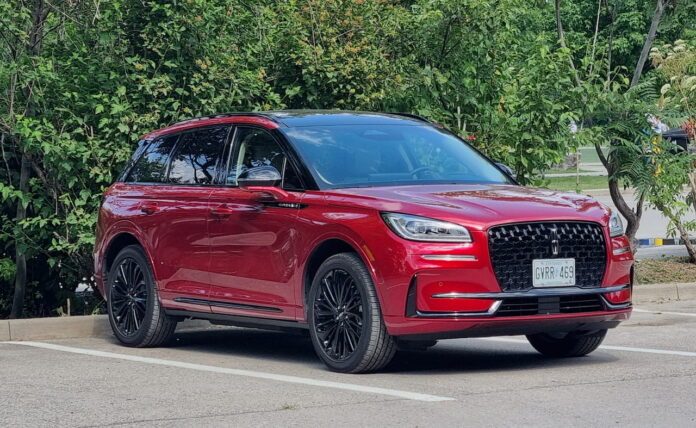
The Corsair has a smooth and rounded design that suits Lincoln’s luxury positioning. This test car had the Jet Appearance Package, which brings a gloss-black grille, black 20-inch wheels, black roof rails, and black exterior accents. The grille looks elegant, though I wish the Lincoln badge illuminated like it does on some larger models.

The front lighting setup uses a split layout. The lower section houses the turn signals, while the DRLs sit below the main headlamp cluster. The main headlights are dynamic and move with steering input, and cornering lights are placed inside the cluster. Lower vents and black trim complete the front design.
From the side, the Corsair looks compact and clean. The charge port sits on the front fender because this is the plug-in hybrid version.
The side mirrors are power-folding and power-adjustable, with blind-spot warning, turn signals, and one of the cameras for the 360-degree system. Keyless entry is provided on all four doors. At the rear, the full-width LED taillight design fits the rest of the car well. Visibility is decent, though rear passengers can reduce the view through the back glass.’

Interior
The cabin feels like a proper Lincoln in most areas. The beige leather, real wood inserts, chrome trim, soft-touch surfaces, and Revel speaker grilles create a luxury feel. The dashboard has soft-touch material on top, though I would have liked it to feel a bit softer. The door cards also use soft-touch material and beige leather where your arms rest.
The material quality is good overall, but not perfect. A few plastic areas feel squeaky, including the voice-assistant button area, the screen surround, and the grille-like trim. Those are small points, but they matter in a luxury SUV. The lower sections of the door cards also use normal plastic.

The 12.3-inch digital driver display has a curved shape, but the sensors near it slightly block visibility. The layout is also mostly fixed, with no real theme selection. There is a calm screen mode, but the overall display still shows a lot of information. It does not feel as customizable as some newer systems.
Infotainment & Controls
The Corsair uses a 13.2-inch infotainment screen. It supports Bluetooth, USB, wireless Android Auto and wireless Apple CarPlay. It also includes built-in navigation, SiriusXM trial access, vehicle settings, seat controls, massage settings, ambient lighting, charge settings, driver-assist settings, and app functions.
The screen is feature-rich, but it feels a bit loaded with options, and the system can slow down. It needs more processing headroom or a simpler layout.
The climate controls sit at the bottom of the screen. They are easy to understand, but adjusting fan speed requires sliding on the screen, which can be distracting while driving. Heated and cooled seat controls are also on screen.
The start button and gear selector buttons sit below the climate section. The start button is tucked away, so it takes time to find at first. The gear buttons are also not ideally positioned. I had to stretch my arm to select reverse, neutral, drive, or park, then bring my hand back to the armrest. That makes the layout less friendly than a dial or a closer control.

The drive-mode dial is simple to use, but the animations take a moment. Sometimes it is not immediately clear whether the mode has changed. It includes Slippery, Conserve, Excite, Normal, Preserve EV, and Pure EV.
Seating & Comfort
The front seats look slim at first, but they are very comfortable once you sit in them. They are finished in beige leather, and both front seats are heated, cooled, 24-way power adjustable, and include massage.
The headrests can also be adjusted for height and angle. The seat bases offer good support, and the thigh extensions can be adjusted separately for each leg, which is unusual and useful.
The massage function is effective, but switching it off was not straightforward. Pressing the same button did not stop it, and I had to switch the car off and back on to stop the massage system. That is a usability issue Lincoln should address.

At 5’11”, the rear seat space feels good for a compact luxury SUV. Knee room is about 3 inches behind the front seat position, and headroom is good enough for most adults. The panoramic roof cutout adds extra space above. The rear seats also slide and recline, which gives passengers added flexibility on longer journeys.
The rear bench is comfortable, but it sits slightly low. As a result, under-thigh support is not ideal, and there is not much room to slide your feet under the front seats. The middle seat is usable, with a soft lower cushion, but the backrest is harder because of the fold-down armrest and cupholders. Rear passengers get heated seats, air vents, four USB-C ports, and seatback pockets.
Cargo and practicality
The Corsair’s cargo area is easy to use because the opening sits low. That makes loading bags easier than in some compact SUVs. With the rear seats up, the trunk offers 941 liters of space. With the rear seats folded, it increases to 1,593 liters. The floor is nearly flat, which is acceptable for daily use.
Lincoln includes a spare wheel and tool kit, which is practical. The rear seats fold 60:40 using buttons in the cargo area, but they only fold down. They do not fold back up electrically. A 12-volt socket, trunk light, scuff plates, and the supplied home charger are also included in the cargo area.
Performance

The Corsair Grand Touring Hybrid combines a 2.5-liter naturally aspirated four-cylinder engine with two electric motors, one at the front and one at the rear. The system sends power to all four wheels.
The 14.4 kWh battery can be charged only through an AC Type 2 connector. A 110-volt outlet takes about 10-11 hours, while a 240-volt connection takes 3-4 hours.
With a full battery, the Corsair can travel about 45 km (28 miles) on electric power. In Normal mode, it tends to use up electric charge first before relying more on the gasoline engine. Even in Preserve EV mode, the car still blends motor and engine use at lower speeds.
Below about 30 km/h (19 mph), it often runs on electric power. After 125 km (78 miles) of driving, 84.2 km (52.3 miles) had been completed on electric power, which shows how often the system uses the motors.
Paddle shifters are provided, but the car works well when the CVT manages everything on its own. Fuel efficiency depends heavily on battery charge and drive mode.
I achieved 5.7 L/100 km (41 mpg) in mixed driving, 7.1-7.2 L/100 km (33 mpg) when running mostly on the engine, and 4.3-4.5 L/100 km (55-52 mpg) on highways. Total range is around 550-600 km (342-373 miles) from the 42-liter (11.1-gallon) fuel tank. With the towing package, it can tow up to 3,000 pounds.

Ride, handling, and refinement
The adaptive suspension offers the Corsair a balanced ride. It feels soft and supple most of the time and absorbs normal bumps well. The body also stays stable, with limited roll. On deeper or heavier bumps, though, the suspension can reach its limit, sending the impact through the chassis and into the seat. That is the main weakness in the ride quality.
The steering is light and works well in the urban setting. The turning radius is small, which makes the Corsair easy to maneuver. Feedback is decent, and the steering feel changes slightly depending on the drive mode.
AWD power distribution feels balanced, and the system reads road surfaces effectively. Light off-road use may be possible because of the electric motor setup, but this is not meant for serious off-roading.

Braking performance is good. The pedal feels progressive, and the brakes are responsive and strong. The double-glazed windows, active noise cancellation, and quiet engine behavior keep the cabin calm. Tire noise and wind noise are well controlled. The only refinement issue comes from the small squeaks in some interior trim pieces.
Safety
The Corsair includes 10 airbags, ISOFIX points on both rear outboard seats, a 360-degree camera, ABS, EBD, tire pressure monitoring, roll stability control, front and rear collision warning, pedestrian warning, rear seat reminder, blind-spot warning, and Lincoln Co-Pilot360. The 360-degree camera output is good, with several front, rear, and combined views.
TopElectricSUV says
The 2025 Lincoln Corsair Grand Touring Hybrid works well as a compact luxury plug-in hybrid SUV. It has a comfortable cabin, excellent front seats, a flexible rear bench, good cargo room, and strong refinement.

Its weaker areas are mainly usability-related: the screen can feel slow, some controls sit too far away or too deep in the interface, the massage system is awkward to switch off, and a few cabin plastics squeak. The suspension also doesn’t like deeper impacts.
Despite those issues, the Corsair Grand Touring feels elegant, efficient, and well suited to daily luxury use. We strongly feel that Lincoln should consider bringing this model back in the future with refinements.

An automobile engineer by training, I’ve analyzed the global car market since 2005, with a keen focus on EVs since 2008. My journey in online automotive publishing spans 17 years, during which I have reviewed cutting-edge automotive technologies and interviewed leading global CEOs and vehicle developers.

