
By Mitesh Zaveri & Shrawan Raja
Recently, I got to drive the North American-spec 2026 Hyundai Sonata Hybrid, in the Preferred Trend variant, over 7 days and about 550 km (342 miles), in Canada.
While I found it spacious, efficient, and easy to use, the hybrid system needs smoother transitions, and a few equipment and comfort limitations pop up when you spend a few days with it.
Design
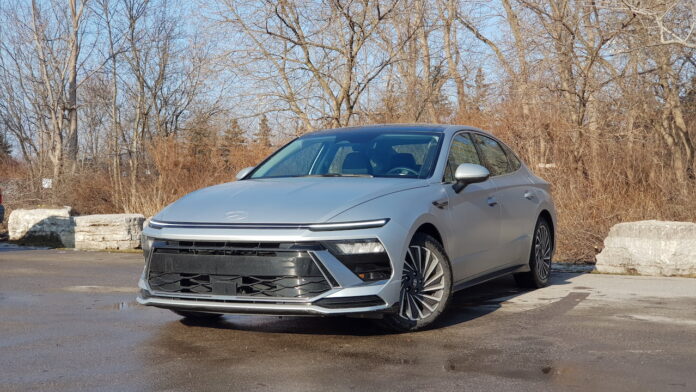
The Sonata Hybrid has a low, wide front end with a gloss-black grille, diamond-style detailing, cooling openings, and chrome trim along the lower section. The satin gray paint on this test car gives it a more upscale appearance in sunlight.

The continuous LED DRL strip runs across the front, and the outer sections double as turn signals. The main LED headlamps sit lower in the fascia, with functional vents on either side.
The nose curves down and sits quite low. I noticed that around the front because it can feel close to the ground, even though the side profile still looks balanced. The 17-inch dual-tone wheels suit the hybrid’s efficiency focus, and the profile has a long rear overhang.
The body-colored mirrors are power-adjustable and include blind-spot warning, but they are not power-folding, which feels like a missing convenience feature.
The rear design is clean, with a full-width LED light bar, gloss-black lip spoiler, Sonata and Hybrid badging, and glossy lower trim. Rear visibility is decent at the upper and middle levels, but the lower view is slightly restricted.
Interior

The cabin design feels clean and has an ergonomic layout. The top of the dashboard uses soft-touch material, and the center console is shaped so that it is easy to rest your hand and operate the switches. The steering wheel is leather-wrapped, and the cabin gets black perforated leather seats with gray trim details across the dashboard.
Material quality is a mixed bag. The upper dash feels decent, but I still wished it was a little softer. The lower areas use more normal hard plastic, and the side areas near the legs could have used softer padding. That matters on longer journeys because the knee-side contact points can become annoying.
The door cards also mix soft-touch areas with normal plastic, so the cabin feels practical rather than consistently premium.
The driver display uses two fixed dials and a 4.2-inch center screen. You can change the center information and adjust the dial colors through the infotainment system, but it is not as flexible as a full digital cluster.
The 12.3-inch infotainment screen is familiar from other Hyundai and Kia products and supports Bluetooth, USB, wireless Android Auto, wireless Apple CarPlay, SiriusXM trial access, hybrid information, phone projection, valet mode, service menus, and vehicle settings. There is no ambient lighting; the lighting menu mainly controls exterior light behavior.

Controls & Storage
The dual-zone climate panel uses physical temperature dials on both sides and touch buttons in the middle. The layout is straightforward, and at least the controls are not buried inside the infotainment screen, but the touch buttons still feel a bit fiddly because you need to look down while using them. The left temperature dial on this car also felt loose and wonky, while the right one felt solid.
The Sonata Hybrid has two USB-C ports up front, with one also used for connectivity, plus a 12V socket. Rear passengers get two USB-C ports. There is no wireless charger, which feels like a missing feature in a modern midsize sedan. The drive-mode button is also small and needs a precise press, though the modes themselves are simple.
Storage is useful in the center console, with a large tray, two flexible cupholders, an armrest bin, and a passenger-side phone slot. The door pockets are small, though, and hold only about a half-liter bottle. That is not ideal for a family car.
Seating & Comfort

The front seats are black leather, heated, and ventilated. They are wide and long, with good under-thigh support and decent side bolstering. They are slightly firm, but still comfortable enough for long drives.
The driver’s seat is 8-way power-adjustable with 2-way lumbar support. The passenger seat is 6-way power-adjustable and does not get lumbar adjustment, which is a limitation on longer trips.
At 5’11”, I found the rear space usable. With the front seat in my driving position, I had almost 3 inches of knee room. The rear seat base has some angle, so under-thigh support is good, but there is no real room to slide feet under the front seats.
Headroom is more restricted because of the sloping roofline, and someone around six feet may start brushing the headliner.
The rear bench has three headrests, but three adults would be a squeeze. The middle passenger has to deal with a floor tunnel, a raised cushion area, and a firmer backrest because of the fold-down armrest and cupholders. It works best as a temporary seat.
Rear passengers do get air vents, two USB-C ports, seatback pockets, and ISOFIX points on the outboard seats.
Cargo & Practicality
The trunk is one of the Sonata Hybrid’s strong areas. With the rear seats up, it offers 15.6 cubic feet of space, and the floor is wide, deep, and useful for regular luggage. The trunk opening has plastic scuff plates, and the space itself goes quite far in.
The rear seats fold 60-40, but the folded opening is limited by thicker arches on both sides. That makes it useful mainly for longer objects rather than bulky cargo. The seats also cannot be folded directly from the seatbacks; you need to pull the levers in the trunk first.
Under the floor, Hyundai provides a tire repair kit and tools instead of a spare wheel, which is a limitation for buyers who prefer a physical spare.
The Sonata Hybrid uses a single reverse camera, not a 360-degree system. The camera quality itself is good and offers three views, but the lens is fully exposed. In snow, rain, or wet and dirty road conditions, grime sticks to it quickly, so it needs regular wiping.
Performance

The Sonata Hybrid combines a 2.0-liter 4-cylinder DOHC engine with an electric motor, a 270-volt lithium-polymer battery, and a 6-speed automatic transmission. Total output is 192 hp, with the electric motor capable of 151 lb-ft of torque, and the engine capable of putting out 139 lb-ft.
Unsurprisingly, the powertrain is tuned in favor of efficiency. The 6-speed automatic transmission is smoother than a CVT-style setup, and the electric motor can assist even at highway speeds around 90-100 km/h (56-62 mph). It can also handle light acceleration without needing harsher engine input.
The 192-horsepower output is acceptable on paper, but the car can feel like it struggles slightly when stronger acceleration is needed. Power delivery takes time to build, and the added weight is noticeable. I also expected the transition between electric and engine power to be smoother.
Efficiency is the Sonata Hybrid’s gift. I averaged about 6.2 L/100 km (38 mpg) in the city and 4.9 L/100 km (48 mpg) on highways. The displayed full-tank range was around 850 km (528 miles), which makes it fit for long road trips. Paddle shifters control regenerative braking levels, with three settings and an auto mode.
Ride, Steering & NVH


The ride is comfortable overall, but the suspension is slightly on the firmer side. The car feels a bit heavy, and that weight shows during acceleration and over continuous bumps. Body roll is minimal, and the sedan layout keeps it stable.
The electronic steering is light and works well for urban use, but feedback is limited. Sport mode adds some weight, yet it still does not feel especially engaging. The turning radius also feels slightly larger than expected.
The Sonata Hybrid has four disc brakes, and the pedal feels progressive with good bite. Noise control is mostly good from the front and side glass, but some sound filters through the rear glass. There is also a bit of tire noise, even with the 17-inch wheels.
Pricing
The 2026 Sonata Hybrid is priced starting from USD 29,200 (excluding freight charges, tax, title, and license fees) in the U.S. market, and from CAD 39,121 (excluding taxes) in Canada.
TopElectricSUV says
The 2026 Hyundai Sonata Hybrid is a practical and efficient midsize sedan with excellent range, good cabin space, useful comfort features, and a no-nonsense control layout. Its biggest strengths are fuel economy, cargo space, rear-seat usability for two adults, and highway comfort.
The suspension, steering, turning radius, rear-glass noise, and tire noise also leave room for improvement. Even with those issues, the Sonata Hybrid delivers excellent value.

An automobile engineer by training, I’ve analyzed the global car market since 2005, with a keen focus on EVs since 2008. My journey in online automotive publishing spans 17 years, during which I have reviewed cutting-edge automotive technologies and interviewed leading global CEOs and vehicle developers.

