
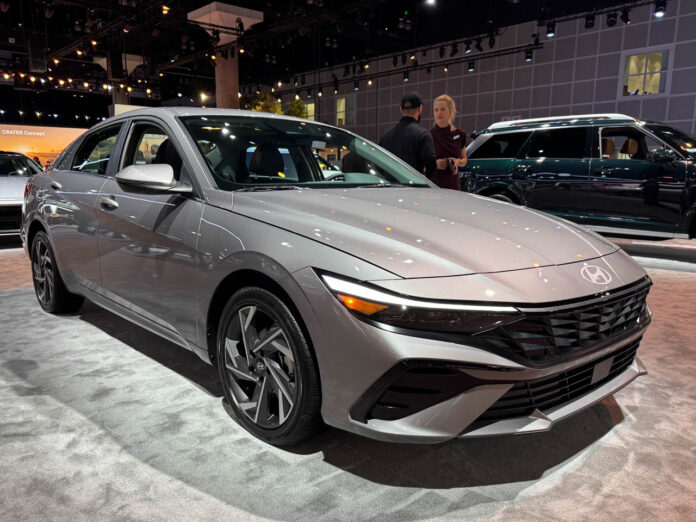
Last fully redesigned for its seventh generation in 2020, the Hyundai Elantra is set to undergo a complete makeover and move to its eighth generation. While still a compact sedan, the next-gen Elantra (codename: Hyundai CN8) is set to take on a different character, with a brand-new hybrid system and next-gen infotainment.
Having seen it up close last year in the 2026 model year guise, and having reviewed the hybrid sedan not so long ago, here’s everything we know and expect from the future Elantra, which should land stateside for the 2027 model year.
Design
The Hyundai Elantra adopts a bolder and more unconventional design in the eighth generation. Spy shots confirm that Hyundai is aiming for a cross between an executive and offbeat look.


The low and broad hood of the next-gen Elantra is flanked by inverted T-shaped daytime running lights that double as turn indicators.
The low- and high-beam lamps are positioned separately, lower into the bumper, which carry a completely new design. Unlike the current model, spy shots also reveal that it won’t feature a unified front grille.
The more expressive front-end will be contrasted by a rather traditional side profile, featuring a flatter roofline, a straighter beltline, squarer windows, and a rear quarter glass. At the rear, the upper part should have a less aggressive concave surface. Slim lights will likely span across the width and form an H-shape.
Interior
Hyundai is adopting a new interior concept with the arrival of the Ioniq 3, and its influence will be seen in the 2027 Elantra. The dashboard will feature a slimmer and sharper design and have a cleaner look with a more tightly integrated layout for many of the buttons, switches, and knobs in the center.

The instrument cluster would be a slim 9.9-inch panel positioned on the top of the dashboard. The steering wheel will have a squircle shape and feature Morse code “H” instead of the brand logo.
The infotainment system will likely have a new 14.6-inch touchscreen, although lower trims may feature a 12.9-inch unit. Hyundai Motor Group’s new Pleos Connect system is based on Android Automotive OS and features a tablet-like UI, Gleo AI voice assistant, and a marketplace for native apps.
Specifications
According to a report the Korean Car Blog published on February 13, 2026, the length and width will be 4,765 mm (187.6 in.) and 1,855 mm (73.0 in.), respectively, which would make it 55 mm longer and wider than the outgoing model. The wheelbase would measure 2,750 mm (108.3 in.), representing a growth of 30 mm (1.2 in.).


Hyundai would offer a hybrid system in the next-gen Elantra. Expected to feature the company’s next-gen 1.6L TMED-II system, improvements in power and torque are a given. Whether the future model is able to match or improve over the 2026 model’s EPA-estimated fuel economy of 54 MPG remains to be seen.
TMED-II is Hyundai’s latest hybrid system and is already used in the redesigned 2026 Palisade Hybrid. Unlike the older TMED-I setup, it uses two electric motors: a smaller 17 hp unit for engine start-up and vehicle systems, and a larger 72 hp motor for propulsion and regenerative braking.
The system also adds a new Stay Mode, which can run the infotainment and HVAC systems using the hybrid battery with the engine off for about an hour.
Price & Release Date
South Korean publication Auto Daily reported earlier this month that the next-gen Hyundai Avante (as the Elantra is known locally) will celebrate its premiere at the 2026 Busan Mobility Show, which opens on June 26 for the media.
The next-gen 2027 Hyundai Elantra Hybrid should arrive in the U.S. by early next year, with prices ranging between USD 26,000 to USD 30,000. It will compete with hybrid versions of the next-gen Honda Civic and the all-new Toyota Corolla, both of which are expected stateside in 2027-28.
Featured Image: Current Elantra shown for reference

International Automotive News Editor since 2014, covering global motor shows, industry events, and test-driving various vehicles, with a focus on hybrid and electric cars in recent years.

