
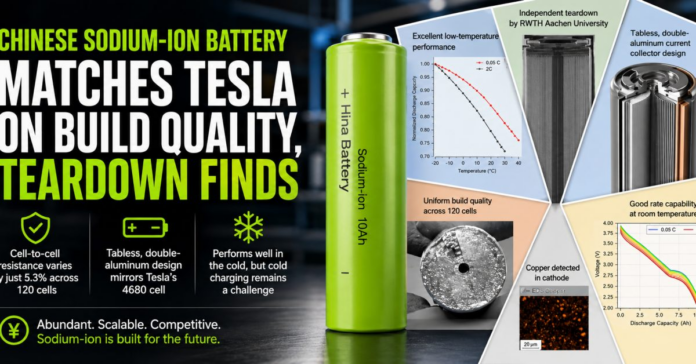
A commercial sodium-ion battery from Chinese manufacturer Hina matches Tesla’s lithium-ion cells on manufacturing quality and internal design, according to an independent teardown published in the Cell Press journal Cell Reports Physical Science.
Researchers at Germany’s RWTH Aachen University measured cell-to-cell resistance varying by just 5.3% across 120 cells — a sign of tightly controlled mass production rivaling the best lithium cells on the market.
What the teardown found
The study, led by Christian Siebert and Moritz Schütte, set out to benchmark a widely used Hina sodium-ion cell against more advanced Tesla lithium-ion technology.
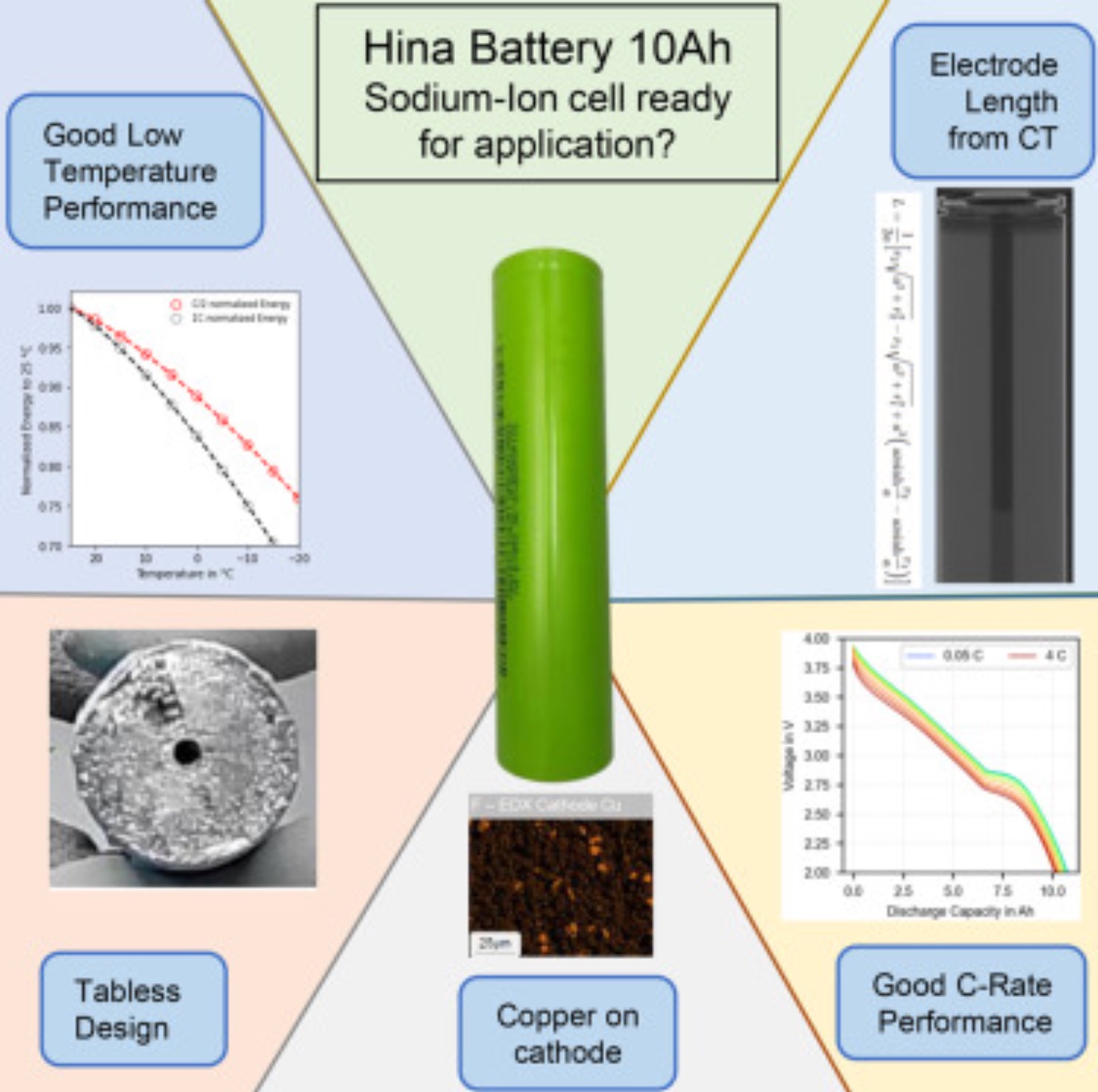
The team ran impedance spectroscopy — a non-destructive method — across 120 cells to gauge uniformity, then tested performance at currents and temperatures ranging from −20°C to 45°C. They used X-rays to image the internal structure before physically dismantling the cells to measure electrode dimensions, composition, and microstructure.
The standout finding was structural. The Hina cell uses a “tabless, double-aluminum current collector design that reduces resistance and ensures a uniform temperature distribution — and also mirrors the current design of Tesla batteries,” the researchers wrote.
That tabless architecture is the same headline feature Tesla introduced with its 4680 cell. The researchers say this is the first commercially available sodium-ion battery to use it. Sodium-ion has a structural cost advantage here, too: it can use aluminum current collectors on both sides of the cell, while lithium-ion requires more expensive copper on the anode side.
“We were positively surprised by how uniform the cells are,” Schütte said.
Where it still trails Tesla
The skepticism is warranted on the parts that matter most for electric cars. The researchers were clear that the cell still trails leading lithium-ion technology on two fronts.
The first is energy density. “Today’s commercial sodium-ion cells generally have lower energy density than the best lithium-ion cells, and the technology is less mature overall,” Schütte said. That keeps sodium better suited to stationary storage, grid services, and shorter-range or commercial vehicles than to long-range passenger EVs.
The second is cold-weather charging. Sodium handles cold discharge well, but charging is the problem. “For applications that require frequent charging at low ambient temperatures, appropriate thermal management or operating strategies will be important because low-temperature charging remains a clear weakness,” Schütte said.
The teardown also turned up an oddity: unexpectedly high and unevenly distributed copper in parts of the cathode, which the researchers said “raises interesting questions about its role in performance and aging.” Schütte added that he’d like to see future sodium cells “free of nickel and copper” while reaching competitive energy density.
The competitive context
The finding lands as China’s battery giants push sodium-ion from lab curiosity to mass production. We reported in April that CATL is launching its Naxtra sodium-ion batteries in EVs in 2026, targeting around 175 Wh/kg now and roughly 600 km (372 miles) of range as the chemistry matures, with charging down to −30°C.
The technology is already on the road. In February, CATL and Changan unveiled the world’s first mass-produced sodium-ion EV, the Changan Nevo A06. And researchers have been chipping away at sodium’s weak spots, with one group demonstrating a sodium-ion cell with 11-minute charging and 450 km of range.
Hina, a spin-off of the Chinese Academy of Sciences, supplies cells for both vehicles and grid storage and has shown commercial packs rated around 165 Wh/kg.
Electrek’s Take
The headline writes itself: a Chinese sodium-ion battery “matching” Tesla, but it’s worth being precise about what the study actually says, because the distinction is the whole story.
This isn’t sodium beating lithium on the spec sheet. On energy density, the metric that decides how far an EV goes, sodium still loses. What the German team confirmed is something arguably more important for the long game: an independent Western academic teardown found that a Chinese sodium-ion cell is being built at a quality and design level on par with the best lithium cells, using abundant, cheap, supply-chain-friendly materials. A 5.3% spread in resistance across 120 cells is the kind of consistency that only comes from a mature production line, not a lab bench.
That’s the real takeaway. The knock on sodium has always been that it’s a promising chemistry stuck in the “not quite ready” phase. This teardown says the manufacturing is already there — the remaining gaps are energy density and sub-zero charging, both of which are engineering problems with clear roadmaps rather than fundamental barriers. Combined with CATL putting sodium packs into production cars this year, it’s another data point in how far ahead China’s battery industry has pulled.
The open question is whether that quality translates beyond grid storage and entry-level cars into the mainstream EV market. If sodium closes the density gap the way LFP did, the cost math gets very hard for everyone else to ignore.
My bet is that those sodium cells are fairly cheap already.
If you’re charging an EV at home, pairing it with rooftop solar is one of the smartest ways to lock in low fuel costs for the long haul. With electricity rates climbing nearly 10% last year, home solar protects you against future rate increases. And with lease and PPA options, you can go solar with zero upfront cost and start saving immediately. If you want to find the best deal, check out EnergySage. It’s a free service with hundreds of pre-vetted installers competing for your business, so you save 20 to 30% compared to going it alone. No sales calls until you pick an installer. Get your free quotes here.


FTC: We use income earning auto affiliate links. More.

