
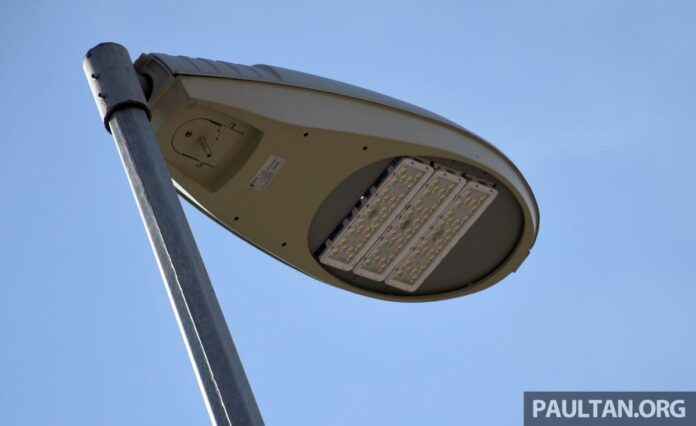
The works ministry has announced that 3,000 solar-powered LED streetlights are set to be installed at 32 highway accident blackspots nationwide before the end of the year. The initiative, which is being made under the Pantau Madani programme, is aimed at reducing fatal crashes and improving road safety, as The Star reports.
According to works minister Datuk Seri Alexander Nanta Linggi, the project is expected to be completed by the end of November, and will cover several major highways, including the North-South Expressway (NSE), the Seremban-Port Dickson Highway (SPDH), the Kuala Lumpur-Karak Expressway (KLK), and the East Coast Expressway Phases 1 and 2 (LPT 1 and LPT 2).
The move comes following prime minister Datuk Seri Anwar Ibrahim’s announcement made during Budget 2026 to enhance road safety across the country. Nanta said the government had approved RM25.24 million for the project from the RM30 million allocation that was announced in the budget, with the remaining funds to be considered based on prevailing needs.
“The balance of the allocation will be considered based on current requirements, as the installation of streetlights must be carried out in a targeted manner and based on risk assessments as well as actual needs at specific locations,” he said.
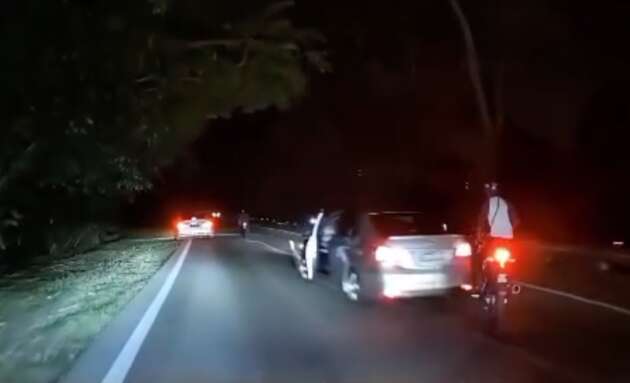
Malaysian Highway Authority (LLM) director-general Datuk Mohd Hadzmir Yusoff said the 32 locations were identified through accident data analysis and road safety assessments, particularly in areas with a higher risk of crashes at night and during adverse weather conditions.
He said LLM had engaged highway concessionaires and analysed data from the Malaysia Highway Road Accident Database and Analysis System (MHROADS) to identify high-risk stretches requiring improved lighting. He said that locations that recorded a weighted score of 15 points and above in the MHROADS system were classified as blackspots and prioritised under the project.
Of the 32 locations identified, the southern region will receive the highest number of installations, involving 1,305 streetlights at 11 locations. This is followed by the northern region with 691 units at nine locations, the eastern region with 690 units at nine locations, and the central region with 314 units at three locations.
The streetlights require a minimum of 4.5 hours of effective sunlight to generate electricity and are equipped with Deep Cycle batteries, allowing them to operate for at least two days even during cloudy or rainy conditions.
Looking to sell your car? Sell it with Carro.

