
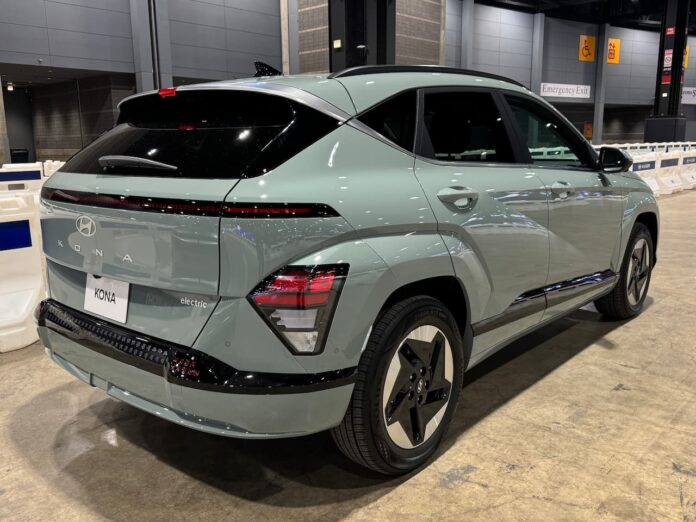
The Hyundai Kona Electric is set to return to the U.S. lineup for the 2027 model year after a brief hiatus, in the same shape.
However, test prototypes of the next-generation Kona (codename: SX3) have been spotted in Europe, Korea, and even here in California, and that can only mean a brand-new Kona launching globally in 2027
Having spent considerable time with the current-gen model in different global specifications, we’ve identified areas where Hyundai needs to step up if it wants the Kona Electric to stay competitive in the U.S. market.
1. Faster DC Charging

The current Kona Electric still uses a 400-volt electrical architecture, and its DC fast-charging speed is modest by today’s standards. Depending on the battery pack, the charging rate is up to 100 kW, with a 10-80% charging time of about 43 minutes.
That is acceptable for daily commuting, but not ideal for U.S. highway use, especially when Hyundai’s newer E-GMP EVs can complete the same 10-80% charge in around 18 minutes.
The next-gen Kona Electric does not need to become an Ioniq 5, but a peak charging rate of between 150 kW and 200 kW would make a difference.
2. AWD Option
The Kona Electric remains front-wheel drive only, even though the gas-powered Kona is available with AWD. That limits its appeal in Snow Belt states, where buyers often expect all-weather capability from a crossover.

A dual-motor Kona Electric would not need to be an ‘N’ performance model. Even a modest rear motor designed mainly for traction would make the vehicle more useful in rain, snow, and loose surfaces.
It would also help Hyundai compete more effectively with compact electric crossovers that already offer AWD and allow Hyundai to include an N-Line variant with a meaningful performance difference.
3. Smarter Traction Control
Hyundai reduced the second-gen Kona Electric’s torque output compared to the original model, dropping from 290 lb-ft to 188 lb-ft. That helped reduce torque steer and wheelspin, as we found in our review.
With a 0-60 mph time of 7.0-7.5 seconds, the current Kona Electric is quick enough, but better traction control calibration would be a smarter solution than simply detuning the motor in the next-gen Kona EV.
4. Better Charging Port Location & Frunk


The front-mounted charging port is not ideal for U.S. use. Besides accumulating road grime and snow, it can also make positioning awkward at public chargers with short cables.
Moving the port to a rear fender would make charging easier in more situations. Hyundai could also investigate if the freed-up front space can lead to a more useful frunk, instead of the current tray-like compartment that is good enough for the charging cable.
5. Better Cabin Materials & Smarter Variant Walk

The dual 12.3-inch screens give the Kona Electric a modern look, but the lower cabin still uses slightly harder, scratchy plastics. A richer mix of materials would help the next-gen model feel more premium.
Hyundai should also rethink feature packaging for the new Kona. A power passenger seat, driver memory settings, and a heat pump should not feel overly restricted. Standardizing the heat pump across the U.S. would especially help cold-weather buyers deal with winter range loss.

An automobile engineer by training, I’ve analyzed the global car market since 2005, with a keen focus on EVs since 2008. My journey in online automotive publishing spans 17 years, during which I have reviewed cutting-edge automotive technologies and interviewed leading global CEOs and vehicle developers.

