
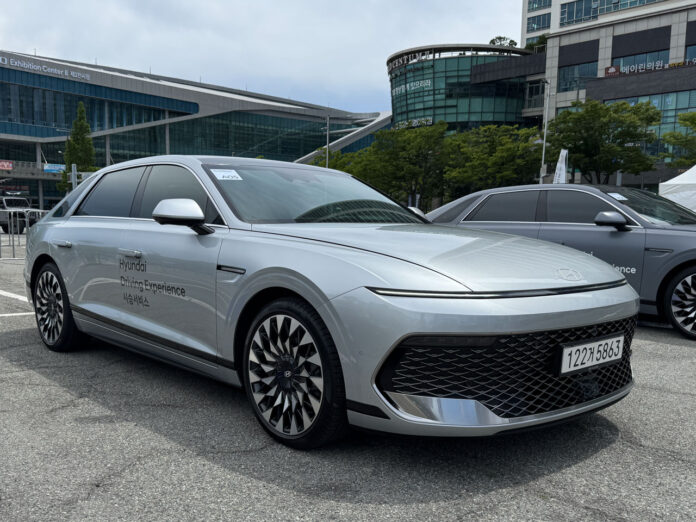
Once sold in the U.S. as the Hyundai Azera and currently in its seventh generation, the Grandeur is Hyundai’s flagship sedan. The latest version is a radically different, noticeably more upmarket vehicle compared to the last, fifth-generation model offered in the U.S. until the 2017 model year.
The 2026 Grandeur, which is a facelift of the seventh-gen model, is available in South Korea in gas and hybrid variants. At the 2026 Busan Mobility Show, I had an opportunity to check out the former in detail.
Design
The 2026 Hyundai Grandeur builds on the seventh-gen model’s distinctively stately yet futuristic design formula. The exterior changes are subtle but still make it easy to differentiate the latest version from the old one.

The redesigned front-end gives the car a stronger and more assertive look. The full-width daytime running light bar at the leading edge of the hood is slimmer and bezel-less, while the vertically stacked boxy headlamps have been replaced by ultra-slim units. This change also leaves more room for a wider and more prominent grille.
The grille features a new mesh pattern and looks better integrated with the bumper. Its concave surface and hexagonal frame add a sporty touch, but the overall look remains elegant and restrained.


On the sides, Hyundai has moved the turn indicators from the side mirrors to the front fenders. The new units sit in a recessed horizontal section and feature a gloss-black surround. The company has also introduced new 20-inch alloy wheels with an intricate multi-spoke design, available in dual-tone and all-black finishes.
At the rear, Hyundai has only revised the bumper. In a first for a Hyundai sedan, the new Grandeur features a hidden antenna without protrusions instead of a conventional shark fin antenna, which gives the roof a cleaner look.
Interior
The interior of the 2026 Hyundai Grandeur has substantial changes. Hyundai has redesigned nearly every key element, from the dashboard and door cards to the center console, steering wheel, seats, and displays.
Most surfaces now have a softer, more rounded treatment and draw inspiration from lounge furniture. The real wood/real aluminum trim on the dashboard, the couch pattern on the door trim, the quilted seat covers, and available burgundy color lend the cabin a rich look.


The dashboard integrates new, electronically controlled air vents that are hidden away from sight. Also new is a full-length glass roof with electrochromic shading instead of a conventionally used mechanical blind. Hyundai has replaced the steering-mounted gear lever with a traditional unit that needs to be moved up and down for shifts.
The new instrument cluster is a 9.9-inch slim display positioned on the dashboard, and it is complemented by a 17-inch touchscreen infotainment system. Together they form Hyundai Motor Group’s new Pleos Connect cockpit, based on the Android Automotive Operating System (AAOS).
As for safety and driver assistance, Hyundai has introduced a Memory Reversing Assist function. It records the vehicle’s path while parking and can automatically reverse it out of the spot along the same route.
A new Pedal Misuse Safety Assist (PMSA) function limits the driving force and applies braking if it detects that the driver has mistakenly pressed the accelerator pedal instead of the brake while stopped or driving at low speeds.


Experience in the 2026 Hyundai Grandeur
I spent time in the Grandeur Calligraphy, and the frameless doors immediately give this large sedan a more upscale feel. The experience I’m about to share should be broadly similar in the gas and hybrid versions.
Once I settled into the driver’s seat, I found the seats very comfortable, with excellent back support, good side bolstering, and strong under-thigh support. The adjustable thigh extenders improve comfort further, especially on longer drives.
With the driver’s seat set to my usual position for a 6-foot frame, I had about 3.9 inches of headroom left. Head and neck support were also good.
The pedal box is well designed, and the dead pedal provided comfortable support for my feet. Outward visibility is strong for a sedan, helped by small front and rear quarter-glass panels.
The steering wheel is flattened at the top and bottom and feels fairly light. It also carries Hyundai’s Morse-code-style detailing. The electrically adjustable steering column offers a wide range of movement, though raising the wheel too far can partly obstruct the instrument cluster.

Material quality looks premium, even if some surfaces reveal their plastic construction when tapped. The upper dashboard and door panels use soft-touch materials, while the middle section has a convincing wood-like finish.
The lower dashboard remains hard plastic. Alcantara-like trim on the pillars and headliner adds to the Calligraphy’s upscale atmosphere.
I also liked that the dual-zone climate controls and ventilated-seat functions use physical buttons instead of relying entirely on the Pleos Connect touchscreen. The door-release mechanism feels reassuringly well weighted.

Rear-seat entry requires me to watch my head because of the sedan roofline. Once inside, back support is good, and my size 12 shoes slide beneath the front seat. However, rear headroom is limited to about 2.4 inches for a 6-footer. Under-thigh support is nothing out of the ordinary for this segment.
Rear passengers get a center armrest with seat and audio controls, individual climate controls, two air vents, and a 100W USB-C charger. Outward visibility from the rear is also reasonably good.
Specifications
Hyundai has introduced several minor technical changes in the 2026 Grandeur Hybrid for improved power and efficiency.

The company has improved power efficiency by combining a ‘P2’ traction motor with a ‘P1’ starter motor. The former handles regenerative braking and driving, while the latter manages starting, power generation, and drive assist functions.
A new Hybrid Stay Mode allows customers to cut off engine power and use only the battery power to run the AC, infotainment system, and lighting when parked. It can be used only if the charging level of the traction battery pack is at least 35%.
As before, the hybrid powertrain is based on a 1.6-liter turbocharged gas engine, but the combined power has gone up from 230 PS (227 hp) to 239 PS (236 hp). The fuel economy has increased from 18 km/l (42 mpg) to 18.4 km/l (43 mpg).


Price
The 2026 Hyundai Grandeur’s prices start at KRW 42.45 million (USD 28,479) in the gas variant and KRW 48.33 million (USD 32,423) in the hybrid variant.

An automobile engineer by training, I’ve analyzed the global car market since 2005, with a keen focus on EVs since 2008. My journey in online automotive publishing spans 17 years, during which I have reviewed cutting-edge automotive technologies and interviewed leading global CEOs and vehicle developers.

