
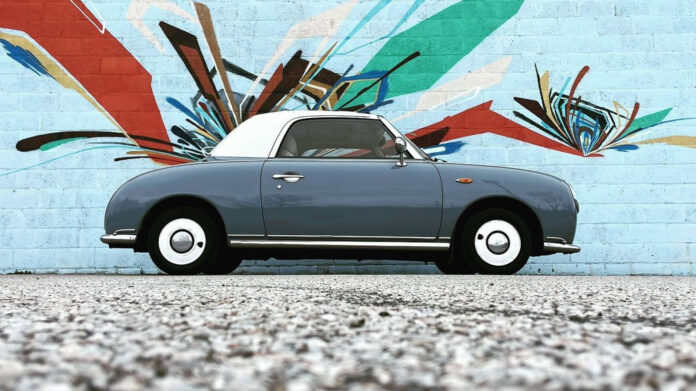
My wife and I were looking for a fun little summer car to enjoy and came across this pale blue Figaro at a local enthusiast dealership. It was fun while it lasted, but it was more trouble than it was worth, and it wasn’t fun enough to keep around. I liked this car, but I never really loved it.
Nissan’s “Pike” cars are legendary among car enthusiasts for their incredibly executed vintage aesthetic. The quartet of cutesy post-modernist Nissan vehicles (all based on the Micra platform) included the S-Cargo, Pao, Be-1, and Figaro. I chose the diminutive two-seater (technically, there is a back seat, but it functionally doesn’t exist) Figaro for its striking good looks, more powerful turbocharged and fuel-injected engine, and its folding roof.
Purchased for $12,000 and sold at a small loss a bit over 12 months later, this was a short and probably ill-advised fling with a car that didn’t really fit my life in the way I thought it might. I was looking for a reasonably frugal summer daily with some retro cues and engaging dynamics. It delivered on 90% of the criteria, but the driving experience fell well short of expectations. It also turned out to be an entirely too center-stage attention grabber. I was getting more attention driving this thing than I would’ve in the most powerful hypercars.
Don’t get me wrong, the car was screwed together pretty well and had held up well over its 60,000 miles of life. But the Figaro was just never built with American roads in mind, and it didn’t have any kind of sporting intentions to back up its tiny turbocharged runabout 2+2 vibes.
Everything you need to know
My two big takeaways from a year with the Nissan Figaro were that it is aesthetically incredible and that it has way more storage than you would think for a car of its size. Between the vestigial rear seats, the clamshell that holds the vinyl roof when it’s down, and the actual “trunk” tucked just above the rear bumper, I could do complete Costco runs in this car with plenty of room to spare. You lose a bit of space with the roof stowed, but it’s usually worth it.
The top stows away with reasonable ease, but you have to get out of the car to tuck it away. Inside the car, you unclip the top from the windshield header and push a button to release the rear clamshell. Folding the top into its storage area is easy, but pushing it down enough to get the retaining straps clipped can be finicky. Once it’s in there and retained, you can close the clamshell and snap the short vinyl tonneau to the rear bulkhead. It can definitely be done in under a minute, but on the spectrum of convertible top operating, it’s closer to the complicated top of a Porsche Boxster Spyder than the ultra-quick-folding top of a Mazda Miata.
Figaros are all equipped identically, so the only differences between them are the colors, each named after a season. This grey/blue color is Winter, while green is Spring, turquoise is Summer, and beige is Autumn. If you see one in another color, it’s been done custom. The interiors, similarly, were all ivory white with exterior color accents like the seat piping, carpet mats, dash cap, and steering wheel horn button. All of the HVAC, radio, signal, and door switches were capped with a vintage-look bakelite-style plastic and trimmed in chrome, which added a lot to the vintage feel.
Not built for America
At 6-foot-2 and just shy of 300 pounds, I’m a large person, even by American standards, but I still fit in the Figaro without much issue. Climbing in required getting very low and sliding in under the large no-airbag steering wheel. Once inside, the seat was reasonably comfortable, if a bit close to the dashboard. I found that I could drive this car for about an hour and a half at a time without needing to get out for a stretch.
The Figaro is hardly a grand tourer, and it’s probably best to avoid highway-heavy routes altogether, if only for your safety inside this tiny tin can. It is, after all, a tiny 35-year-old city car first and foremost. Safety measures basically don’t exist, as it rides on tiny tires and doesn’t even feature anti-lock braking. There’s not a hint of a side curtain airbag or any rollover protection. I ride motorcycles on a regular basis, so I can get past stuff like that, but not everyone can.
Nissan quotes a leisurely 12.9-second 0-60 time for the Figaro, but decades later it feels even slower than that. I could forgive a fun car its tepid acceleration if it at least manages to feel fun when the roads get curvy. Unfortunately, the Figaro didn’t deliver there, either. This car felt like a small aluminum row boat going through rough seas whenever I pressed it into turns. The tiny wheels with generous sidewalls meant the car was imbued with less traction than dress shoes in an ice storm. Perhaps with some work, it could be made to handle, but the stock suspension package rolled and wallowed far more than the car’s 1800-ish pounds suggested it should. All hampered by the ridiculous three-speed slushbox automatic.
What if it breaks?
Early on in my Figaro ownership, I took the car to a local car show, but it came home on a flatbed. In Ohio, you can’t get anywhere without using the interstate, and while the Figaro can achieve the speed limit, it’s really wringing its little turbocharged 1.0-liter engine out at high RPM in order to do so. Theoretically, the car’s top speed is 106 mph, but I never had the guts to make a true top-speed run. I was, however, convinced that if I hung out in the right hand lane and kept my speeds just a bit under the limit, I’d be okay. I was wrong.
Apparently, these MA10ET engines don’t love to hang out at high RPM because the bolts holding the rocker shaft to the cylinder head vibrate loose and the shaft flexes in the middle until it snaps. It’s a relatively common failure, but an entire ocean away from the people who built it, I was unaware. Thankfully, this failure mode didn’t mean more destruction elsewhere, so I gathered up all of the broken bits and changed the oil before digging into my options.
With just 20,000 Figaros built, all of them for the Japanese market, parts supply in the U.S. is basically non-existent. Quite a few have been imported to the United Kingdom, though, and The Figaro Shop there has a reasonable assortment of components. In a pinch, I probably could have had the shaft welded back together and sourced some new bolts, but Figaro Shop had my back. About $300 and two weeks later, I had what I needed to get the car running again. If you’re unwilling or unable to wait for foreign-sourced parts, Figaro life is going to be tough, though — especially if something a bit more rare and/or expensive breaks.
Why you might want one
If you ever want an opportunity to talk about your car, the Figaro is going to facilitate it. At the gas station, in traffic, in parking lots, you’ll be surrounded by curious people looking for an opportunity to shout questions like “What year is that?” This sort of interaction was actually the thing that drove us to get rid of the car.
On a late night drive in the city, we had a car stop in the middle of the road in front of us, and the driver got out of their car to approach us and find out more about the Figaro. You might like attention, but for us, that (admittedly rare) situation was a bit too sketchy.
When it comes to cheap and cheerful, you can’t beat the Nissan Figaro. This is about as cute a car as you can buy at any price, and if your driving needs are almost exclusively in-town affairs, you don’t feel like driving very quickly at any point, and you don’t mind everyone looking at you all the time, it could be just right.
I think I would have been comfortable keeping the Figaro around for several years to come if I had just a few minor changes. It’s possible that a set of good coilovers, a better wheel and tire package, and a manual transmission swap would have made it an incredibly competent car. On the flip side, swapping the powertrain for an electric setup would make it a much better city vehicle, and a highway-capable one to boot. Maybe one day I’ll find myself with enough time and spare money to build such a perfect Figaro. Until then, I had my fun and moved on, and I’m okay with that.

