
Back to articles
For a long time, high-power charging infrastructure has been built around a simple principle: add more chargers, more power, and more central power cabinets. However, as the number of electric vehicles continues to grow, this approach is gradually reaching its limits.
At EVBox, we believe that a high-performance charging station should not only be powerful. It should also be scalable, resilient, and designed to support future mobility needs. This vision led to the development of DDA (Distributed Dynamic Architecture).
Rethinking Fast Charging as a System
Traditionally, fast-charging infrastructure has relied on two main models:
- Standalone chargers, each equipped with its own power electronics;
- Centralized architectures, where multiple charging satellites depend on a single power unit.
These approaches have enabled the rapid deployment of high-performance charging networks. However, they also come with certain limitations: rigid sizing, dependence on a central point, complexity when expanding sites, and high infrastructure costs in some locations. DDA takes a different approach.
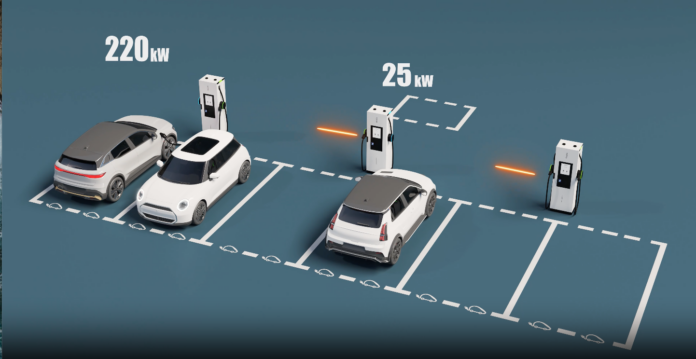
Rather than concentrating power in a single location, it intelligently distributes energy resources across the entire site. Chargers communicate with one another and dynamically share available power based on the actual needs of the vehicles being charged. The result is a more flexible, modular infrastructure that is better aligned with real-world fast-charging usage patterns.
Dynamic Power Distribution
In a conventional charging station, a significant portion of installed power can remain unused when certain vehicles naturally reduce their energy demand during a charging session. With DDA, available power is directed wherever it is actually needed. This dynamic orchestration becomes particularly valuable in high-traffic charging hubs, where charging profiles continuously evolve throughout the day.
An Architecture Designed to Evolve Over Time
One of the biggest challenges for charge point operators is the ability to expand a station without having to rebuild it entirely a few years later. DDA was specifically designed to support gradual growth. A site can be deployed with an initial number of charging points and later expanded as demand increases by adding new chargers or additional power modules.
This modularity makes it possible to:
- Align investments with actual demand growth;
- Simplify future expansions;
- Preserve overall site consistency;
- Avoid the proliferation of fragmented infrastructure.
In a rapidly accelerating market, this scalability is becoming as much a strategic advantage as an operational one.
Improved Service Continuity
Station availability is now one of the most important criteria for both drivers and operators. Charging infrastructure is no longer judged solely by its maximum advertised power output, but also by its ability to provide reliable day-to-day service. Thanks to its distributed logic, DDA reduces dependence on a single point of failure. In the event of maintenance work or a localized issue, part of the site can continue operating without causing a complete service interruption. In a context where driver confidence is essential to the widespread adoption of electric vehicles, service continuity becomes a critical success factor.
Preparing for Tomorrow’s Charging Needs
The electric mobility ecosystem is evolving rapidly. 800-volt vehicles are becoming increasingly common, while charging requirements for commercial vehicles and heavy-duty trucks are driving demand for ever-higher power levels.
DDA was designed with this evolution in mind. Its dynamic resource-sharing model enables future increases in power capacity and changing usage patterns without requiring a complete overhaul of existing infrastructure. This forward-looking capability is essential for building networks that can sustainably support the transition to electric mobility.
Beyond the Charger: A Vision for Infrastructure
Fast charging can no longer be viewed as simply a collection of independent chargers. As charging networks grow, value increasingly lies in the ability to orchestrate energy distribution, maintain service availability, and adapt infrastructure over time. DDA embodies this vision. Its goal is not simply to deliver more power. It aims to create charging infrastructure that is smarter, more adaptable, and more resilient to future demands. Because the performance of a charging network is measured not only in kilowatts, but also in its ability to stand the test of time.

