
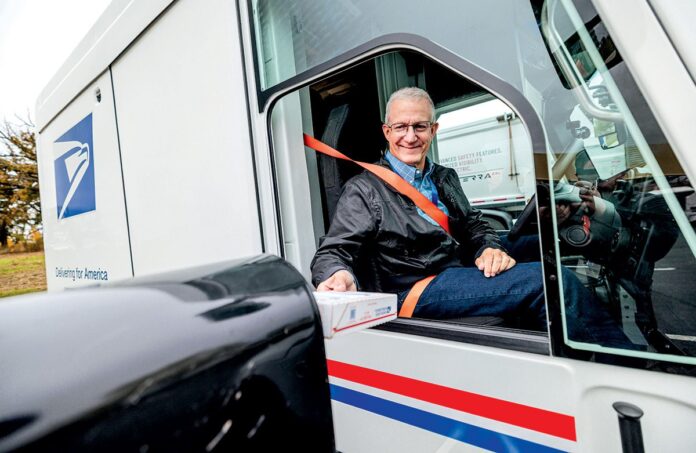
The most common EV some Americans will see over the next few years may be the one that delivers their mail.
A new electric vehicle has now quietly launched onto US roads. As of now, you can’t buy one for your own use, but you’re going to see a lot of them in coming years, and they will offer a very public demonstration of the benefits—or pitfalls—of mass EV adoption into daily delivery fleets.
The new EV is the Oshkosh Next Generation Delivery Van (NGDV) now being delivered to US Postal Service locations in many states. NGDVs actually come with two powertrain options. The EV uses a 94 kWh lithium-ion battery pack that powers a 150 kW (201 hp) motor driving the front wheels. EPA documents suggest the combination will give a range of about 120 miles. Even in very cold or very hot weather, that offers a comfortable safety margin over a delivery vehicle’s average daily mileage of 18 to 24 miles: a whopping 96 percent of the vehicles the NGDVs will replace cover fewer than 40 miles a day.
The other powertrain is a turbocharged 2.0-liter inline-4 gasoline engine, driving the front or all four wheels. These will be used for routes that cover longer distances, most of them rural, or over challenging terrain. Roughly 5,000 NGDVs, with both powertrains, have been delivered to date, part of 29,000 new USPS vehicles this year. Of 106,500 new vehicles of all types now under contract, the Postal Service says 66,000 will be zero-emission, including NGDVs. The current contract with Oshkosh calls for 51,500 vans, though ultimately a further 110,000 may be needed.
70 percent EV, 30 percent gasoline
USPS proposals originally requested bids on a fleet of EVs, and then bids on a separate set of gasoline-powered vehicles. According to its CEO John C. Pfeifer, Oshkosh was the sole bidder to suggest a single vehicle that could meet the requirements of both requisitions. The Postal Service liked the idea, which meant drivers could get familiar with just a single vehicle, regardless of powertrain. In the end, Pfeifer told Charged, roughly 90 percent of the parts are common to both versions of the vehicle.
Once a contract was signed, it specified that 90 percent of NGDVs purchased would be gasoline, with only 10 percent running on battery power. Over the course of development, as the Postal Service tested and validated prototypes and analyzed the performance and lifetime operating costs, it became clear that the EV models could cover a majority of today’s delivery cycles.
The final contract specified 70 percent EVs and 30 percent ICE models, and that ratio is what’s being delivered today.
The final contract specified 70 percent EVs and 30 percent ICE models, and that ratio is what’s being delivered today—despite an attempt to slash the EV percentage inserted as a last-minute provision into a major, must-pass Congressional bill by anti-EV elected officials.
Oshkosh and its lobbyists laid out the enormous added operating costs that reducing the number of EVs would impose on the USPS. In due course this provision was removed from the bill, and the percentage remains at 70-30.
Form following function
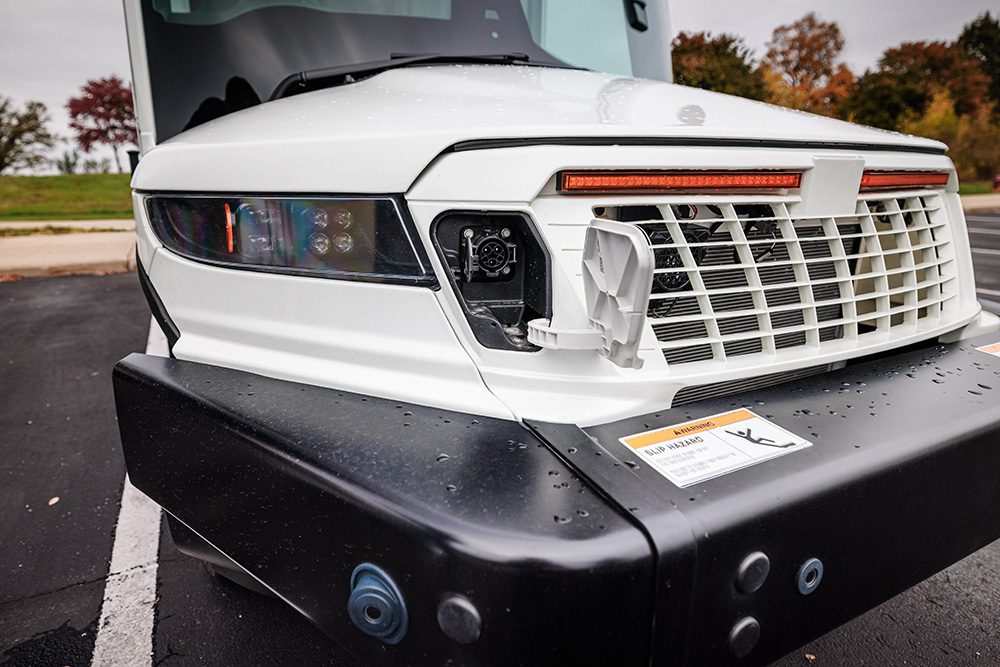
The Postal Service’s NGDV is instantly identifiable by its duck-billed appearance, with a low and rounded nose in front of a very tall windshield. The NGDV’s looks have garnered a great deal of criticism, but they’re a prime example of form that follows function.
The low nose, with edges that slope down on either side of the centerline, maximizes visibility from the driver’s seat during neighborhood deliveries. Mail-delivery drivers may encounter small children, mailboxes, driveway posts, cats and dogs, and a host of other hazards along their daily routes. From the firewall forward, that specific front-end design belongs to the USPS alone. While Oshkosh can sell NGDVs to other customers, they will have to have a different front-end design.
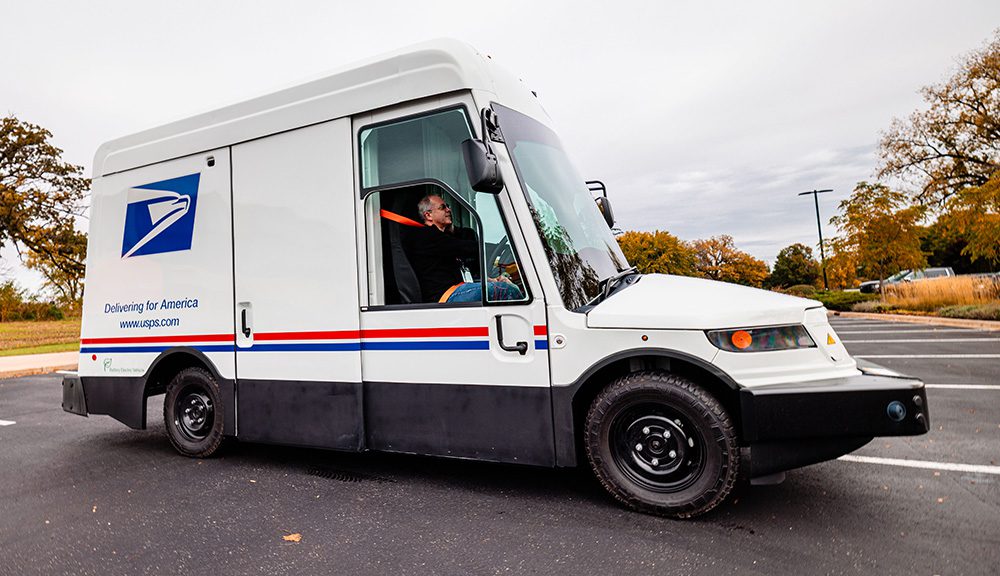
The tall cargo body—much taller than that of the decrepit Long-Life Vehicles that these will replace—reflects the Postal Service’s very different mission in the 2020s compared to that of the late 1980s, when the LLVs started rolling out. As First Class mail volume is only a tiny fraction of what it used to be, today’s Postal Service has a much higher volume of parcels to deliver, including last-mile deliveries for huge e-commerce vendors like Amazon.
The load bay is tall enough for a 95th-percentile adult to stand up in: 78.5 inches, or more than six and a half feet, even with the roller door open.
As a result, the load bay is tall enough for a 95th-percentile adult to stand up in: 78.5 inches, or more than six and a half feet, even with the roller door open. That’s very different from the LLVs, which required drivers to stoop and/or walk to the rear doors. Cargo volume has expanded from 120 to 330 cubic feet, and rated payload has doubled: 2,000 pounds rather than 1,000 pounds.
LLVs: living long beyond the plan
The NGDVs will replace the Long Life Vehicles built by defense contractor Grumman, which an aluminum van body on a Chevrolet S-10 light-truck chassis, powered by GM’s pushrod 2.5-liter “Iron Duke” 4-cylinder engine. In 1984, the USPS issued a set of requirements for a standardized vehicle to replace the motley collection of production vehicles it used. The vehicles had to have right-hand drive, be easy to get in and out of, use standardized powertrains that could run 12 hours a day every single day, and be capable of surviving harsh climates and hard use. They were tested for tens of thousands of miles over pavement, gravel and dirt roads, potholes, and even cobblestone surfaces. Finally, they had to be simple to maintain and easy to repair.
The NGDVs will replace the Long Life Vehicles built by defense contractor Grumman, with an aluminum van body on a Chevrolet S-10 light-truck chassis.
Ultimately 140,000 were built from 1986 to 1994—all designed for a 24-year lifespan—of which 130,000 remain on the roads today. They lacked amenities new-car buyers take for granted today: airbags, air conditioning, even anti-lock brakes. And in stop-and-start low-speed use, they returned all of 8 miles per gallon of gasoline.
The LLVs were followed by similar Ford UtiliMaster vans, put into service starting in August 1999, though just 21,000 were delivered through 2001. Using a Ford Explorer chassis, they were capable of running on alternative fuels to comply with a government fleet-vehicle mandate. Their engine was a 4.0-liter Ford V6 engine that could run on either gasoline or E85 ethanol. Many remain in service as well, with fuel economy even worse than that of the 8 mpg Grummans.
Terrible duty cycles for gas, ideal for EV
Every one of these vans has now outlived its design life—the first LLVs are now almost four decades old. As they aged, the Postal Service came up against a core problem: gasoline engines are a terrible powertrain for the duty cycles of postal-route delivery, with perpetual stops and starts, low speeds and low daily mileages.
Gasoline engines are a terrible powertrain for the duty cycles of postal-route delivery, with perpetual stops and starts, low speeds and low daily mileages.
The average curbside delivery route has 500 stops over just 20.8 miles, covered in roughly 6 hours. Only one quarter of that time is spent in motion, while 64% is spent stopped during deliveries. The average drive between stops is just 11 seconds. As one mechanic commented, the engine (switched off at stops) never runs long enough to warm up properly, and the continual on/off cycles produce a high proportion of under-lubricated running time before the oil pressure builds back up. Exhausts often don’t warm up enough to dry the moisture that rots them from the inside. And some USPS rules allow work on the vehicles only if they break, meaning there’s no room for necessary preventative maintenance. Today, each LLV costs the USPS roughly $10,000 a year in maintenance—and more than 100,000 of them are still on the roads.
Under that particularly challenging duty cycle, EVs turn out to be perfect. No oil pressure to build up, no combustion engine to warm up, no exhaust, no need to switch on and off at each stop…and far, far lower cost per mile on electricity than the gasoline burned by an 8 mpg vehicle.
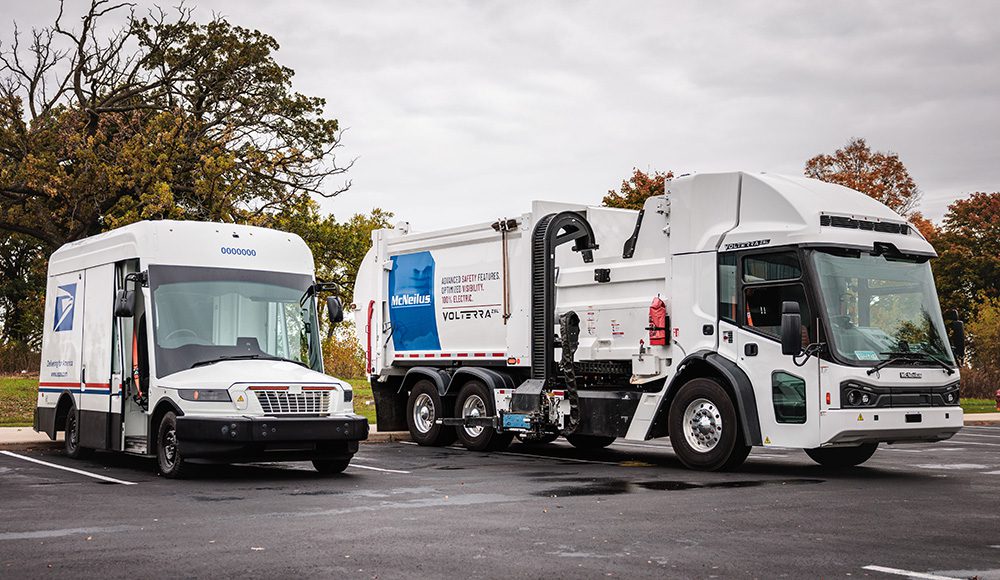
The USPS contract specifies a 20-year lifespan for the NGDVs, slightly shorter than that of the LLVs. The simplicity of their powertrain, however, suggests that they too may last far beyond their design life—and with considerably less powertrain maintenance. Moreover, should the Postal Service see significant battery degradation in some NGDVs, they might conceivably be retrofitted with a higher-capacity, less costly battery pack before the end of their lives.
Tears of joy
A brief drive in an early prototype electric NGDV showed us that this EV is no Cadillac or Lucid or Tesla. It’s a basic, purpose-built commercial vehicle with rubber mats, vinyl seats, a manually winding window, and large, industrial knobs and switches. It does, however, bring postal workers decisively into the 21st century of vehicle tech: it has modern safety systems like automatic emergency braking, a backup camera (rear visibility is nonexistent), and the feature that will likely matter most to USPS workers: air conditioning. One mail delivery worker is said to have burst into tears after her first drive, owing to that feature alone.
It’s not quick, but the power-delivery software is predictable, especially at low speeds—while creeping along residential roads from mailbox to mailbox.
On the road, the electric NGDV proved easy to maneuver despite its size (236 inches long) and heft (more than 3 tons). It’s not quick, but the power-delivery software is predictable, especially at low speeds—while creeping along residential roads from mailbox to mailbox. The regenerative braking pauses for a fraction of a second before taking effect, but it’s smooth and linear. And there’s no idle creep, a significant safety factor for a vehicle that stops hundreds of times a day in residential areas.
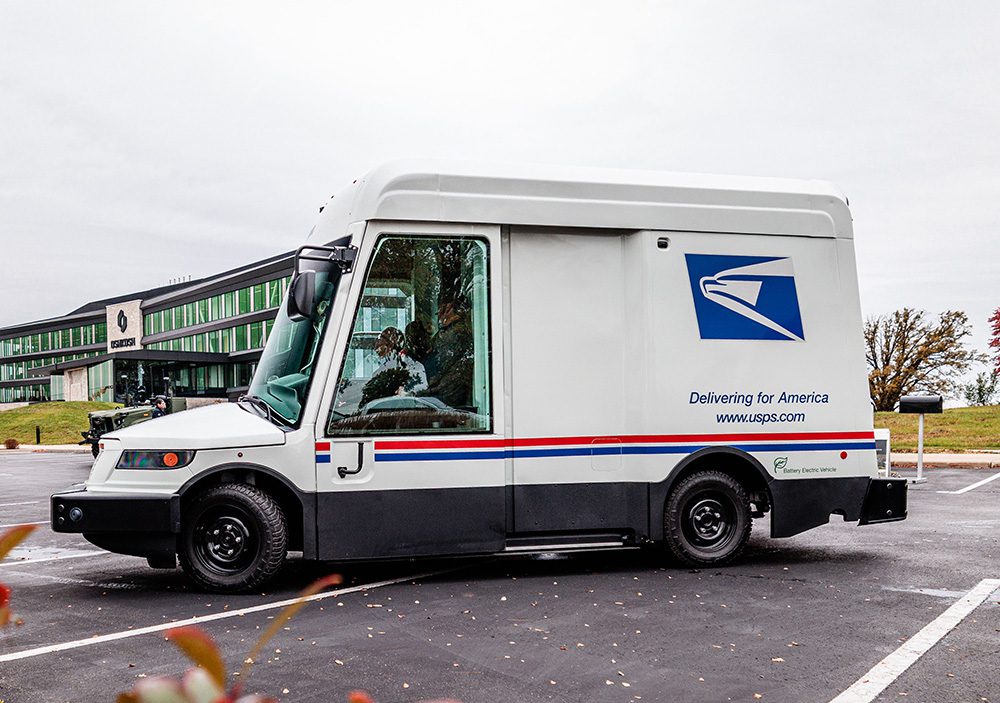
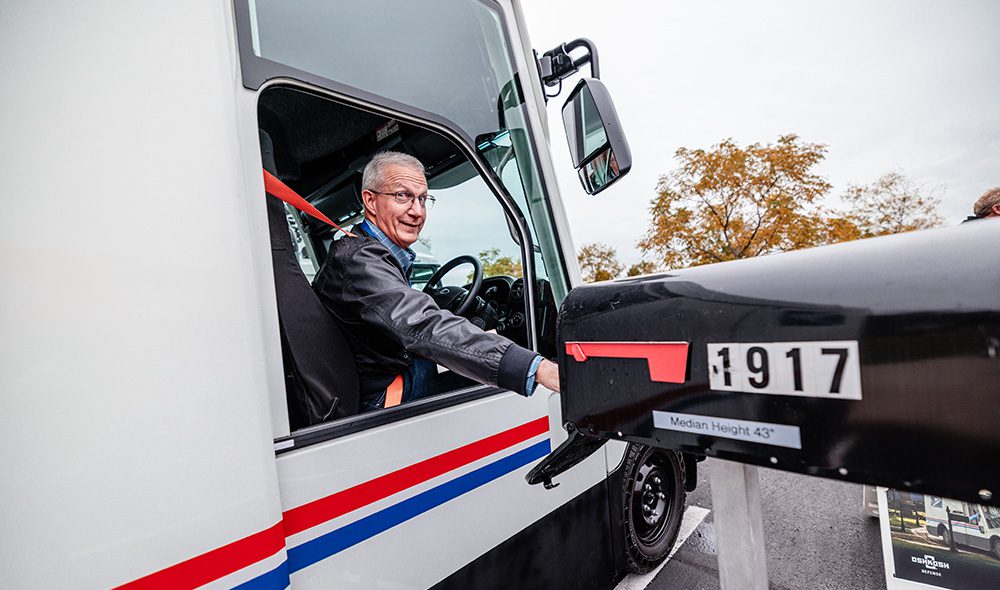
We were surprised to find that it doesn’t provide full one-pedal driving—the left pedal is required to come to a full stop. This makes the driving behavior of the electric and gasoline versions more similar—meaning less potential for driver confusion if they move from one type to another. In our brief test drive, we pulled alongside a regulation-height mailbox, reached out the open window, stuffed envelopes and flyers into it, and purred on…just as a USPS employee would.
We were surprised to find that it doesn’t provide full one-pedal driving—the left pedal is required to come to a full stop.
If any use is well suited for EVs, it’s daily mail delivery. Watch for NGDVs in your neighborhood—and ask the postal workers what they think of them. After all, they may be around for decades.
Oshkosh Corporation provided airfare, lodging and meals to allow Charged to bring you this first-person drive report. The company also let us drive its electric fire truck, garbage truck and airport emergency vehicles. It was great.
This article first appeared in Issue 74 – Subscribe now.

