
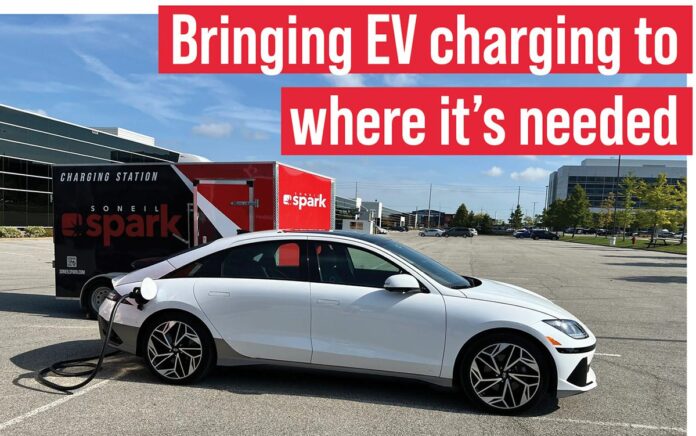
- Soneil Electronics has been manufacturing batteries and chargers for 30 years. A few years ago, the company created a new division called Soneil Spark to address the EV market.
- Soneil Spark’s new Mobile Charging Trailer (MCT) is a trailer-mounted system that includes battery storage and both AC and DC charging. Battery capacity, connectors and other features are totally customizable.
- The MCT serves all the typical mobile charging applications (off-grid locations, events, disaster relief, etc), but Soneil Spark is also seeing demand from fleets looking to get around the high cost and long wait times for installing permanent charging infrastructure.
Bringing EV charging to where it’s needed.
For over 30 years, Soneil Electronics has been manufacturing battery chargers and AGM batteries (Absorbent Glass Mat batteries are the newest generation of lead-acid batteries). Soneil’s headquarters is located in Brampton, Canada, but the company has offices in the US, England, Italy, China, Hong Kong, Malaysia and Australia.
A few years ago, the company started up a new division to address the growing EV market, and soon identified a demand for mobile charging solutions. Soneil Spark’s new Mobile Charging Trailer (MCT) provides on-demand charging in remote, underpowered or off-grid locations. It’s suitable for a wide range of commercial applications, including construction and mining sites, municipal fleets, outdoor events, disaster response and remote utility projects.
The Spark MCT is equipped with 50 kWh (or more) of battery capacity, can deliver AC and/or DC charging, and supports multiple energy sources, including solar, wind, methane gas and propane. Soneil Spark Sales Manager Graham Borden gave us the details.
Charged: Why don’t you start with Soneil Spark’s origin story?
Graham Borden: Soneil started 30 years ago. It’s a private company. Sach Jain was the founder and he started providing battery and charging solutions for manufacturers. Anything with either lithium-ion or AGM batteries: RVs and boats, wheelchairs, golf carts, assisted mobility devices, floor polishers, material handling machines.
Four years ago, the decision was made to focus on the EV segment and we created the Soneil Spark division specifically for that. I was brought on board as Sales Manager three years ago to help build the brand.
Charged: It seems like every company that has anything to do with electrical equipment is selling EV chargers these days, but Soneil has a long pedigree in the battery and charging industry. Would you say that gives you an edge over the competition?
Graham Borden: For sure. When you’re talking about multiple decades in this space, it’s a significant differentiator from our competitors—it’s kind of the Wild West right now. The other big differentiator is that our R&D team and our engineering team work on both the electronics and the EV sides, so we do all that in-house, and manufacture as much as we can in Canada.
When you’re talking about multiple decades in this space, it’s a significant differentiator from our competitors.
Charged: I want to hear about your new Mobile Charging Trailer, or MCT.
Graham Borden: We’ve been doing research and development on mobile energy for just over two years now and have done some pilots, but we really launched the MCT in January this year.
The majority of the components are made in-house. For the batteries, we rely on the relationships we’ve had with battery manufacturers spanning 30 years, but the other core components we manufacture in our facilities, and we do the assembly at our head office in Brampton, Ontario.
For the DC components, we’re manufacturing a lot in our factories in China, Malaysia, and some here in Markham, Ontario. So, it’s a combination of Soneil factories that actually manufacture the components—we’re not white-labeling or repurposing another company’s products.
Charged: I’ve heard about several different flavors of mobile charging, and all kinds of different applications that it’s good for. Tell me about some of the applications that you envision for the MCT.
Graham Borden: This really came out of the obstacles that we saw our customers facing putting in DC charging infrastructure, whether that was wait times or the capital cost for utility service upgrades. Servicing remote under-powered areas was another application. And then fleet charging. We’ve had some customers that lease their property, and they were in a battle with their landlord. They were in a 10-year lease, and the landlord didn’t want to spend $350,000 or $400,000 for something that would benefit the tenant, and the tenant didn’t want to incur an expense that they could only cover over five years.
So, coming up with solutions to provide DC charging on a temporary or interim basis was a great solution for us. Our trailers have the ability to charge from 98% of the public DC chargers in North America. You can pull up at an Electrify America or Electrify Canada or a Tesla station, refill the trailer and then deploy it, whether it’s with a rental EV fleet at an airport or at a location where the charging infrastructure can’t be put in place.
This really came out of the obstacles that we saw our customers facing putting in DC charging infrastructure, whether that was wait times or the capital cost for utility service upgrades.
Charged: Off-grid locations, events, emergency relief—those are obvious applications for mobile charging. However, I’ve heard a number of people say that the cost, the wait time and other obstacles to installing permanent infrastructure are so daunting that for many fleets, mobile chargers start to look like an attractive solution.
Graham Borden: We’ve seen a lot of customer interest for that situation, particularly from leasing companies that have made commitments on EV purchases and need to find creative ways to convert an ICE fleet customer over to electrification. Those pilot periods generally span four or five vehicles over 30 or 60 days. A lot of the time, they need at least one charger per vehicle, which requires an electrician coming in, and those costs can be in the $50-60,000 range for a 30- or 60-day pilot. That’s a big obstacle. So having a trailer come in and fuel up the EVs, with the added ability to hardwire it into the building, makes a lot of sense.
Charged: When you say a leasing company, you mean a company that provides vehicles to other companies, and that’s making a transition to EVs?
Graham Borden: Yeah. For example, let’s say a leasing company has made a commitment to buy a percentage of electric vehicles. The landscape in the US isn’t as EV-friendly as it was a year and a half ago, so the company has an abundance of EVs, and they need to be creative in how they get the pilots running. Electrification over time with a leasing company makes sense, but there’s a lot of unknowns with converting a fleet to EVs. Our Mobile Charging Trailer reduces the cost for a company to showcase EVs, and if the pilot is successful, then they can put in the permanent infrastructure required to support the fleet.
Charged: So mobile charging is a way for them to sweeten the deal for their customers by avoiding the up-front cost of installing charging infrastructure.
Graham Borden: For sure.We see this around airports as well. There was a Canadian company last year that specialized in turnkey solutions for fleets, taking care of the routine maintenance and the charging, so the operator could just hop in and drive. A lot of companies don’t want to have to manage the electrification of their fleets.
Charged: I’ve talked with several companies that do turnkey fleet solutions. Sounds like that would be a likely customer for you.
Graham Borden: They’re a great customer. We supply hardware to those companies. We can customize the product for their applications, so if they’re charging Teslas, they want a NACS port, we can do a NACS port with a CCS port. We can even do CHAdeMO without having to do it through an adapter, although CHAdeMO is dropping off now.
The question is, with the agreement between Canada and China for vehicles, are the Chinese vehicles going to be coming in with a GB/T port configuration or a European port configuration? We’ve got the ability to meet the requirements of a customer that needs, for example, one GB/T port and one CCS1 or CCS2 port.
The question is, with the agreement between Canada and China for vehicles, are the Chinese vehicles going to be coming in with a GB/T port configuration or a European port configuration?
Charged: Now, that’s something I hadn’t thought about. I understand that Canada has agreed to open the market to a limited number of Chinese EVs, but I assumed that when they start coming in, that they’re going to have the kind of ports you’re using in Canada, which would be CCS or NACS.
Graham Borden: From my conversations at the provincial and the federal level, it definitely won’t be NACS. The situation that Mexico’s in right now, a lot of the Chinese vehicles that are coming in from BYD are coming in on the Chinese specification, and we Canadians don’t want to get into a port war.It doesn’t help the end user or the customer at all. It’s going to be debated at a political level and hopefully we can get to a common standard. The Caribbean’s in a similar situation.Jamaica and Barbados, they’re advocating for, I believe, the European CCS2.
Charged: Well, that could be a problem, and the political situation here in the US is definitely not helping matters. That kind of leads into another question I had. Is the current…shall we say…mess in the US causing you to rethink your strategy?
Graham Borden: It has caused a minor pivot, but the interest hasn’t diminished significantly with privately funded projects. The biggest impact has been on projects with federal, state or county funding. We did pivot to increase the microgrid capabilities of the trailer, but that was on the roadmap already. Canada and the US, we’ve always been very valued neighbors. A good percentage of our business and long-term relationships have been with our US partners, and we wanted to make the product as marketable and viable in the North American market as possible.
Charged: Tell me some more about the microgrid capabilities. Do you have customers that are using those to power buildings during outages, or…?
Graham Borden: There are different applications for microgrids. For one example, we can power specific circuits on the building. If overall power goes out, those circuits will be powered off the trailer seamlessly, so refrigerators or medical equipment don’t see that outage. Another application of the microgrid: there’s a class of buildings in Canada called Class A that are surcharged or demand charged at a very, very high rate during peak electricity usage, and we can reduce the amount of energy that that building draws by incorporating one, two or three trailers, depending on the size and the capacity of the trailer.
Charged: Your web site describes a 9x8x15-foot trailer, with battery capacity of 215-430 kWh, but in fact, you can provide trailers in different sizes, right?
Graham Borden: Yes, definitely. Our base specification for the trailer is 215 kWh. We can go as low as 50 kWh, although the dollars per kilowatt-hour at that capacity don’t make a lot of sense. On the high side, we’re doing a megawatt and a half on a triaxle trailer. Those units are more geared to microgrid and overall output speed for the ports. They can charge an EV at 400 kilowatts, but if a hurricane comes along and it needs to be transported to a disaster zone, then it can serve as emergency backup power as well.
On the web site, we’ve kept to what we can manufacture fairly quickly. If a customer needs to have a base specification, say 215 kWh with one CCS output with 120 kW of power, that’s something we can deliver within days or within a week. We can do quick turnarounds right up to 430 kWh units. Anything over 430 kWh, then it’s about a 60-day period for delivery.
With 30 years of experience with charging, we get some very, very unique requests. The trailers that we move out of the building, we haven’t had one that’s been configured exactly like the next trailer. The configuration is very customized to meet the needs of each customer, whether that’s battery capacity, port setup or input charging for the batteries—we’ve got a lot of versatility and flexibility.
The trailers that we move out of the building, we haven’t had one that’s been configured exactly like the next trailer. The configuration is very customized to meet the needs of each customer, whether that’s battery capacity, port setup or input charging.
Charged: What about off-road EVs? Things like construction and agricultural equipment. Is that an application that you’re seeing, and are there some special needs for that market?
Graham Borden: For sure. We’re doing some work right now with underground mining applications. Anything off-grid that wouldn’t be feasible without a trailer or an ability to charge conveniently. That’s our tag: Energize your freedom. Whether that’s a personal application in the desert with some side-by-sides or if it’s meters down in a salt mine underground where they need to power mining equipment.
Charged: What would you say your most common types of customers are at this point?
Graham Borden: Fleet providers for sure. Turnkey charging providers for fleets. We also work pretty extensively with utility companies in Canada. We sell hardware at this point, but we’re exploring a renting program, because there’s often a finite period of need for charging, and that option isn’t available in the marketplace right now.
Charged: What about competitors? There’s a number of companies offering various kinds of mobile charging. One that’s been around a while is SparkCharge.
Graham Borden: I know SparkCharge pretty well. I think it’s great. There’s a lot of food on the table for everyone right now. We’re concerned with what this landscape looks like over decades, not years, and we’re in this for the long term. We’ve got a niche where we can customize the product and provide assistance or service years down the road, and we’ve done that with our OEM customers on the electronic side for 30 years now. It’s going to be interesting to see who the players are. The attrition rate’s pretty high, with manufacturers coming in and out.
It’s really tough for customers because you can end up with proprietary equipment that is very, very difficult to service if the manufacturer closes. Some of our partners have been in the space for a while, and they got into electrification with other companies’ products. So, we work on products from competitors that have gone out of business too.
Charged: Boy, I bet that’s fun.
Graham Borden: It’s easier for me than for the engineers. They’re not very happy to see me some days if they know I’ve been talking with a customer that has a Lion product, for example.

