
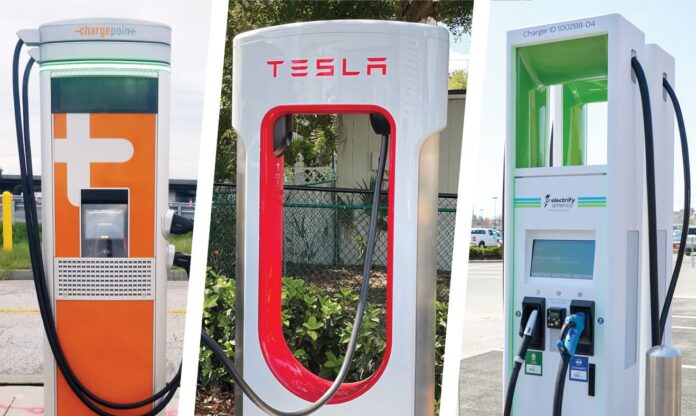
The US charging network 2.0—The evolution of a revolution: Part 1
The US public charging “network” didn’t emerge from a single master plan. It grew out of grants, bankruptcies, corporate settlements, acquisitions—and one automaker that decided it couldn’t wait.
Since the current generation of EVs emerged more than 15 years ago, the “network” of EV charging stations in the United States has been a patchwork of sites run by a constantly changing landscape of players. The recent rollback of federal support for EVs and charging infrastructure has cast the industry into even greater turmoil that could further erode driver and investor confidence. After all this time, how can an industry seeking to disrupt transportation still be circling through the revolving door of market expansion, contraction and participants? And what does the future hold for the charging network’s ability to meet EV driver needs? These articles provide an overview of how the network has morphed, the challenges therein, and insights on how to keep it growing.
A patchwork that somehow became an industry
According to the US Department of Energy’s Alternative Fuels Data Center, as of November, 2025 there were more than 80 companies listed as charging network operators, and 77,000+ public charging locations. Only seven companies operate more than 1,000 locations, and fewer than half manage 100 locations or more.
Those big seven got there via a surprisingly small set of origin paths:
- Federal stimulus and early grants (ChargePoint and the roots of Blink)
- Court settlements and penalties (Electrify America and EVgo)
- Startup-to-acquisition pipelines (EV Connect; Shell’s charging buildout via Greenlots and others)
- A vertically integrated OEM network (Tesla)
Here’s how each of them came to be—and why they survived while countless others faded out.
ChargePoint: the ARRA boost plus a platform play
ChargePoint of Campbell, California began as Coulomb Technologies in 2007, and now boasts the largest US charging network, with nearly 43,000 locations. The company was one of two awardees of the federal American Recovery and Reinvestment Act (ARRA) funds in 2009 to develop charging stations. The $15-million ChargePoint America project was launched in 2010 and required the company to provide matching funds. The project resulted in the deployment of 4,600 residential and public chargers in 10 metropolitan areas, which coincided with funding for 2,000 EVs that would have their performance and their charging habits studied by the DOE. Also in 2010, the California Energy Commission provided an award of $3.4 million to Coulomb to install chargers across the state. The company adopted the ChargePoint name in 2012.
ChargePoint shows how early federal funding helped seed network scale—and how scale doesn’t automatically translate into profits.
ChargePoint’s diversified business model has included the manufacture of its own equipment, the licensing of its software platform for managing charging stations manufactured by other companies, the sale of equipment to site host charging operators, and recurring revenue from site hosts who use the company’s software platform to manage revenue and performance.
ChargePoint continued to grow as a privately-held company and raised several rounds of funding, including an early investment from infrastructure giant and hardware partner Siemens. In February 2021, ChargePoint went public through a special purpose acquisition company (SPAC). In June 2021, ChargePoint’ (CHPT) reached a market cap of more than $8 billion. Since going public, ChargePoint has never produced an annual profit, and in November of 2023 the company replaced longtime CEO Pat Romano with current CEO Rick Wilmer. ChargePoint notably had two significant rounds of layoffs in 2024, and in its fiscal year ending in January of 2025 had total revenue of $417 million and a net loss of $277 million. As of February 19, 2026, the market cap had fallen to $146 million.
Why this origin matters: ChargePoint shows how early federal funding helped seed network scale—and how scale doesn’t automatically translate into profits.
Blink Charging: born from a boom and bust (and an asset auction)
Blink Charging’s roots can be traced to Ecotality, a transportation and energy storage company founded in San Francisco in 1999. In 2007 Ecotality acquired eTec, an alternative fuel infrastructure company. In 2009 Ecotality was awarded a $99.8-million grant to install chargers under the ARRA’s EV Project. During the program, which ended in December 2013, more than 12,000 AC and DC EV chargers were installed in 20 metropolitan areas. The program captured data from more than four million charging events, which was the most comprehensive analysis of EV charging at the time.
Blink’s story shows how early “boom” buildouts didn’t vanish when the first wave collapsed—they were bought, rebranded, and folded into today’s market.
The company’s initial public offering was on May 19, 2010, and by June 2011, the stock was trading at $2.80 per share. An October 2013 report from the DOE’s Office of Inspector General Office of Audits and Inspections cited concerns that were highlighted in reports during 2013, including that “the cost for some commercial EV chargers was about 200 percent higher than the original budgeted cost per unit,” and doubted that Ecotality would be able to complete charger installation and data collection deadlines. In September of 2013, Ecotality filed for Chapter 11 bankruptcy, and the company’s assets were auctioned off the following month.
Those assets were purchased by Car Charging Group, a competing EV charging company that was founded in 2009. Earlier in 2013, Car Charging Group had scooped up the assets of networks Beam Charging and 350Green, an EV charging startup that had been shuttered after its founder had been convicted of fraud and sent to prison. Car Charging Group, which was publicly traded, changed its name to Blink Network in 2017. (It now calls itself Blink Charging.) The company continued to grow, and in June of 2022, Blink acquired SemaConnect, an East Coast operator of charging stations, for $200 million. Since that time, Blink has never reported an annual profit. As of November 2025, it had a stock price of less than $2 per share.
Why this origin matters: Blink’s story shows how early “boom” buildouts didn’t vanish when the first wave collapsed—they were bought, rebranded, and folded into today’s market.
Electrify America: the charging network created by a penalty
Electrify America is a privately-held subsidiary of the Volkswagen Group. In 2016 Volkswagen agreed to settle multiple criminal and civil claims with the US Department of Justice, the EPA and the California Air Resources Board in response to claims that the company altered diesel vehicles sold in the US market so that during emissions testing they would register far lower pollutant emissions than were allowable.
Electrify America is the clearest example of “forced market creation”—a network built because a settlement required it, not because the business case was already proven.
As part of the settlement of the cases (which eventually climbed to nearly $20 billion in penalties), VW was required to invest $2 billion in “ZEV charging infrastructure and in the promotion of ZEVs.” Some $800 million of this was to be spent in California, and $1.2 billion across the rest of the United States. In February of 2017, VW announced the formation of Electrify America as a subsidiary to manage the funds, which were designated as the Mitigation Trust.” The rollout of charging stations was to take place in four 30-month cycles (10 years), and the settlement agreement enabled Electrify America to own, operate and collect revenue from the stations.
Despite the challenges of establishing a business unit, designing charging hardware, integrating a new software platform and then acquiring and equipping a site, the first Electrify America location opened less than a year and a half later. The original Cycle 1 plan called for 450 chargers to be installed by Q2 2019, but by the end of 2020, just 323 stations were open. In the following years, progress in building out the network significantly accelerated—by the end of 2024, Electrify America had installed 4,800 DC fast charging stations in 47 states. For the current Cycle 4 Investment Plan, between January 2024 and December 2026 the company will spend $412 million on infrastructure, of which $130 million will be spent on upgrades and repairs, even though the oldest equipment was installed in 2018. Commercial charging equipment is widely expected to last up to 10 years, but technology advances have made some of the older, slower stations obsolete.
Why this origin matters: Electrify America is the clearest example of “forced market creation”—a network built because a settlement required it, not because the business case was already proven.
EVgo: another network launched via settlement money
Based in El Segundo, California, EVgo was founded in 2010, and like Electrify America, has its roots in a legal dispute. On April 26, 2004, the California Public Utilities Commission approved a settlement with energy conglomerate NRG and frequent partner Dynegy to settle claims that the companies had set electricity prices at “unjust and unreasonable rates” during California’s energy crisis in 1999-2000. The settlement between the parties was initially approved by the Federal Energy Regulatory Commission on April 27, 2012, and required NRG to invest $102.5 million in EV charging station projects, including $50.5 million to build “Freedom Station” fast chargers in four metropolitan areas of California. While the agreement was in the midst of final regulatory approval, NRG created EVgo in 2010 to develop charging stations.
EVgo highlights how regulation can create the conditions for a network—and how ownership and strategy can change hands as the market shifts.
In an interview with the author in May of 2012, Arun Banskota, then President of NRG Energy’s EV Services, said that consumers benefitted from the settlement because “NRG’s investment and innovation in DC fast chargers will break open the EV market by addressing the number-one challenge facing the industry—range anxiety. This settlement puts the state on the path to creating a backbone of fast charging stations.”
After several parties, including ChargePoint, objected to EVgo being permitted to generate revenue from the stations and have the exclusive right to temporarily sell equipment to the selected site hosts, the settlement was amended and finalized on February 24, 2016. The final agreement modified how some of the funds for charging station “make-ready” and demonstration programs were to be spent.
EVgo continued to build its network in other states, while parent NRG saw its stock fall by more than 60 percent between 2014 and 2016. In May of 2016 NRG sold its majority stake of EVgo to Vision Ridge Partners for about $50 million. In December of 2016, EVgo announced the selection of the Driivz software platform to manage its network of chargers.
In January of 2020, infrastructure company LS Power acquired EVgo. In July of 2020, EVgo and GM reached an agreement to build charging stations that would result in tripling the size of EVgo’s network. Then, in July of 2021, EVgo combined with Climate Change Crisis Real Impact Acquisition Corporation, forming a SPAC (as ChargePoint also did) to go public. Also in July of 2021, EVgo acquired Recargo (the author is a former employee), the parent company of PlugShare, a popular application the helps EV drivers to find charging stations. EVgo’s stock peaked at $18.90 per share in November of 2021, and as of November 2025, traded at under $3.
For both Electrify America and EVgo, being legally bound to spend tens of millions of dollars seems a curious way to launch charging networks. Dave Packard, a former charging industry executive who held roles at ChargePoint and charging equipment company ClipperCreek, was initially skeptical of the settlement agreements. But in a recent interview he said he doesn’t believe that the nascent industry was ultimately harmed. “I don’t think they necessarily stole market share. I think they created market share,” Packard said.
Why this origin matters: EVgo highlights how regulation can create the conditions for a network—and how ownership and strategy can change hands as the market shifts.
EV Connect: the quieter software-first path (and a strategic acquisition)
In contrast to the more complicated histories of some of its competitors, EV Connect has been inconspicuous. The company was founded in 2009 and like EVgo, it’s based in El Segundo, California. The company has focused on developing charging management software and partnering with hardware makers, OEMs and utilities. It has developed an open platform (similar to that of Greenlots) that will operate on a wide variety of hardware, including charging stations from ABB, BTC Power, Efacec, Siemens and Tellus Power.
EV Connect represents the software platform layer—less visible to drivers, but critical to making multi-hardware networks work at scale, especially inside utility programs.
In 2011, EV Connect and hardware manufacturer ClipperCreek won an award from the California Energy Commission of $2.3 million to upgrade chargers. In 2016, EV Connect was invited to participate in Southern California Edison’s (SCE) Charge Ready pilot. By 2018, more than 1,000 charging stations using the company’s software were in operation in SCE’s program. In 2021 the company was again selected by SCE and received part of the $436-million program rollout.
In 2019, EV Connect received $12 million in funding, including an investment from Japanese electronics company Mitsui. In July of 2020, competitors EV Connect and Greenlots integrated their software platforms to allow customers of either network to “roam” (a term borrowed from the mobile phone industry) and pay for charging at each other’s stations, one of the first such competitor agreements in the industry. In March of 2022, EV Connect was named one of Time magazine’s 100 most influential companies. Then, in June of 2022, global infrastructure company Schneider Electric acquired EV Connect. In September of 2023, founder Jordan Kramer left the company.
Why this origin matters: EV Connect represents the software platform layer—less visible to drivers, but critical to making multi-hardware networks work at scale, especially inside utility programs.
Shell Recharge: built by acquisitions (Greenlots and more)
Shell Recharge Solutions is owned by Shell USA, a subsidiary of Shell, the Dutch/British oil giant that owns thousands of refueling and convenience store locations. The Shell Recharge network was largely built through acquisitions. In 2017, Shell made its entrée into EV charging when it acquired Dutch charging station operator NewMotion. Shell first entered the US EV charging market with the acquisition of software platform company Greenlots in January of 2019. Greenlots was founded in Singapore in 2008 and operated its US headquarters in Los Angeles. Like EV Connect, the company focused on licensing software with its SKY charging platform and partnered with hardware companies such as ABB and Eaton to create charging solutions. Greenlots was a strong supporter of enabling networks and equipment to share data, and in 2014 became a founding member of the Open Charge Alliance, which supports the Open Charge Point Protocol (OCPP) standard that is in widespread use by networks globally.
Shell’s charging arc follows the energy major playbook: scale quickly through acquisitions, then refocus on the sites and customers you control.
In July of 2017, Energy Impact Partners, a coalition of utility companies, invested in Greenlots. The company earned a significant win to grow its network of chargers when in January 2018, Electrify America selected Greenlots’ platform for its initial rollout of EV chargers. In November of 2021, Shell dispensed with the Greenlots name and took up the Shell Recharge Solutions moniker.
In March of 2023, Shell purchased Volta, a network of ad-supported EV chargers that had been in operation since 2010, for $169 million. Just two and half years later, in August of 2025, Shell announced that it was closing the Volta network as the first step in exiting the third-party charging market. In December of 2024 Shell announced it would no longer support the use of its software on third-party stations, and would instead focus on operating chargers at convenience locations owned by the company. In November of 2025, Shell sold the Volta network to JOLT, an international network of ad-supported charging stations, as its first entry into the US market.
Why this origin matters: Shell’s charging arc follows the energy major playbook: scale quickly through acquisitions, then refocus on the sites and customers you control.
Tesla: the OEM that built the network it wished existed
Tesla Motors was founded in July 2003 and rapidly grew into the leading EV manufacturer in the US The company didn’t want its customers to be frustrated by an EV charging industry that was not keeping pace with rising EV sales. Therefore, in September of 2012, the company launched the Supercharger network of DC fast chargers in California. Tesla boldly developed its own technology for charging stations and connectors, a strategy that proved to be highly prescient and rewarding. By the end of 2013, the Supercharger network ran the length of the US West Coast along the two largest highways. It rapidly expanded across the entire US.
Tesla’s charging strategy is the opposite of the one most networks have followed—vertical integration first, standardization later, and a customer-experience motive that reshaped the market.
Tesla provided charging at the Supercharger network to its customers without fees, instead bundling the cost of the network and electricity into the purchase price of the vehicles. Tesla uniquely had capital to help finance its network because the company was collecting fees from its automotive competitors. Starting in 1990, California and other states required automotive OEMs to manufacture a certain number of EVs or other fuel-efficient vehicles. Companies that failed to meet the targets could purchase automotive regulatory credits from OEMs who exceeded the targets. Many OEMS chose to purchase hundreds of millions of dollars’ worth of these credits from Tesla rather than produce electric vehicles. Bolstered by these annual windfalls, after a decade of operation Tesla first achieved profitability in the first quarter of 2013. The market for regulatory credits continued to grow—between 2022 and 2024, OEMs handed Tesla more than $6.3 billion in credit revenue.
During the 2010s, Tesla was diversifying by adding solar and battery storage products to its offerings. It dropped the word “Motors” from its name in 2017. Tesla continues to leverage these technologies at many of its charging locations to reduce operating costs and increase their energy efficiency. Tesla continued to upgrade its charging technology to more quickly charge vehicles and stay ahead of competitors. In addition to the fast Supercharger network, Tesla began paying to install Level 2 Destination chargers at retail and dining locations. By 2017, Tesla had added more than 5,000 AC chargers.
While the rest of the industry was utilizing two international standards for connecting vehicles and chargers (CCS and CHAdeMO), Tesla continued to use its proprietary technology. A major change came to the charging market in November of 2022, when Tesla opened its technology to competitors as the North American Charging Standard (NACS), which was subsequently adopted as an industry standard (SAE J3400). By summer of 2023, many of the largest OEMs, including Ford, Volvo, GM and Rivian, agreed to implement NACS in their vehicles. By all accounts, this has since accelerated demand for charging and increased revenue at Tesla’s locations, and prompted further expansion of the Supercharger Network.
The Supercharger Network had a hiccup in April of 2024 when Tesla CEO Elon Musk abruptly fired the entire team after a spat with lead Rebecca Tinucci. Within two weeks, however, many of the staff were rehired.
Why this origin matters: Tesla’s charging strategy is the opposite of the one most networks have followed—vertical integration first, standardization later, and a customer-experience motive that reshaped the market.
The common thread: resilience (and weird starting lines)
These seven companies have endured while many others have come and gone. A myriad of long-forgotten startups, and several failed attempts by European energy companies to replicate their successes in the US (e.g. Enel and Engie), have proven that operating a successful charging network requires tremendous resiliency and ingenuity.
Next in the series: Now that we know where the big networks came from, the next question is obvious—how much of charging demand has been market-driven, and how much has been policy-driven?
About the author: John Gartner has been analyzing and writing about EV infrastructure since 2009. He is the Senior Director at the Center for Sustainable Energy.

