
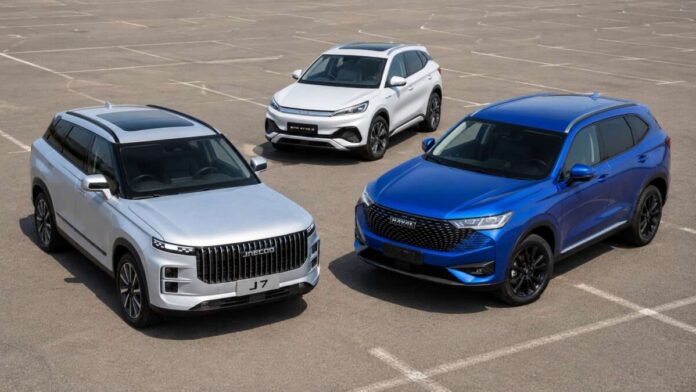
Four years ago, Chinese cars were a rounding error on Malaysian roads. In 2022, brands from China accounted for just 578 of the 744,762 vehicles registered here, or 0.08% of the market. Last year they registered 66,198 units. JPJ registration data lays out just how quickly it happened.
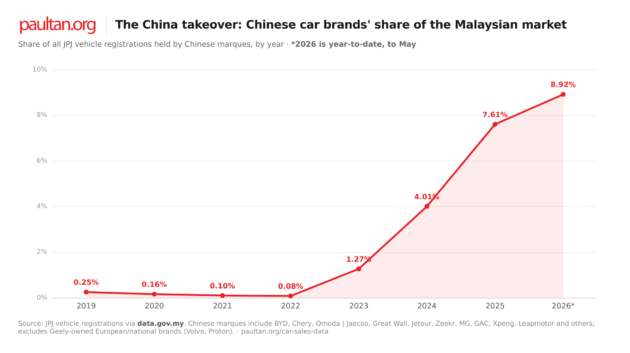
The trajectory is close to vertical. From 0.08% in 2022, the Chinese share of all registrations jumped to 1.27% in 2023, then 4.01% in 2024, and 7.61% in 2025. Through the first five months of 2026 it has climbed further still, to 8.92%, which means almost one in every 11 new vehicles registered this year wears a Chinese badge. No other group of brands has come close to that rate of growth.
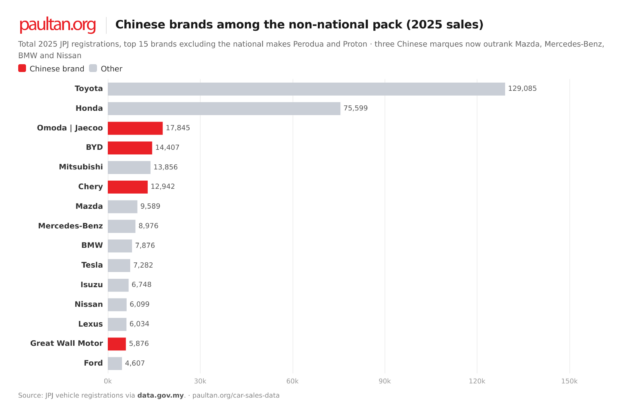
What makes the numbers striking is not just the total but where these brands now sit. In 2025, Omoda | Jaecoo was the fifth best-selling brand in the country with 17,845 units, BYD was sixth with 14,407, and Chery was eighth with 12,942. All three outsold established names such as Mazda, Mercedes-Benz, BMW and Nissan. A decade ago, the idea of three Chinese marques in the national top 10 would have been unthinkable. Today only the two national brands plus Toyota and Honda stand ahead of them.
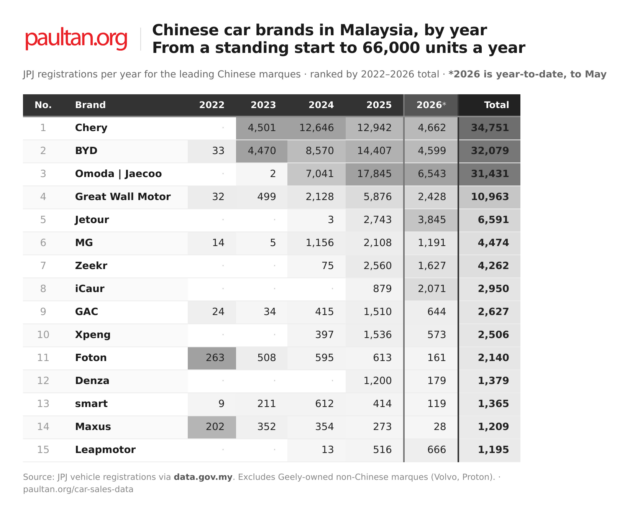
Look closer and you can see distinct waves. Chery and BYD led the first charge in 2023, each going from near zero to over 4,000 units in a single year. BYD pushed hardest in 2025 with 14,407 units, but the real breakout story is Omoda | Jaecoo, which went from a token two units in 2023 to 7,041 in 2024 and then 17,845 in 2025, making it the single biggest Chinese brand in the country.
Great Wall Motor has built steadily to 5,876 units, while a second wave is now arriving, with Jetour, Zeekr, iCaur and Xpeng all scaling up fast in 2026.
The drivers are familiar enough. Aggressive pricing, generous equipment levels, and a head start in electric and hybrid models have all helped Chinese brands win over buyers who once defaulted to Japanese or European marques. The EV incentives that ran until the end of 2025 gave the likes of BYD, Zeekr and Xpeng an additional tailwind. The question now is whether this is a ceiling or a foothold. On the evidence of the first five months of 2026, with the share still climbing and new brands still arriving, it looks far more like the latter.
How do you see the Chinese brands faring from here? Will there be further growth or will they hit a cap soon? Let us know in the comments. In the meantime you can explore more insights like this on our car sales data tool.
Looking to sell your car? Sell it with Carro.

