
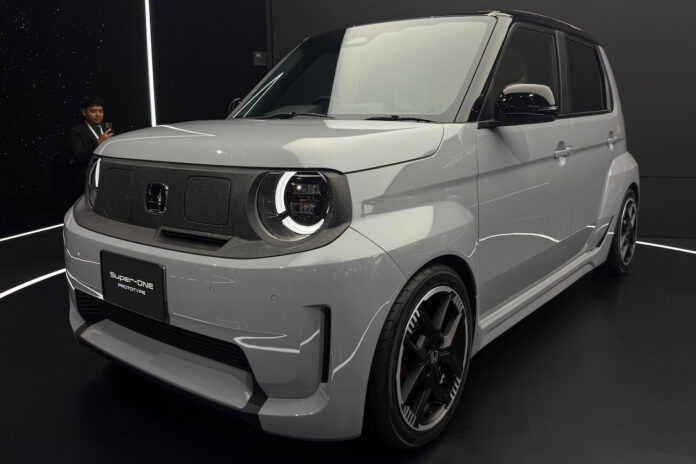
At the 2025 Japan Mobility Show, Honda unveiled the ‘Super-One,’ a pint-sized electric hatchback closely related to the N-One e: kei car for overseas markets in a near-production prototype. After checking out the new EV in person, here are some interesting observations we made:
Design
Evolving from the Honda Super EV concept, the Honda Super-One is smaller than typical European city cars. The future entry-level Honda EV has a cheerful and playful look, evident in elements like the circular headlamps and four-spoke alloy wheels.


In addition to the N-One e:’s clear-lens taillamps, a sporty body kit and low ground clearance, red brake calipers, a shark-fin antenna, and a roof spoiler enhance the Super-One’s visual appeal.
We particularly like the off-centered upper grille and the pronounced blister fenders that widen the stance and communicate stability. In person, the car’s stance feels planted, and the panel surfacing is sharper and more muscular than a traditional kei model.
Interior
Honda has kept the interior layout minimal to reduce distractions as well as lower costs, pairing a horizontal dashboard with a clear sightline over the hood. Sports seats designed exclusively for this vehicle provide additional side bolstering, and the asymmetric blue seat cover adds a playful element. The execution also reminds us of the off-centered upper grille on the outside.

The triple-gauge cluster sports an analog-inspired style, which is refreshing in what’s otherwise a digital-leaning segment. The design choices prioritize tactile feedback and functionality over screens for the sake of screens. Storage solutions are modest, but packaging efficiency feels strong given the segment.
As we experienced in the N-One e:, the low seating position and upright windscreen combine to deliver a commanding view of the road ahead. The walk-through cabin design offers enough room for the driver to slide across and exit on the kerbside.
Specifications

Dimensions
Honda has not disclosed the Super-One’s specifications, but we already know what to expect based on the N-One e:. The global version, not limited by the kei car regulations, would have a marginally bigger footprint than the Japanese model, which is 133.7 in. long and 58.1 in. wide. We can already tell from having seen both cars in person that the Super-One is longer and wider.
Motor & Battery
Needless to say, the Super-One will have a single-motor FWD setup like the N-One e:. However, with no gentleman’s agreement holding it back, we expect the power output to be slightly higher than 47 kW, in line with European customer preference for more responsive acceleration.
An NMC battery pack with an energy storage capacity of around 30 kWh will likely power this motor, and should deliver a WLTP range of around 180 miles.
Boost Mode
Honda has confirmed availability of a Boost mode. When activated, the motor delivers sharper acceleration, and the system synchronizes a simulated 7-speed gearbox with sound synthesis and vibration feedback. Honda says this mode is intended to mimic a gas-powered car’s acceleration, complete with sound, vibration, and visual cues.

Release Date
Honda plans to launch the production version of the Super-One in Japan in 2026, followed by other markets with demand for compact EVs, including the UK and Asian countries. In the UK, the company will call it the Honda Super-N, and we expect prices to begin at under GBP 25,000 (USD 32,809).
Kei cars are a hobby in the United States, but they remain a niche, with imports restricted to older vehicles, and importers buying cars in auctions. We’re not expecting Honda to homologate the Super-N for the U.S.

International Automotive News Editor since 2014, covering global motor shows, industry events, and test-driving various vehicles, with a focus on hybrid and electric cars in recent years.

