
Update: ‘Specifications,’ and ‘TopElectricSUV says’ sections revised.
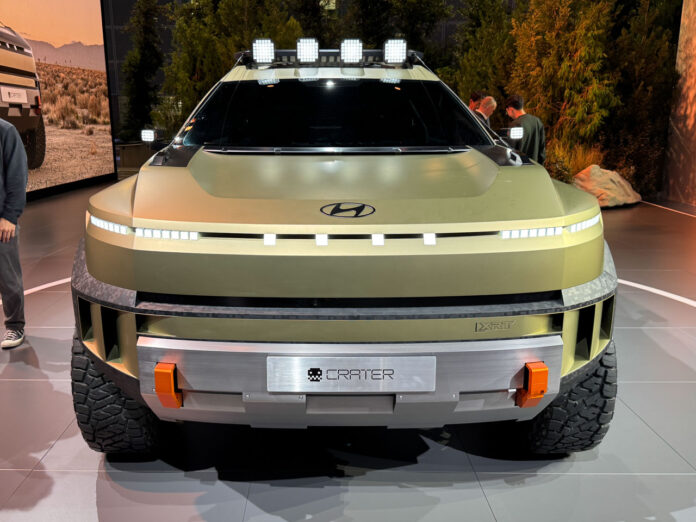
The Hyundai Crater Concept made its global debut last year as an off-road SUV design study created at Hyundai America Technical Center in Irvine, California. We had the opportunity to examine the vehicle in person, and this walkaround gave us a clear sense of where Hyundai wants to go next.
Design


At the front, the concept uses three-dimensional parametric pixel graphics for lighting and indirect illumination, with auxiliary modules on the roof. The Crater Concept includes limb risers connecting the hood to the roof to help manage trail obstacles.
A roof platform supports storage accessories and additional off-road equipment. We also noticed four clusters of pixels on both fascias that represent Morse code for the letter H, a detail also present on the latest Nexo.
Moving to the sides, the concept uses wide body sections with muscular fenders that create the appearance of strong shoulders. The 18-inch hexagonal faceted wheels are paired with 33-inch off-road tires for off-road capability.

The exterior is finished in Dune Gold Matte. In person, the orange-finished recovery hooks stood out, even though they appeared to be decorative elements for the show vehicle. The side-mirror camera pods can be removed and used as flashlights or portable cameras.
The side cladding incorporates a pattern associated with Hyundai’s XRT visual identity. The rear uses opposing-opening doors, and while this is a typical concept-car trick, many rear-end elements look close to production.
Interior
The concept is configured as a four-seater. The interior uses a Black Ember palette with leather surfaces, suede, and brushed metal trim.


Seeing the cabin up close, we found more production-feasible elements than expected. The seat design reminded us of the Concept Three, but the Crater’s execution is sportier and more upright.
A four-point restraint system is included as part of the concept presentation, and the orange clips are made of anodized aluminum. The crash pad uses a bent-metal form with perforations that allow ambient lighting to emit through the surface. The structural roll cage is made of steel and incorporates grab handles.
A metal tube runs across the dashboard and holds the main vehicle controls in the center. Above this tube are four compact displays showing cool decals.
Red ambient lighting spreads across the dashboard surface, creating a tense visual effect. The steering wheel uses a motorsport-style layout with a 12-o’clock marker and button clusters instead of a traditional horn pad.
Specifications


The Crater Concept is presented as a design study and does not include detailed propulsion or chassis specifications. Hyundai confirms the use of a monocoque frame and off-road-focused geometry.
Off-road systems referenced include front and rear locking differentials, traction and braking management through a gear-type controller and terrain selections for snow, sand, and mud. Additional references include an altimeter, compass, trailer brake control, and downhill brake control.
TopElectricSUV says
Hyundai is always serious about transitioning design studies into real cars, and the Crater Concept incorporates several elements that should support future XRT models, including the next-gen Tucson.
But the bigger news is that Hyundai could use the concept’s great reception as momentum to build a Crater-inspired production SUV that competes with the Ford Bronco and Jeep Wrangler.


Randy Parker, President and CEO of Hyundai Motor North America, has revealed that the Crater was built to get feedback from retail partners and U.S. car buyers, as reported by Automotive News.
Now, we are preparing to launch a new body and frame model before 2030 to build out our truck portfolio with the potential for an SUV variant. This expansion allows us to broaden our reach and connect directly with customers at the heart of the U.S. market.
José Muñoz, the CEO of Hyundai, at the company’s 2025 CEO Investor Day on September 18, 2025
While he wouldn’t confirm production plans, it’s possible that Hyundai could use its upcoming midsize truck’s platform to generate a rugged off-road SUV with the Crater’s looks. The company’s global CEO hinted at this in September 2025.
The Crater Concept is also relevant to the Canadian market as it hints at the tougher, adventure-focused direction of Hyundai’s XRT off-road lineup. A model like the Crater, tuned for Canadian drivers who want rugged SUV capability for winter conditions and outdoor use, definitely makes sense.

An automobile engineer by training, I’ve analyzed the global car market since 2005, with a keen focus on EVs since 2008. My journey in online automotive publishing spans 17 years, during which I have reviewed cutting-edge automotive technologies and interviewed leading global CEOs and vehicle developers.

