

We’re heard some pretty bad rental car stories, but getting arrested because it has a license plate frame could be the worst one yet. Now, a lawsuit is attempting to get this Florida law invalidated because it’s unconstitutional, according to CBS 12.
NBC6 reports that police in Davie, FL arrested Demarquize Dawson last December because the license plate frame on his rental car partially covered the first letter of “Sunshine State” at the bottom of the plate. The S was still readable, mind, just slightly covered by the frame. Now, we may not like dealer license plate frames, but having one shouldn’t get you arrested and thrown in jail like Dawson was, especially on a car you don’t even own.
Florida was having a problem with wild personalized license plates, from tinted covers to complete vinyl wraps with unique designs that were not approved by the state. These were already illegal, but on October 1, 2025, new law took effect that was not only more strict, but also made altering or covering a license plate a second-degree misdemeanor, according to CBS 12.
Florida Statute 320.061 reads as follows:
A person may not alter the original appearance of a vehicle registration certificate, license plate, temporary license plate, mobile home sticker, or validation sticker issued for and assigned to a motor vehicle or mobile home, whether by mutilation, alteration, defacement, or change of color or in any other manner. A person may not apply or attach a substance, reflective matter, illuminated device, spray, coating, covering, or other material onto or around any license plate which interferes with the legibility, angular visibility, or detectability of any feature or detail on the license plate or interferes with the ability to record any feature or detail on the license plate.
‘Void-for-vagueness’
Ticket Toro has filed a lawsuit against the State of Florida arguing that this law is unconstitutional. While you might expect freedom of speech to be the justification, Ticket Toro is claiming that the Void-for-Vagueness doctrine applies. From Ticket Toro’s website:
The Due Process Clause of the Fourteenth Amendment requires that criminal statutes define prohibited conduct with sufficient clarity that ordinary people can understand what is forbidden. This is the “void-for-vagueness” doctrine.
A statute is unconstitutionally vague when it either (1) fails to give a person of ordinary intelligence fair notice that their conduct is criminal, or (2) encourages arbitrary and discriminatory enforcement by failing to establish minimal guidelines.
The law is so broad and so vague that a strict interpretation could mean that covering any part of a license plate, including slogans, is illegal. This is how Davie, Florida police interpreted it when they arrested Dawson. They later issued the following statement, from NBC6:
At the initial release of this updated law, the wording was vague, unclear and appeared to be open for misinterpretation. Since the release of a memo of clarification from the Florida Police Chiefs’ Association was provided to our department, our officers are educated on the application and use of this statute. Unfortunately, it appears this arrest was invalid and we extend our apologies to Mr. Dawson.
Clarification on how the law should be enforced is all well and good, but — since it remains on the books as originally written — this situation could well happen again. At a time when police should be making fewer traffic stops, and when racial profiling is common, this only gives law enforcement another tenuous excuse to stop and potentially arrest people.
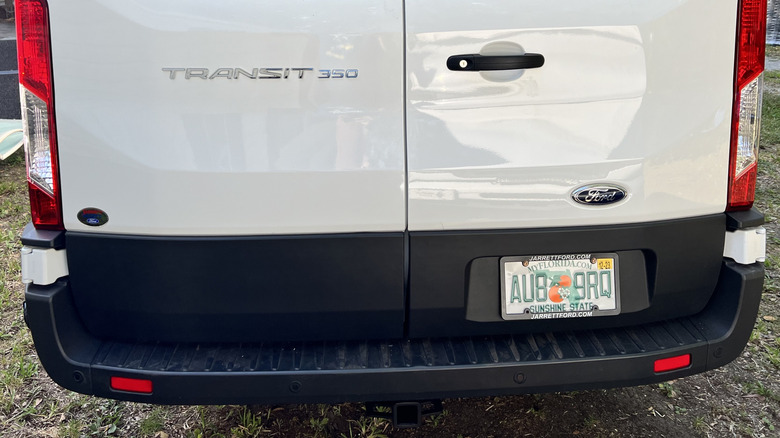
Incidentally, the Transit van in the photo is my camper van, as delivered from the dealer back when it was registered in Florida. The dealer-installed license plate frame barely covers the letter E of “Sunshine State”: under the current law, this could get me arrested, just like Dawson was. With even the Florida Police Chiefs’ Association apparently agreeing that what’s on the books isn’t working, the law needs to be changed, with such clarifications written into it. New Jersey did it, and Florida should, too.

