
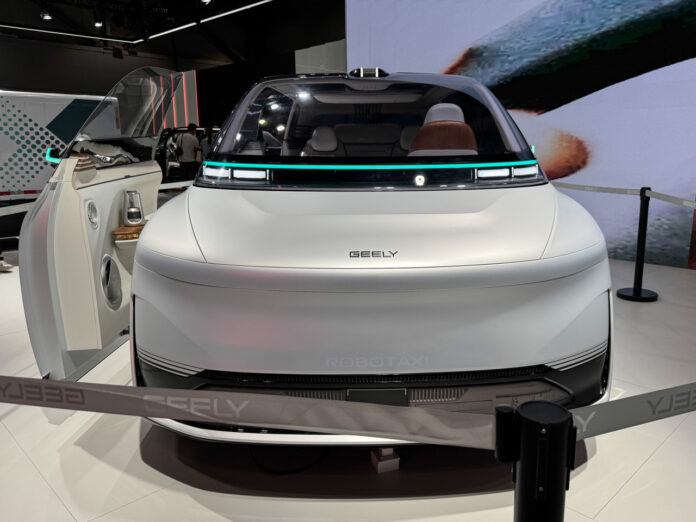
Geely is becoming more relevant to U.S. readers, even without selling cars under its own name here.
The Chinese conglomerate controls Volvo Cars, which recently received U.S. authorization to keep selling connected vehicles, while Polestar, another Geely-linked EV brand, has been pushed toward a U.S. exit from the 2027 model year.
Against that backdrop, the Geely Eva Cab offered us a look at the kind of autonomous vehicle technology the company is developing in China.
Robovan-like autonomous mobility
Showcased at the 2026 International Automotive and Supply Chain Expo (Hong Kong) after its debut at Auto China 2026, the Eva Cab is China’s purpose-built robotaxi developed specifically for autonomous ride-hailing operations.
Developed jointly by Geely, Qianli Haohan, and mobility platform CaoCao, the robotaxi is scheduled to enter mass production in 2027. There are no U.S. launch plans, and given the current regulatory climate around Chinese connected-vehicle technology, that seems highly unlikely. Still, we thought it was worth taking a closer look at what this lounge-like autonomous pod offers.


It is not a conventional minivan adapted for self-driving technology. The Eva Cab has been designed from the outset for Level 4 autonomous driving and commercial fleet use, making it a direct conceptual rival to future autonomous mobility vehicles such as the Tesla Robovan.
Design
The Eva Cab has been developed specifically for autonomous ride-hailing services. The exterior design prioritizes passenger access, with freestyle doors and a low step-in height, while also integrating the hardware needed for self-driving operation.
LiDAR sensors, cameras, and other perception systems are positioned around the vehicle to support Level 4 autonomous driving. The bodywork has been designed to accommodate these sensors while maintaining clear visibility around the vehicle.
Cabin


Inside, the Eva Cab differs significantly from a conventional vehicle and feels like something from Star Trek. There is no steering wheel, instrument cluster, or traditional driving controls. The space normally reserved for the driver has been repurposed for passengers and digital interaction systems.
The layout focuses on maximizing cabin space and improving accessibility for ride-hailing users. It has two forward-facing chairs and one rear-facing seat, along with a rear bench that could seat up to five adults in comfort. Sliding “islands” can be used to rest elbows or enjoy a snack.
Specifications
The Eva Cab uses Geely’s latest autonomous driving platform and a computing system capable of delivering up to 1,400 TOPS of processing power.
At the center of the system is a Step 3.5 large model containing 196 billion parameters. According to Geely, the system can handle 99% of daily driving scenarios.


The vehicle uses 43 sensing devices, including LiDAR units and high-definition cameras. Together, they create a 360-degree perception system capable of monitoring vehicles, pedestrians, and obstacles around the car.
Geely says the system can navigate complex situations such as unmarked roads, manual toll booths, and dense urban traffic. The company also reports a U-turn success rate of 95%.
The Eva Cab also adopts a new World Action Model, or WAM, which combines route planning, environmental understanding, and vehicle control within a single decision-making framework.
Another key feature is Geely’s AI digital chassis technology. The system can react within four milliseconds and is designed to maintain vehicle stability during emergency situations.
Launch plans

The production version of the Eva Cab is being developed for CaoCao Mobility, Geely’s ride-hailing platform. Mass production is scheduled to begin in 2027, with commercial deployment in China starting shortly afterward. CaoCao plans to deploy up to 100,000 Eva Cab robotaxis by 2030.
While global deployment plans have not been announced, the vehicle’s appearance in Hong Kong signals Geely’s intention to demonstrate the technology beyond mainland China.

An automobile engineer by training, I’ve analyzed the global car market since 2005, with a keen focus on EVs since 2008. My journey in online automotive publishing spans 17 years, during which I have reviewed cutting-edge automotive technologies and interviewed leading global CEOs and vehicle developers.

