
By Mitesh Zaveri & Shrawan Raja
The 2025 Mercedes GLC 350e is designed to provide everyday luxury with all the benefits of a powerful plug-in hybrid system. After several days of driving the North American-spec 2025 model, I found the 350e smooth, efficient, and refined, but some quirks in usability and ergonomics remain.
Design
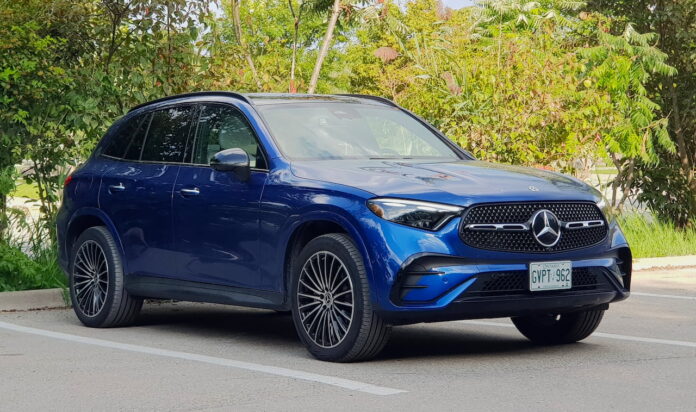
The GLC 350e shares its body with the standard GLC but carries cues that hint at its plug-in hybrid powertrain. The large grille features the Mercedes star pattern and a prominent central logo, behind which sits part of the 360-degree camera system.


Functional vents and an active shutter help direct airflow. LED headlights come standard, with Digital Light technology optional. They perform well and even play a small animation when you start the car.
The AMG Line package on my test car added sportier bumpers, chrome detailing, and multi-spoke 20-inch alloy wheels. Standard wheels are 19 inches. AMG-branded brake calipers and gloss-black side mirrors complete the sporty look.
The side mirrors integrate blind-spot indicators, turn signals, projection lights, and cameras for the surround-view system. The charging flap sits on the left rear fender opposite the fuel filler.
The rear features slim LED taillights, a chrome GLC 350e badge, and fake exhaust tips. Real outlets hide beneath the bumper. The tailgate opens hands-free but occasionally needs a second motion to activate.
Interior
The GLC’s cabin feels luxurious. Soft-touch materials cover the upper dash and doors. Wood trim and ambient lighting are like a welcoming smile, and the fit and finish are excellent throughout. The illuminated “Mercedes-Benz” sills and Burmester 3D surround system enhance the premium impression.

The dashboard houses a 12.3-inch digital cluster and an 11.9-inch infotainment display that runs the MBUX 3.0 software. The screen tilts slightly toward the driver with fluid graphics and real-time animations on the navigation map.
It supports wireless Android Auto and Apple CarPlay, and you can control nearly all functions using the touchscreen. The climate menu, seat settings, and lighting effects all reside within the interface. This layout looks clean but forces you to glance away from the road when needing adjustments.
A fingerprint reader allows personalized profiles, while a small haptic slider controls volume. The screen’s “zero layer” mode keeps navigation and shortcuts visible, which I found useful. Response speed is good, though the system can lag when switching between maps and hybrid menus.
Seating & Comfort
At 5’11”, I found ingress straightforward and visibility excellent. The seats in this AMG Line model use Mercedes’ Artico man-made leather. They’re firm but supportive, with strong side bolsters and long cushions for under-thigh support. Both front seats are electrically-adjustable with four-way lumbar support and extendable thigh rests. Heating is standard, but surprisingly, ventilation and massage are not offered.

Seat controls are placed on the door panels, shaped like the seat outline, and are touch-sensitive. They look futuristic but can prove tricky to operate while driving. The steering wheel is leather-wrapped with a flat bottom, and adjusts electrically for rake and reach. Steering-wheel buttons manage driver-assist, audio, and display settings but can also feel overly sensitive.
Rear Seating & Boot
The rear seats use the same Artico upholstery and are firm but supportive. With the front seat set to my height, I had about a hand’s width of knee room and four fingers of headroom. The seatbacks are slightly reclined for comfort. Two adults fit easily, though the middle passenger faces the challenge of a large tunnel and a firmer cushion.
Two USB-C ports, rear vents, and an armrest with fold-out cupholders are provided, making journeys convenient. Door materials match the front, and ambient lighting continues along the panels. Rear visibility is limited by the sloping windshield but remains manageable.
Boot capacity is 16.6 cubic feet (470 liters) with the seats up, and 54 cubic feet (1,530 liters) when folded. The raised floor from the battery pack cuts some depth. There’s no spare wheel, only a tire repair kit, but fold-down seat releases are located conveniently.
Displays
The digital cluster offers different layouts, including Classic, Sport, and Off-road. Information is clear but not highly customizable. A large head-up display projects navigation, speed, and driver-assist status directly in the line of sight. Brightness and height adjustment are available through steering-wheel controls.


The 360-degree camera delivers sharp images with multiple angles, including trailer and top-down views. The camera cover retracts automatically, and its motor generates a faint noise each time it opens or closes. The parking assistant can detect spaces and maneuver the SUV in or out automatically, though the process feels slow compared to some rivals.
Performance
Under the hood is a 2.0-liter turbocharged four-cylinder paired with a 134 hp electric motor and a 9G-Tronic automatic transmission. Total output is 313 hp and 406 lb-ft of torque, and drive is distributed to all wheels through the 4MATIC system.
The plug supports both AC and DC charging. It can charge at 11 kW AC, taking under 3 hours, or roughly 30 minutes on a 60 kW fast charger to go from 10% to 80%. With a 23.3 kWh pack, the GLC 350e can travel up to 87 km (54 miles) on electricity alone.
As expected, the powertrain feels refined and quiet in Hybrid mode. It starts in EV mode by default and calls on the engine seamlessly when needed. I’d describe acceleration as brisk rather than thrilling, but torque delivery is instant. The 9-speed transmission shifts smoothly, though kickdowns need a moment under hard throttle. When the battery is depleted, the engine alone feels adequate but less lively.

Mercedes includes multiple drive modes: Electric, Hybrid, Sport, Off-road, Battery Hold, and Individual. Hybrid mode prioritizes efficiency, while Sport mode sharpens throttle and steering feel. In this car, the paddle shifters behind the wheel adjust regenerative braking rather than changing gears. The system offers strong regen at the highest setting but not full one-pedal operation.
Ride & Handling
The front suspension uses conventional springs, while the rear axle relies on an air suspension to offset the battery weight. The ride feels compliant on city roads and stable at highway speeds. Sharp bumps don’t go unnoticed, but they never unsettle the car. While cornering, the body stays controlled, and steering weight increases in Sport mode. Feedback is minimal but accurate for confident driving.
At highway speeds, the GLC tracks straight needing little correction. The air suspension automatically levels the car depending on the load, and adjusts ride height for off-road mode.
Braking performance is strong, but I felt that pedal feel can be improved. The first inch or so of travel feels soft before the brakes bite. However, once engaged, the stopping power is excellent. You just need to get used to the delay in response.
Efficiency & Range
During my test, highway consumption averaged 6.7-7.0 liters per 100 km (34-35 mpg), while city driving returned 8.5-8.8 liters (27-28 mpg). With the battery included, real-world combined figures drop to around 3.3-3.5 liters per 100 km (67-71 mpg).
Electric-only range matches the claimed 87 km (54 miles) under ideal conditions. The system can also recharge the battery on the move by routing excess engine power or regeneration.
NVH
Mercedes engineers have worked hard on cabin insulation. Acoustic glass and thick seals reduce wind and tire noise to a minimum. The powertrain stays quiet in EV mode, though the engine can sound coarse under heavy throttle. At times, a subtle artificial tone plays through the speakers, adding a mild sporty character.
Safety
Safety equipment includes seven airbags, ISOFIX anchors, adaptive cruise control, blind-spot monitoring, lane-keeping assist, rear cross-traffic alert, and collision mitigation. The ambient lighting strips on the doors light up red to warn of approaching traffic or pedestrians when opening the doors.
The system suite also includes attention monitoring and a rear seat reminder. As expected from Mercedes, all functions work smoothly, though the touch-based controls for assists can feel complicated.
Pricing
In Canada, pricing for the 2026 GLC 350e starts at CAD 66,900, rising to well over CAD 80,000 with options like the AMG Line, Exclusive, and Pinnacle packages. In the U.S. market, prices start at USD 60,300 (MSRP).
TopElectricSUV says

After driving it for several days, I see the GLC 350e as a balanced luxury SUV. It offers more than enough electric range, strong refinement, and top-tier comfort. Its downsides are few: touch-based seat and steering controls that demand attention, a raised cargo floor, and a soft initial brake response. But these are minor next to the comfort, build quality, and hybrid efficiency it delivers.

An automobile engineer by training, I’ve analyzed the global car market since 2005, with a keen focus on EVs since 2008. My journey in online automotive publishing spans 17 years, during which I have reviewed cutting-edge automotive technologies and interviewed leading global CEOs and vehicle developers.

