
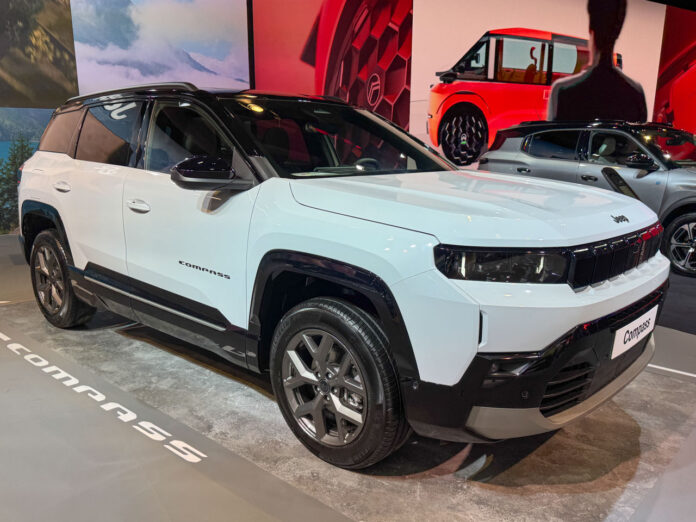
Competing with the Toyota RAV4, America’s top-selling SUV, the third-generation Jeep Compass will be one of the brand’s most significant launches in the U.S. in 2027. The new generation introduces major changes that extend beyond just looks and features.
The all-new Jeep Compass just went on sale in Europe, and we had a chance to check it out in an e-Hybrid mild-hybrid ‘Altitude’ variant recently. Here’s what buyers from the U.S. can expect from the incoming model.
Design

The all-new Compass e-Hybrid adopts a squarer exterior design than the previous model and aligns its proportions more closely with other Jeep offerings. Compared to the current model, it is longer and has a wider visual footprint.
At the front, the redesigned model features slim headlamps and Jeep’s seven-slot grille. The hood has a flatter surface and incorporates pronounced power domes. The lower fascia integrates an active grille that closes when not required for cooling.


On the sides, the all-new Compass e-Hybrid features trapezoidal wheel arches, a flatter roofline, and an elongated glasshouse. At the rear, the tail lamps are larger and feature an X-shaped light signature that extends toward the centrally positioned Jeep logo, which is backlit in red.
Interior
Inside, the new Compass e-Hybrid features a horizontally oriented dashboard with slim outer air vents and a freestanding ultra-wide central touchscreen.
The steering wheel has a squircle shape and features X-shaped trim around the control buttons. The center console houses a rotary gear selector and includes additional storage compartments compared to the previous model.


The digital instrument cluster sits deep within the binnacle to reduce reflections, and a head-up display also presents the key driving information. Other main features include front seats with massage function, a wireless smartphone charging pad, and Level 2 advanced driver assistance systems.
Experience in the all-new Jeep Compass e-Hybrid
The new Compass uses conventional door handles, and there’s no second-guessing how to get in. The door closes with a thud, and the cabin feels completely different from the current Compass.
Up front, the seats felt comfortable for my 6-foot frame. Headroom is good. Shoulder and back support are well-designed, and under-thigh support was good. Visibility is taken care of thanks to the large glass areas around the vehicle, though the hood sits a bit high.


The center console uses a dial drive selector and offers storage, plus two USB ports. Controls are mixed: volume knobs are physical, the fan and recirculation are physical, but temperature is adjusted on the screen, which isn’t how I prefer interfacing with a car’s HVAC.
In the rear, my size 12 shoes slide under the front seat and space is usable. With the front seat set to my driving position, knee room is just sufficient, and under-thigh support is alright, but it doesn’t have a reclinable backrest.
Three adults won’t be comfortable because the rear AC vents and USB-C panel protrude. A flat floor and a center armrest with cup holders will help improve long-distance comfort.
Specifications
The all-new Jeep Compass e-Hybrid is 4,552 mm (179.2 in.) long, 1,928 mm (75.9 in.) wide, and 1,652 mm (65.0 in.) tall and has a 2,795 mm (110.0 in.) wheelbase. It offers 200 mm (7.9 in.) of ground clearance and a water wading depth of 408 mm (16.1 in.).
In Germany, Jeep uses a 107 kW (145 hp) mild-hybrid system in the Compass e-Hybrid. There’s a 1.2-liter turbocharged gas engine producing 100 kW (136 hp) and 230 Nm (170 lb.-ft.) of torque, and an electric motor that develops 21 kW (28 hp) and 50 Nm (37 lb.-ft.) of torque.


The electric motor depends on a 48-volt battery with an energy storage capacity of 0.9 kWh, and its purpose is to improve acceleration and make engine starts and stops smoother. A 6-speed dual-clutch automatic transmission channels drive to the front wheels.
The new Compass e-Hybrid accelerates from 0 to 100 km/h (0 to 62 mph) in 10 seconds and achieves a top speed of 195 km/h (121 mph). According to WLTP, it consumes 5.9 liters (1.6 gallons) per 100 kilometers (62 miles), which roughly converts to a fuel economy of 39.9 U.S. mpg.
Price & Release Date

Also Read: First Look Review: Jeep Avenger, the subcompact Jeep America doesn’t get
Stellantis intends to invest more than USD 600 million to reopen the Belvidere Assembly Plant to expand production of the Jeep Cherokee and Jeep Compass for the U.S. market. With an initial production launch expected in 2027, these actions are anticipated to create around 3,300 new jobs.
Excerpt from Stellantis’ announcement on October 14, 2025
The all-new Jeep Compass is coming to the U.S. in 2027, but we aren’t sure if the e-Hybrid variant is under serious consideration. The non-electrified, gas-powered variant should be priced at around USD 30,000, positioned below the new Jeep Cherokee.

An automobile engineer by training, I’ve analyzed the global car market since 2005, with a keen focus on EVs since 2008. My journey in online automotive publishing spans 17 years, during which I have reviewed cutting-edge automotive technologies and interviewed leading global CEOs and vehicle developers.

