
Update: The story has been revised completely with new info.
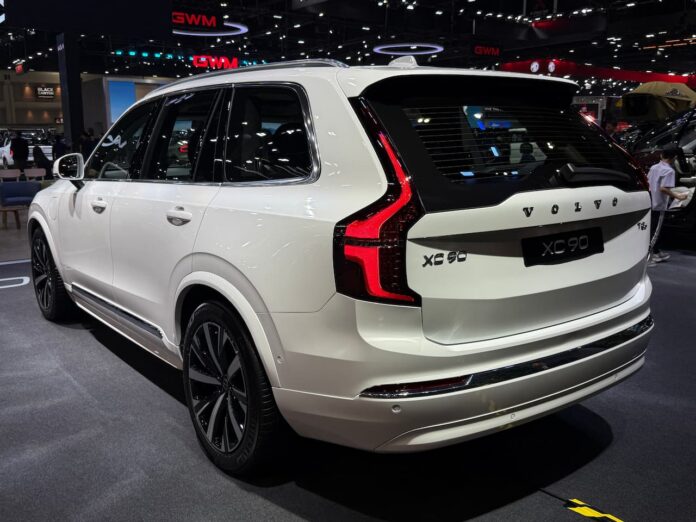
Closing out the Volvo Cars Q2 2025 earnings call on July 17, 2025, CEO Håkan Samuelsson addressed reports about the company adding XC90 production to its U.S. facility in South Carolina in October 2028.
While he didn’t confirm any plans, he said, “No. I think I saw that speculation. Also, of course, one day we will need a new XC90 as it was launched sometime in…2015, okay. But I think, now there will be probably more speculation, more than before we can say anything more concrete!”
U.S. EREV production confirmed
At a media roundtable on September 23, 2025, at Volvo Cars’ U.S. headquarters in Ridgeville, South Carolina, Samuelsson provided more clarity, confirming that Volvo will manufacture a new EREV locally, developed specifically for U.S. demand.
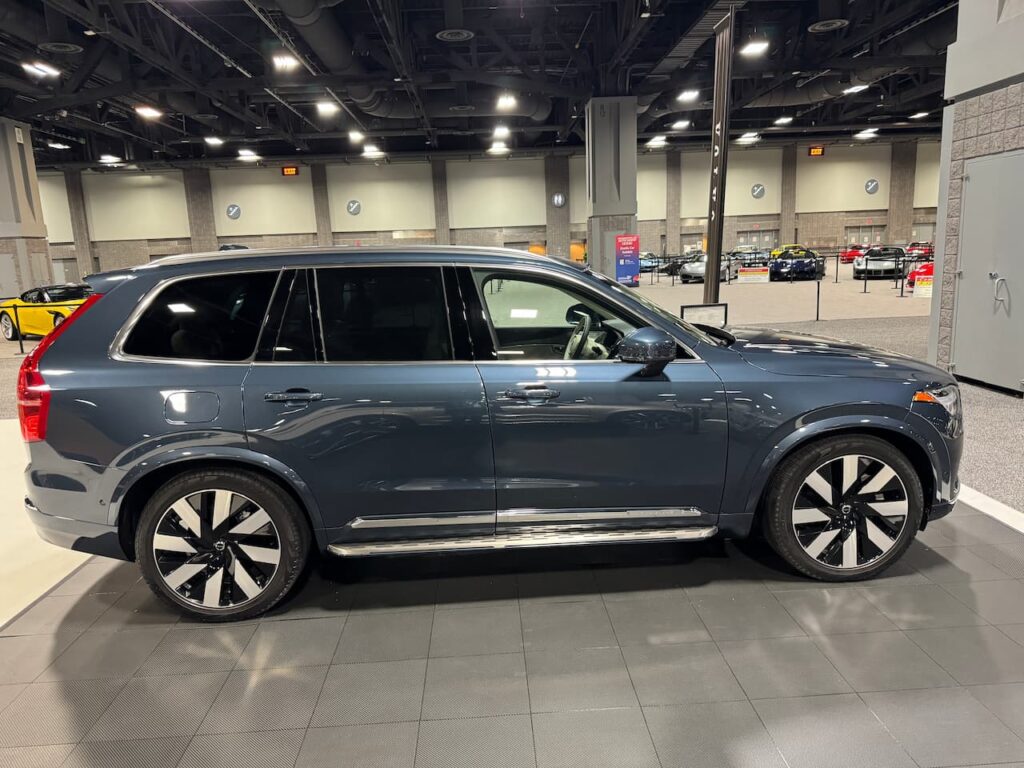
“We call it the second generation of hybrids,” he told reporters, as reported by InsideEVs. The EREV will operate mainly as an electric car but include a backup engine to extend range. While the model was not named, Erik Severinson, Chief Commercial Officer, said during the meeting that the XC90’s size and segment represent where the company expects demand for extended-range technology.
Susanne Hägglund, Head of Global Offer at Volvo Cars, had highlighted the SUV’s importance at the Capital Markets Day 2024. “The XC90, which we revealed a new version of yesterday, has sold to almost a million customers,” she said. “We are continuously upgrading our models to make sure that we have appealing choices for all customers.”
SPA 1.5
Swedish publication Carup has learned from its sources that Volvo has resumed the development of the SPA 1 platform from the current SUV. The evolution, called the SPA 1.5, is expected to underpin the next-gen Volvo XC90.

This was along expected lines as company officials have spoken about releasing long-range versions of the XC90 and XC60 in future updates. The plan to continue investments in plug-in hybrids, revealed at the company’s Capital Markets Day 2024, reflects Volvo’s revised strategy to balance electrification plans with market reality and customer demand.
When it comes to PHEVs, what we have communicated today is that we are taking a pragmatic approach in how to create a balanced portfolio. We have said that we will continue to invest in our very successful PHEVs that we have today, and also continue to upgrade with long-range versions of those.
Erik Severinson, Chief Product & Strategy Officer at Volvo Cars, speaking about future model plans, on September 5, 2024
While Severinson did not specify timelines last year, he cited the example of the XC90’s SPA 1 platform, which could support future updates. “With relatively small efforts, we think we can keep those cars very competitive for a long time to come,” he added.
600+ miles of driving range
While it is early to talk about specifications, the XC70, Volvo’s first extended-range plug-in hybrid (EREV) which was launched in China recently, is a good reference point. It offers two powertrain options, each paired with 400V batteries and motors.
In the top-spec model, the 1.5L turbocharged gas engine and three-motor layout (front double and rear single) allows fully electric driving with the grip and stability of all-wheel drive. The 39.6 kWh battery enables a pure-electric range of 212 km (132 miles, CLTC), and the system produces up to 462 hp for 0-100 km/h (0-62 mph) acceleration in 5.3 seconds.


Fast charging from 0 to 80 percent is possible in 23 minutes, and bi-directional charging lets the battery power electrical tools and appliances. With a combined driving range of over 1,200 km (746 miles) in the regional test cycle, which should translate to over 600 miles of range in EPA testing, the XC70 demonstrates the type of capability that we expect when Volvo introduces its EREV for the U.S. market.
Differentiated strategy
Volvo is addressing the uneven global adoption of electric vehicles. Not all countries are moving quickly towards electric cars, so the company has to invest in plug-in hybrids to ease this transition. Volvo still aims to be an all-electric brand by 2030, but the new PHEVs will serve buyers in regions with limited charging infrastructure or heavy reliance on traditional fuels.
These long-range PHEVs will help the transition for Volvo Cars globally, but perhaps, they are most important in China where the premium electric car transition is taking longer.
Erik Severinson, Chief Product & Strategy Officer at Volvo Cars, during the Capital Markets Day 2024 on September 5, 2024
That said, customers looking to go fully-electric will have the option of both the EX90 and EX60 starting in 2026. These cars use the SPA 2 and SPA 3, respectively.

An automobile engineer by training, I’ve analyzed the global car market since 2005, with a keen focus on EVs since 2008. My journey in online automotive publishing spans 17 years, during which I have reviewed cutting-edge automotive technologies and interviewed leading global CEOs and vehicle developers.

