
When we use the term “future classics” there is the implication that trends in the collector car market evolve and are subject to change. The inevitable question is what will be the Top “Future Classics” for 2026? Ever since the collector car market became commoditized as an equity investment, car collectors have been trying to predict what the next hot trend would be in hobby cars. Thus the term “future classics.” It loosely implies predicting a trend where you can buy a car before it gets super hot. Buy low, sell high is the name of the game.
The collector car market is shifting as Millennials (Gen‑Y, roughly born between 1981–1996) gain more buying power and emotional attachment to the cars they grew up admiring. Many predict that by the end of 2026, the “future classic” landscape will heavily feature late‑’90s to early‑2010 models with analog feel, nostalgic styling, and limited production runs.
It may be that the collector car world will hum a new tune — one driven not by carburetors or chrome, but by childhood memories. The drivers now bidding in Monterey, Scottsdale, and online aren’t retirees chasing the Mustangs of their youth. They are Millennials, Gen‑Y kids, who grew up on PlayStations, dial‑up, and the sound of VTEC wailing through early YouTube videos. Hagerty Insurance tells us that Gen-X and Gen-Y collectors have tipped the scale and now out-number Boomers in the collector car community (according to their records of collector cars presently insured.) That makes us reflect on how the collector car market may change in the very near future, sometimes referred to as the “Analog Renaissance.”
The following lists are based on the current trends shifting away from ’50s and ’50s cars and muscle cars to “tuner” power and manually shifted analog cars. Here are 10 strong candidates for “future collectible” status among Gen‑Y enthusiasts by 2026, with notes on why they’re appealing:
- Toyota Supra (A80, 1993–2002)
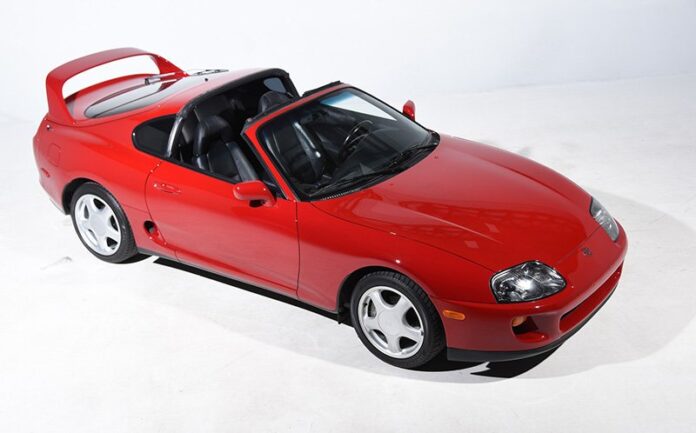
A cultural and media icon of the 1990’s the Toyota Supra was featured in movies, ie. Fast & Furious. Turbocharged with manual transmissions, these A80 generation Supras have peaked in value a few years ago but have come down some since. Low‑mileage, stock Supras were fetching $175K–$250K+ at auction, rivaling classic Porsches and Ferraris in value. But you can still find some today at a deep discount. Interest continues due to limited supply and strong cultural allure. What makes the A80 unique is that it appeals not only to collectors but also to the emotionally connected generation that grew up idolizing it — from posters to PlayStation to film. It stands as the most recognized JDM offering in the collector car spectrum. (See the prime example, a 1994 Toyota Supra Turbo in the photo above, having been listed for sale by Motorcar Classics in New York.)
- Nissan GT‑R (R35, 2009–2024)
The Nissan GT-R in its R35 generation introduced the JDM supercar to the world. It was the “Godzilla” of affordable supercars introducing performance to the digital age. Gen‑Y grew up with it dominating gaming culture (Gran Turismo, Forza) and YouTube car media. When the R35 debuted, it was a revelation … 3.8‑liter, hand‑built twin‑turbo V6 making 480 hp initially (and up to 600 hp in later trims), paired with a dual‑clutch transmission — technology usually reserved for exotic European supercars at the time. With all-wheel-drive, it had incredible stability, and no‑nonsense grip. It made ordinary drivers look like pros on track. When it first hit the Nürburgring in 2008, the R35 clocked a then‑astonishing 7:29 lap time, embarrassing cars costing two or three times as much. This was a shift in the way we viewed supercar performance.
- Subaru WRX STI (GD & GR, 2002–2014)
The WRX (World Rally eXperimental) was developed by Subaru’s motorsport arm and Prodrive, in collaboration with STI – Subaru Tecnica International. The all-wheel-drive rally car achieved World Rally Championship dominance with the STI turbocharged, manual transmission only and designed as a Subaru rally car. Piloted by legendary drivers like Colin McRae and Petter Solberg, the Impreza WRX STI won three consecutive WRC Manufacturers’ Championships (1995–1997) and the 2003 Drivers’ Championship. It stands as the blue‑collar hero of the modern sports‑car world. Nothing was more popular during the younger years of the Gen-Y generation. It was the tuner car to own.
- Mazda RX‑7 (FD, 1992–2002)
The Mazda RX-7 from 1992 to 2002 was transcendent in automotive history. It is one of the few Japanese cars praised in design museums worldwide for its beauty and iconic influence. It was the essence of simple design and performance in perfect balance. It had a twin-turbocharged, 1.3‑liter two‑rotor engine producing 255–280 hp. Although small in displacement, it delivered power in a linear, exotic way, revving far higher than equivalently priced cars. It was often compared to a Ferrari in the way it handled. The RX‑7 FD was the first mass‑produced car to use a sequential twin‑turbo system, minimizing lag by using one turbo for low rpm and a second for high rpm. Gen-Y collectors remember them from the Gran Turismo and Need For Speed video games. It was also featured in the Fast & Furious movie.
- Honda S2000 (1999–2009)
Some cars are more about the smile they leave on your face rather than the 0 to 60 times they can achieve. Honda built the S2000 to celebrate its 50th anniversary year. It was Honda’s mechanical love letter to its fans. The engine, a naturally aspirated 2.0 liter F20C, was exciting with its 240 horsepower revving to 9,000 rpm. Wow! The mid-engine designed chassis brought the 6-speed manual transmission to a precise 50/50 balance. It was widely praised for having one of the best shifting gearboxes ever. It made for perfect steering and road feedback. In other words, this car was all about the driver and the feel of the road. The engineers who worked on the S2000 were prepared to bring Honda’s extensive racing heritage to the build. This was treated as a baby Formula 1 car.
- BMW M3 (E46, 2000–2006)
Why: A near‑perfect analog M car. Naturally aspirated straight‑six, manual and coupe form are revered by young enthusiasts craving purity.
- Ford Mustang Shelby GT350 (2016–2020)
Why: Flat‑plane V8, manual transmission, loud and visceral. The last of an era for analog American muscle.
- Porsche Cayman GT4 (981, 2016–2019)
Why: Considered by many as the purest modern Porsche driving experience. Naturally aspirated flat‑six, manual, mid‑engine balance.
- Audi R8 (First‑gen, 2008–2015 V8/V10)
Why: The attainable “everyday supercar.” Manual‑transmission V10 examples already climbing fast — especially since future generations are electric.
10. Mitsubishi Lancer Evo, (2005-2015) IX and X generation
Street racer charisma; cult hero among rally fans; examples fading fast from today’s landscape, becoming very rare = rising desirability.
🧠 Bonus Wildcards: also very popular among Gen-Y collectors
- Acura NSX (Second‑gen hybrid, 2017–2022) – tech‑savvy hybrid rarity
- Dodge Viper (Gen V, 2013–2017) – brutal, last‑of‑its‑kind V10 manual
- Tesla Roadster (2008-2012) – Tech collectible; historical significance outweighs driving experience
- Chevrolet Corvette Z06 (2006-2013) ranks right up there in performance with the top cars in the world
- Mazda Miata MX-5 (1995-2005) surprising performance and balanced handling at an affordable price
What is even more interesting is the valuations on these “future collectibles.” Here is a chart of how the values break down according to CHAT-GPT collected data.
| Rank | 2024 Avg Value | 2026 Projected Increase | |
| Porsche Cayman GT4 2016-2019 | $120K‑$145K | 25 to 30 % | |
| Honda S2000, 1999-2003 | $55K‑$70K | 30 to 40% | |
| Toyota Supra, 1993-2002 | $150K‑$225K | 20 to 25% | |
| BMW M3, 2000-2006 | $60K‑$85K | 35 to 40% | |
| Shelby Mustang GT350, 2018-2020 | $80K-$95K | 25 to 30% | |
| Audi R8 V10, 2008-2012 | $180K-$220K | 20 to 25% | |
| Nissan GT-R, 2009-2014 | $85K‑$110K | 15 to 20% | |
| Mazda RX-7, 1993-2002 | $75K‑$120K | 20 to 25% | |
| Acura NSX, 2017-2022 | $140K‑$170K | 15 to 20% | |
| Subaru WRX STI, 2002-2014 | $25K-$35K | 30 to 45% | |
| Mitsubishi Lancer EVO, 2005-2015 | $35K-$50K | 45 to 50% |
At a cool Saturday cars‑and‑coffee event in Austin, a clean Honda S2000 sits surrounded by 30‑something engineers. One of them bought his for $42,000 in 2023. Now, barely three years later, collectors whisper values north of $65,000. “It’s the last car you feel through your hands,” he says, proud that his analog roadster is suddenly worth more than his daily EV.
Across the parking lot, a silver Porsche Cayman GT4 (981) draws quiet reverence. Its owner isn’t a collector—he’s a driver. “Everything that’s coming after this is digital,” he says, describing how the car’s mechanical honesty makes it feel timeless. Auction houses agree: by 2026, GT4s are fetching $130K‑plus, up 30% in two years.
Meanwhile, the cars that once lined gaming screens—Toyota Supras, RX‑7s, Nissan GT‑Rs—are transformed into blue‑chip collectibles. At the Barrett‑Jackson stage, a pristine Supra Twin‑Turbo 6‑speed crosses $200K, applause echoing from an audience that grew up watching Brian O’Conner row its gears on screen.
But it’s not just JDM legends. BMW’s E46 M3 and Ford’s Shelby GT350 are pulling the analog torch into Europe and America alike. The M3, once just a used performance coupe, now commands respect as the end of the naturally aspirated M lineage. The GT350? The last Ford Mustang that made drivers earn its speed—its flat‑plane V8 howl now a relic of mechanical artistry.
Even the first‑generation Tesla Roadster—once dismissed as Silicon Valley’s science project—sits quietly at the back of the room, its value climbing as collectors begin to realize its historical weight. It’s not beautiful, not visceral, but undeniably important: the car that started the electric era.
If you were to chart the price escalations of the Top Four cars on our list above as you might your stock market prices they would all look like winners. Review here a chart made for us by CHAT-GPT.

So as their garages fill with Supras, S2000s, GT4s, and GT‑Rs, a quiet understanding is developing in the collector car market. The Gen-Y generation is not just collecting cars, they are archiving dreams of their younger days … not too different from the way we Boomers feel about our Chevelles and Cudas, eh?

