
Update: ‘Interior’ section revised with observations from the official teaser.
As Yoichi Miyazaki, Executive Vice President, Toyota Motor Corporation (TMC), announced on April 7, 2023, the first series-production EV the company plans to manufacture in the United States will be a three-row SUV.
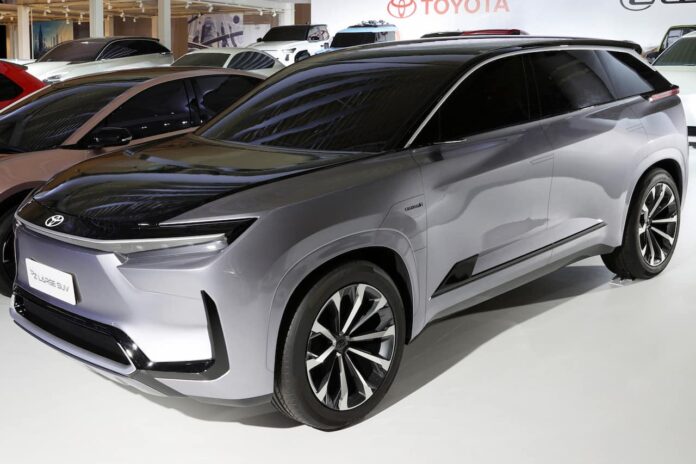
Widely expected to draw design cues from the bZ Large SUV concept from 2021, the new Toyota electric SUV was also confirmed to enter production in 2025. However, Automotive News had reported that the launch is rescheduled to late 2026, with production shifting from Indiana to Kentucky.
Here’s everything we expect from the future electric SUV.
Design

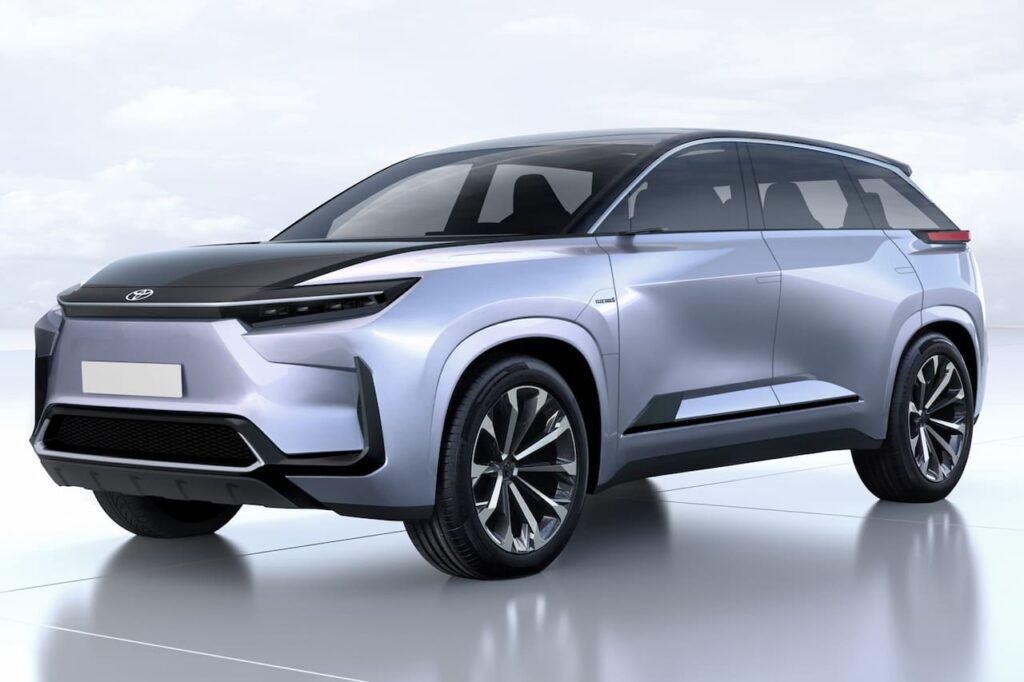
The Highlander EV should feature a hammerhead shark-like front, similar to the bZ when seen head-on. On the sides, it may not feature black wheel arch moldings, which would give it a cleaner look.
An airy greenhouse, flush door handles, sleek glass panels, simplistic door panels, large wheels, tapered rear, and slim taillamps could be among other visual highlights of the profile. Sitting lower than a comparable gas-powered model, the electric three-row SUV should look more dynamic.


Interior
Seating and space
The vehicle shown in the video appears to use a six-seat layout, with two individual seats in the third row. Large second- and third-row side windows are visible, with a tall glass area that is in the style of the Sienna minivan. The seat cushions look generous with plenty of shoulder support, and headrests with side wings.

Rear passenger comfort
Second-row passengers get dedicated rear climate controls. Second-row heated seats are shown, while second-row ventilation doesn’t appear in the teaser. Air vents are positioned along the roof for uniform airflow to the second and third rows.
Displays and controls
The car’s center touchscreen appears similar in layout to the 2026 RAV4’s, and could be a 12-inch unit, paired with what looks like a 12.3-inch instrument panel. The two-tone steering wheel uses physical buttons, and the center console includes a physical volume knob. We expect an optional head-up display, while a digital rear-view mirror is hinted by the teaser.
Lighting, charging, and audio
Ambient lighting is visible in the second row, below the touchscreen, and along the front doors. Two wireless charging pads are shown up front. A rear USB-C port is placed under the third-row window, and is illuminated. Like in other Toyota, we also expect a 11-speaker JBL-branded sound system.
Roof and safety
A large panoramic glass roof is shown, and the version in the video does not appear to include a sunshade. As far as safety is concerned, if not TSS 4.0 which debuts in the 2026 RAV4, I expect TSS 3.0 as standard.
The safety suite currently includes Full-Speed Range Dynamic Radar Cruise Control, Pre-Collision System with Pedestrian Detection, Lane Tracing Assist, Lane Departure Alert with Steering Assist, Road Sign Assist, Proactive Driving Assist and Automatic High Beams.

Specifications
Our expectation is that the Highlander EV will come in both FWD and AWD versions, riding on the e-TNGA platform shared with the bZ, C-HR Electric, Solterra, and the RZ.
Considering the size of the vehicle and the general limitations of battery tech, I doubt it’ll do better than 300 miles (EPA-est. combined) in the long-range model.
The base variant could employ a 75-80 kWh battery, with a ~220 hp motor, aimed at drivers who operate in the city. The top-end Highlander EV could employ a 95 kWh battery, and dual-motor setup with 350 hp, targeting families or those who regularly haul a full load of passengers.
Production
TMC’s first U.S.-assembled EV should be localized in Kentucky. It is expected to use batteries assembled at its dedicated plant in Liberty, North Carolina, where production for hybrid models began in late June 2025, as per Triad Business Journal.
Price & Release Date

The Toyota bZ Highlander, designed and engineered primarily for U.S. families, will debut on February 10, before going on sale later in the year.
Placed above the Toyota bZ Woodland within the North American lineup, I’m expecting it to be priced between USD 50,000 and USD 60,000. Besides the Kia EV9, it will also rival the Hyundai Ioniq 9, which reached the U.S. market last year as another three-row SUV without a tailpipe.
TopElectricSUV says
The Highlander has seen a significant year-over-year sales decline in 2025 (-37.3%) to 56,208 units. With Toyota further promoting newer crossover models like the Grand Highlander and the Crown Signia, the Highlander faces increased pressure and a higher risk of cannibalization.

Also See: First Look Review: 2026 Toyota Crown Nightshade Edition rocks a bolder styling
I feel that the best way to keep this nameplate relevant is to reinvent it as a three-row electric SUV. While numbers may be down, the Highlander enjoys an excellent reputation in the U.S., making it a strategic move to leverage its brand equity, while maintaining a long-term view.
Featured image: Toyota Motor Corporation/Noriaki Mitsuhashi/N-RAK PHOTO AGENCY

An automobile engineer by training, I’ve analyzed the global car market since 2005, with a keen focus on EVs since 2008. My journey in online automotive publishing spans 17 years, during which I have reviewed cutting-edge automotive technologies and interviewed leading global CEOs and vehicle developers.

