
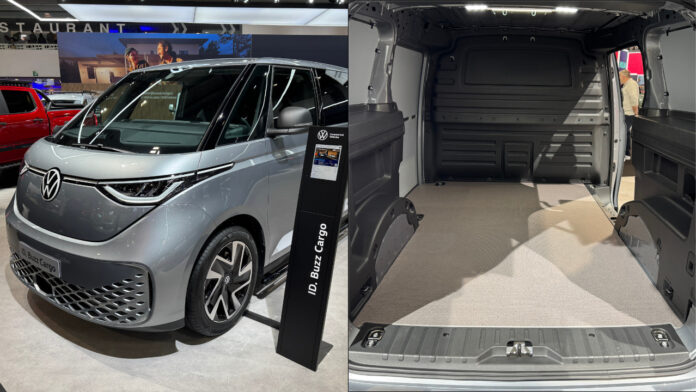
On sale in Europe since 2022, the VW ID. Buzz Cargo hasn’t made it to the U.S. The passenger sibling is proving to be a tough sell in this market, and local regulations, including the Chicken Tax, make importing the Cargo variant as a CBU impractical. As a result, the chances of the ID. Buzz Cargo reaching the U.S. remain very low.
Internationally, though, the ID. Buzz Cargo is seeing strong traction and Volkswagen Commercial Vehicles (VWCV) wants to make it more appealing. We got to spend some time with the vehicle, and here’s what we learned from our experience.
Major contribution to the sales mix
The ID. Buzz Cargo is witnessing an encouraging uptake. In 2025, Volkswagen Commercial Vehicles delivered 60,700 units of the ID. Buzz and ID. Buzz Cargo combined worldwide. According to the company, around 46 percent of that total, or approximately 28,000 units, came from the Cargo variant.


After selling around 30,000 units in 2024, combined ID. Buzz and ID. Buzz Cargo sales increased by 102 percent year over year in 2025. VWCV plans to expand the ID. Buzz Cargo range with a long wheelbase version later this year to fuel growth.
Design
The ID. Buzz Cargo features the same design as the ID. Buzz. It has a drag coefficient of 0.29, which is marginally higher than the passenger model (0.285) and comes with minor visual differences.
The front end is no different from the passenger model. On the sides, the ID. Buzz Cargo gets typical commercial van traits like disabled rear windows and a single sliding door on the passenger side. VWN will allow configuring it with a second sliding door optionally, though.


The ID. Buzz Cargo’s taillights are also different from the ID. Buzz as they are narrower and don’t include the inner-side extended portion of the passenger model’s cluster. In the same vein, it has deleted the thin light strip.
Interior
The ID. Buzz Cargo has a differently designed dashboard with a unique upper part that doesn’t house a full-width AC vent. There are five USB-C ports instead of eight.
Several differences make the ID. Buzz Cargo more practical than the MPV for its application. For example, two additional cup holders are located in front of the A-pillars.


As standard, the commercial van accommodates three passengers in the first row instead of two, sitting on a double bench seat. However, a more comfortable, two-seat layout with an individual passenger seat is optional.
A fixed partition separates the cargo space, which has wood flooring, and as an option, customers can specify it with a window and an opening for loading items from the inside. There are lashing rings on the floor and lashing rails on the side walls to secure cargo.
Specifications
| VW ID. Buzz Cargo Aspect | Value |
| Length | 4,712 mm (185.5 in) |
| Width | 1,985 mm (78.1 in.) |
| Height | 1,932 mm (76.1 in.) |
| Wheelbase | 2,989 mm (117.7 in.) |
| Cargo Space | 3.9 m3 (137.7 cu ft) |
| Maximum Payload Capacity | 516-647 kg (1,138-1,426 lbs) |
| Towing Capacity (unbraked) | 750 kg (1,653 lbs) |
| Towing Capacity (braked, at 12% gradient) | 1,800 kg (3,968 lbs) |
| Turning Circle | 11.1 m (36.4 ft.) |
In Germany, VWCV offers the ID. Buzz Cargo in Pure, Pro, and 4MOTION trims.
Pure
The Pure trim uses a rear-mounted electric motor producing 125 kW (168 hp) and 310 Nm (229 lb.-ft.) of torque. It accelerates from 0 to 62 mph in 10.3 seconds and reaches a top speed of 145 km/h (90 mph). Power comes from a 59 kWh NCM battery pack, delivering a WLTP range of 331 km (206 miles).
Pro
The Pro trim upgrades to a higher-output rear-mounted motor with 210 kW (282 hp) and 560 Nm (413 lb.-ft.) of torque. Acceleration from 0 to 62 mph drops to 7.0 seconds, while top speed increases to 160 km/h (99 mph). It is paired with a larger 79 kWh NCM battery pack, providing a WLTP range of 455 km (283 miles).
4MOTION (AWD)
The 4MOTION trim adds a front motor for all-wheel drive, resulting in a combined system output of 250 kW (335 hp). It completes the 0-62 mph sprint in 5.8 seconds and shares the same 160 km/h (99 mph) top speed as the Pro trim. The 79 kWh NCM battery pack is retained, though the dual-motor setup reduces WLTP range to 430 km (267 miles).


The 59 kWh unit supports charging at up to 165 kW and takes 24 minutes for a 10-80% charging session. The 79 kWh unit has a higher peak charging input of 185 kW and charges up from 10% to 80% SoC in 26 minutes.
Production & Pricing
Also See: Sporty VW ID.4 GTX needs to be considered for the U.S. market
Production of the ID. Buzz Cargo takes place in Hannover, Germany, since the rollout started in the first week of April 2022.
The VW ID. Buzz Cargo’s prices in Germany start at EUR 50,836.80 (approx. USD 59,500) in the Pure trim, EUR 57,387.75 (approx. USD 67,000) in the Pro trim, and EUR 59,934.35 (approx. USD 70,000) in the 4MOTION trim.

An automobile engineer by training, I’ve analyzed the global car market since 2005, with a keen focus on EVs since 2008. My journey in online automotive publishing spans 17 years, during which I have reviewed cutting-edge automotive technologies and interviewed leading global CEOs and vehicle developers.

