
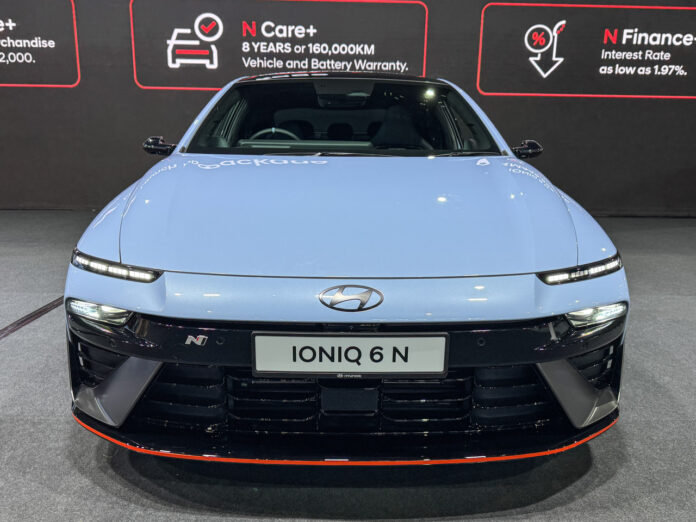
Hyundai revealed the Ioniq 6 N at the Goodwood Festival of Speed in July 2025 before presenting the high-performance EV’s North American debut at the Los Angeles Auto Show in November 2025.
Ahead of its U.S. launch this year, we got to check out a global-spec Hyundai Ioniq 6 N, and this is our experience.
Design


The exterior features widened fenders, a motorsport-inspired swan-neck rear wing and model-specific aerodynamic enhancements designed to increase downforce while maintaining a drag coefficient of 0.27.
Standard equipment for the U.S. includes 20-inch forged wheels wrapped in 275/35R20 Pirelli P Zero 5 tires developed specifically for the Hyundai Ioniq 6 N.
Available exterior colors include Performance Blue Pearl, Onyx Black Pearl, Serenity White Pearl and Nocturne Gray Matte.
Interior


The cabin features a black interior theme with Performance Blue accents. Bucket seats combine Alcantara suede inserts with H-Tex leatherette bolsters, while Hyundai has also fitted an N-specific steering wheel with dedicated N1 and N2 drive mode buttons.
Additional N-specific touches include aluminum N logos, metal pedals, an N knee support pad and welcome lighting integrated into the front N logo.
The Ioniq 6 N also introduces N Ambient Shift Light, which provides visual shift cues synchronized with the vehicle’s virtual gear-shift system.
Driver assistance technologies include Forward Collision-Avoidance Assist, Blind-Spot Collision-Avoidance Assist and Highway Driving Assist 2 as part of Hyundai’s SmartSense suite.


Experience in the Ioniq 6 N
Getting into the global-spec Hyundai Ioniq 6 N immediately reminded me that this is still a low-roof sedan, so I had to watch my head while entering. Once inside, though, the cabin makes it clear that this is no normal Ioniq 6.
The front seats are much firmer, with aggressive side bolsters on the backrest and seat base. I found them intrusive at first, but that is also the point in a performance EV like this, where the seats need to hold the driver in place during hard cornering.
The driving environment feels properly serious. The steering wheel is grippy and packed with controls, including the N buttons and N Grin Boost button, while the paddle shifters, sport pedals, and red ambient lighting are all performance-focused.


The digital mirrors look advanced, but they won’t be offered everywhere, and I can see why. Besides local regulations, in markets with winter grime and road salt, they could become a visibility concern.
Comfort is not the priority here. The headrest and back support are acceptable, but buyers wanting a more relaxed seat should look at the Ioniq 5. At my driving position, I had about 2.5 inches of headroom, and the pedal box felt fine, although I would have liked a larger footrest for my shoe 12 size.
The rear seat has abundant knee room, but the battery floor makes passengers sit with their knees slightly raised. Headroom is tight, at roughly 0.8 inch for me, and I treat it as another reminder that the front row is clearly the best place to enjoy this car!
Specifications


Power comes from a dual-motor all-wheel-drive setup producing 601 hp and 568 lb-ft of torque. Activating N Grin Boost temporarily increases output to 641 hp for up to 10 seconds.
Hyundai estimates a 0-60 mph time of approximately 3.2 seconds with N Launch Control and N Grin Boost engaged, while top speed is rated at 160 mph.
The front motor develops 223 hp, while the rear motor produces 378 hp. An 84.0-kWh battery pack supplies energy. The vehicle supports Hyundai’s 400V/800V multi-charging architecture, and when connected to a 350-kW DC fast charger, the battery can charge from 10 to 80 percent in approximately 18 minutes under optimal conditions.
Compared with the standard Ioniq 6, Hyundai has developed a revised chassis featuring a lower roll center, reworked suspension geometry, additional body reinforcements and stroke-sensing electronically controlled dampers. The vehicle also features an electronic limited-slip differential and N Torque Distribution with 11 adjustment levels.


Braking hardware includes 15.7-inch front rotors with four-piston calipers and 14.2-inch rear rotors with single-piston calipers. Hyundai also claims regenerative braking performance of up to 0.6G, including up to 0.35G during ABS intervention.
The Hyundai Ioniq 6 N further features N Battery preconditioning modes for drag, sprint and endurance driving scenarios, N Drift Optimizer, N Track Manager, N e-Shift, N Active Sound+, N Pedal and TPMS Custom Mode.
Price & Release Date
Hyundai has not yet announced U.S. pricing for the Ioniq 6 N but anything above USD 70,000 feels unreasonable, despite the performance on offer. The company says the model will arrive in limited quantities in the United States during 2026, and we’ll keep an eye out for an official announcement in the second half of the year.

An automobile engineer by training, I’ve analyzed the global car market since 2005, with a keen focus on EVs since 2008. My journey in online automotive publishing spans 17 years, during which I have reviewed cutting-edge automotive technologies and interviewed leading global CEOs and vehicle developers.

