
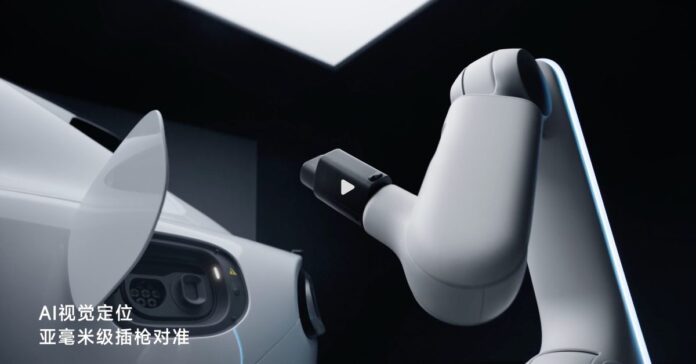
Xiaomi has unveiled a home robotic arm charger that autonomously plugs and unplugs your EV — delivering on a concept that Tesla prototyped over a decade ago but never brought to market.
The compact device, only 152 mm wide, is designed to fit in tight home garage parking spaces and integrates into Xiaomi’s smart home ecosystem for smartphone control.
Tesla’s unfulfilled promise
In December 2014, Elon Musk tweeted that Tesla was working on “a charger that automatically moves out from the wall & connects like a solid metal snake.” He added: “For realz.” By August 2015, Tesla showed a functional prototype — a multi-segmented robotic arm that slithered snake-like toward the charging port, aligned itself, and connected automatically.
It looked like the future. But a decade later, the product never shipped. Tesla quietly abandoned the snake charger concept, and the last we heard about it was in 2020, when it was still supposedly “not dead.” It’s dead.
Tesla instead pivoted to wireless charging, acquiring German startup Wiferion in 2023 and designing the Cybercab robotaxi without a charging port entirely. But even that effort has stalled — Tesla gave up on wireless charging for the Cybertruck last year because the vehicle sits too high off the ground.
What Xiaomi built
Xiaomi Auto published a demonstration video on June 11 showing its home charging robotic arm in action. The arm mounts to a wall or floor next to a parking space, detects the vehicle’s charge port, plugs in the connector, and unplugs it when charging is complete — all without the driver touching anything.
Key specs from Xiaomi’s announcement:
The arm’s housing is only 152 mm wide, making it narrow enough to install alongside tight parking spaces in home garages. The system uses AI vision recognition for sub-millimeter precision when inserting the plug. It can communicate with the vehicle to trigger motorized charge port covers to open and close automatically. And the entire system integrates into Xiaomi’s “human-car-home” ecosystem, so owners can monitor and control it remotely via smartphone.
The robotic arm joins Xiaomi’s existing home charging lineup, which already includes 7 kW and 11 kW wallbox chargers and a portable charge/discharge gun. No pricing or availability has been announced yet — this is still at the demonstration stage.
However, the company is framing this as a product it plans to make available for the home.
Xiaomi isn’t the only company working on this. Hyundai has been testing its own automatic charging robot at Incheon International Airport, and Chinese companies have deployed ceiling-rail-mounted charging robots in parking garages across several cities. But Xiaomi’s solution is specifically designed for home use, which is where 80% of EV charging happens.
Robotic arm vs. wireless charging
The obvious comparison here is wireless charging, which Tesla, BMW, Genesis, and others have been pursuing as the “hands-free” charging solution. Wireless inductive charging eliminates the plug entirely — you just park over a pad.
But wireless charging comes with trade-offs. Current systems operate at 88-93% efficiency under proper alignment, compared to roughly 95% for conductive plug-in charging. That efficiency gap means more energy wasted as heat and higher electricity bills over time. Wireless systems also top out at 11 kW under the SAE J2954 standard, while a plug-in connection can handle significantly higher power levels.
A robotic arm charger like Xiaomi’s gives you the same hands-free convenience of wireless charging while maintaining the full efficiency of a direct plug-in connection. You don’t sacrifice any energy to the air gap between charging pad and vehicle. And there’s no need to retrofit the vehicle with inductive charging hardware — the arm works with any EV that has a standard charging port.
Electrek’s Take
I think robotic arm charging is a better solution than wireless charging , especially on an efficiency basis. Every kilowatt-hour you waste to inductive losses is money out of your pocket, and over years of daily charging, that adds up. A robotic arm gives you the same “park and forget” experience with none of the efficiency penalty.
That said, the wireless charging industry will argue the gap has narrowed — and they’re right that modern systems have improved significantly from the early days of ~80% efficiency. But even a few percentage points of loss at 7-11 kW, every single day, compounds into real money.
The real question is price. We don’t know what Xiaomi will charge for this robotic arm, and that’s going to be the deciding factor. If it costs $500 on top of a wallbox — compelling. If it costs $3,000 — harder to justify versus a wireless pad, which can also get very expensive. Xiaomi has a track record of aggressive pricing on its EV accessories, so there’s reason to be optimistic, but we’ll have to wait and see.
If you’re charging an EV at home, powering it with solar is one of the smartest ways to cut your energy costs — especially with a system running 24/7 like a robotic charger. With electricity rates climbing nearly 10% last year, home solar protects you against future rate increases. And with lease and PPA options, you can go solar with zero upfront cost and start saving immediately. If you want to find the best deal, check out EnergySage. It’s a free service with hundreds of pre-vetted installers competing for your business, so you save 20 to 30% compared to going it alone. No sales calls until you pick an installer. Get your free quotes here.


FTC: We use income earning auto affiliate links. More.

