
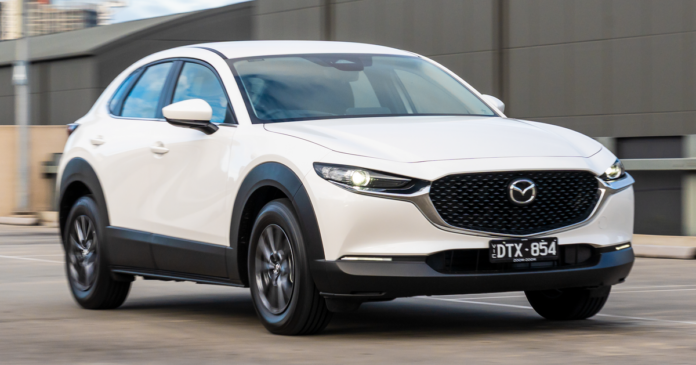
In an ever-rising sea of affordable new SUVs and crossovers, it’s easy to feel like you’re drowning in options.
The 2026 Mazda CX-30 doesn’t look all that old, but it is in fact a veteran of the small SUV segment, having launched pretty much in its current form at the turn of this decade.
When the Japanese brand’s Mazda 3-based crossover first landed it was considered quite expensive, but now I’m not so sure that’s the case – especially for the version we’re testing here.
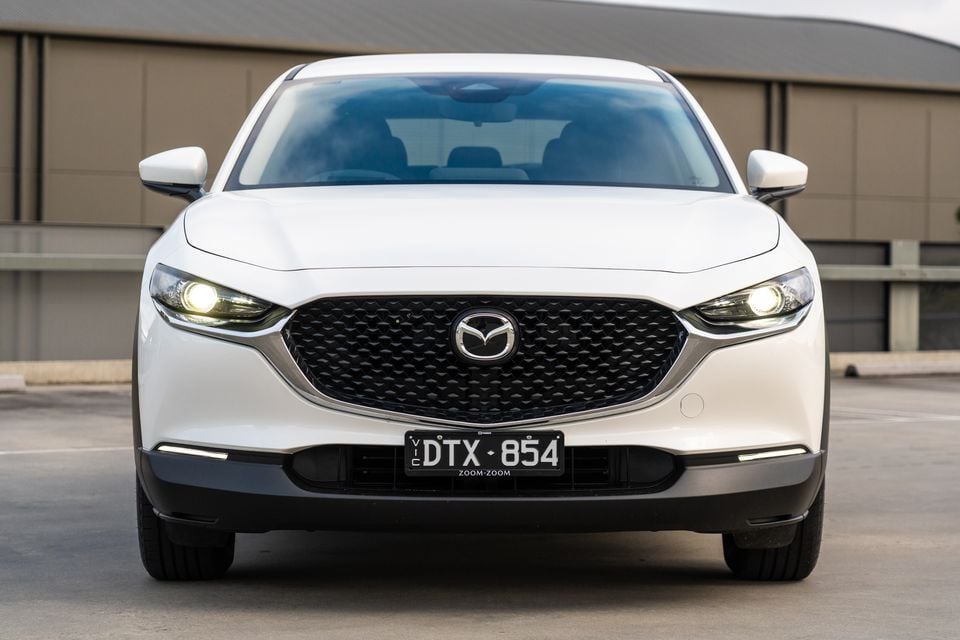
Sure, a tenner under $34,000 on the road isn’t quite as cheap as some Chinese-branded rivals, but the base CX-30 retains much of the core goodness we’ve come to appreciate from the nameplate.
It may lack some of the luxurious trimmings and digital screen real estate available in Chinese competitors at the same price point, but there’s something to be said about Mazda’s wide-reaching dealer network, long legacy in the Australian market, and generally good reputation with a big pool of loyal customers.
There’s no in-vogue electrification, nor the big-screen wizardry and theatrics the Chinese brands employ. But that, in a lot of ways, works in the Mazda’s favour.
Is the basey worth a look if you’re after a small SUV in 2026? Read on to find out…
How much does the Mazda CX-30 cost?
Mazda quietly upped retail pricing for the CX-30 range by $300 across the board, though the base G20 Pure on test here is currently being offered for a pretty sharp $33,990 drive-away.
|
Model |
Price before on-road costs |
|---|---|
|
2026 Mazda CX-30 G20 Pure |
$34,360 |
|
2026 Mazda CX-30 G20 Evolve |
$36,260 |
|
2026 Mazda CX-30 G20 Touring |
$40,060 |
|
2026 Mazda CX-30 G25 Touring |
$41,560 |
|
2026 Mazda CX-30 G20 Touring LE |
$42,360 |
|
2026 Mazda CX-30 G25 GT SP |
$43,560 |
|
2026 Mazda CX-30 G20 Astina |
$45,260 |
|
2026 Mazda CX-30 G25 GT SP AWD |
$45,560 |
|
2026 Mazda CX-30 G25 Astina |
$46,760 |
|
2026 Mazda CX-30 G25 Astina AWD |
$48,760 |
While the Japanese brand has gradually rationalised the range over the years, the CX-30 still has one of the most diverse lineups in the small SUV segment.
Find your perfect new car with CarExpert
Two engine options and the availability of front- and all-wheel drive are covered across the 10-strong range, but sadly the previously available mild-hybrid versions are no longer sold here.
At this end of the market there’s a gap between the most affordable models from legacy brands and the Chinese challengers, with even the low $33,990 drive-away price point of the Mazda being significantly higher than that of the Chery Tiggo 4, which can be had from $23,990 drive-away, or the related Omoda-Jaecoo J5 which kicks off from $25,990 drive-away.
More traditional rivals include the Honda HR-V (from $32,990 drive-away) and Hyundai Kona (from $35,990 drive-away), while the cheapest Toyota Corolla Cross Hybrid starts from $37,440 before on-road costs.
To see how the Mazda CX-30 lines up against the competition, check out our comparison tool
What is the Mazda CX-30 like on the inside?
While it sits on the lowest rung in the CX-30 ladder, the Pure grade doesn’t feel all that entry-level these days.
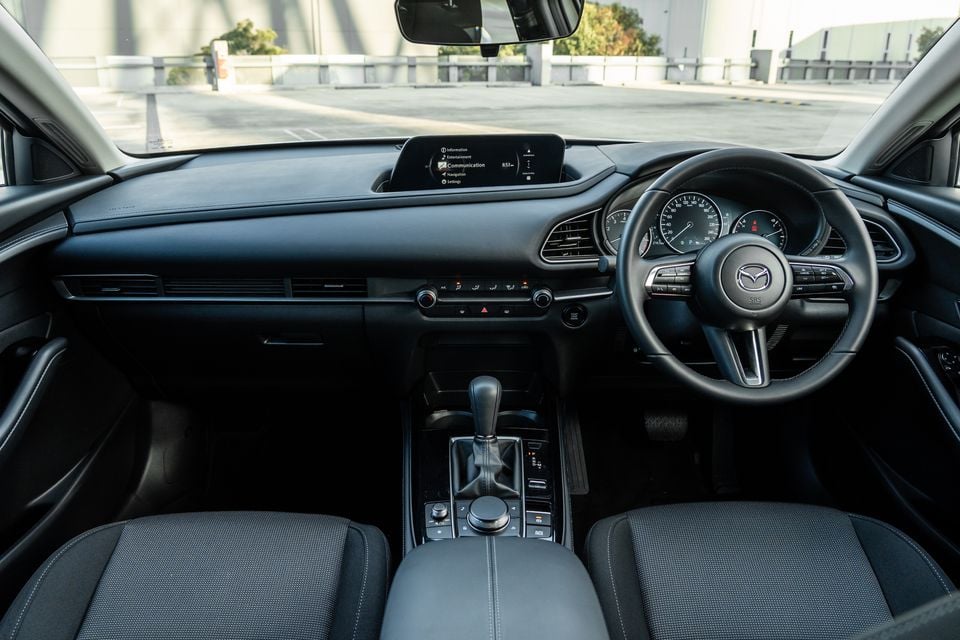
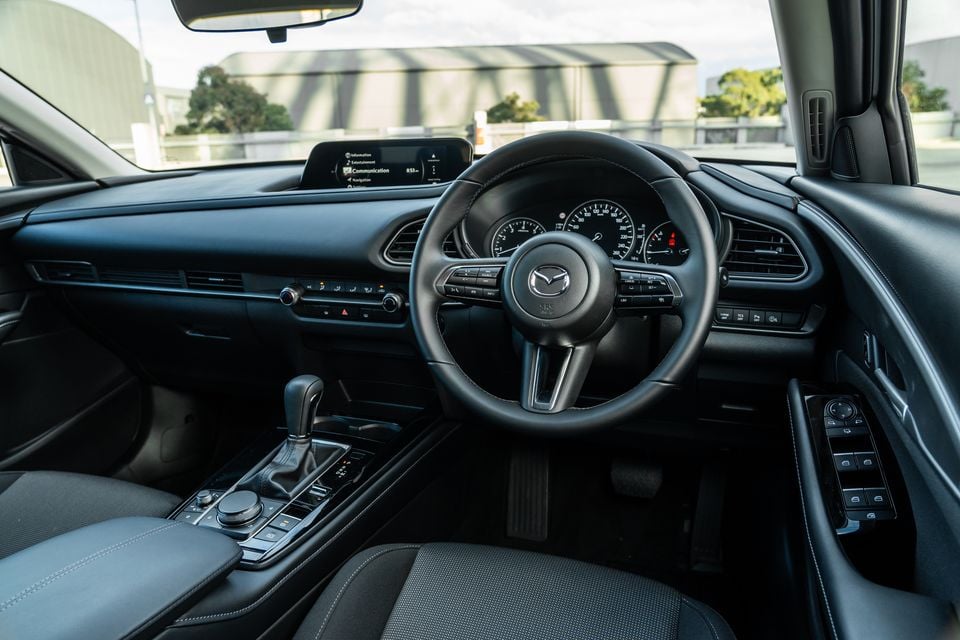
A couple of years back Mazda added a leather steering wheel which really uplifted the ambience and tactility element, while the high ratio of soft-touch cabin surfaces and Mazda’s generally premium-leaning interior design shines through here.
Even the standard cloth-trimmed seats (manually adjusted up front) feel a cut above those of most rivals at this price point. The ergonomic chairs deliver excellent all-round support, while also offering more adjustment than you expect – Mazda cleverly includes base cushion angle adjustment which is pretty much unheard of at this end of the market.
We also appreciate the stitched and padded detailing on the dashboard insert, as well as along the sides of the centre console. It all comes together to make the CX-30 feel a lot more like an entry-level premium product rather than an under-specified mainstream car.
Other details remind you of the Pure’s status in the lineup, namely the smaller 8.8-inch widescreen infotainment display, which is looking a little compact these days, and the manual air-conditioning controls rather than automatic climate control you’ll find in higher grades.
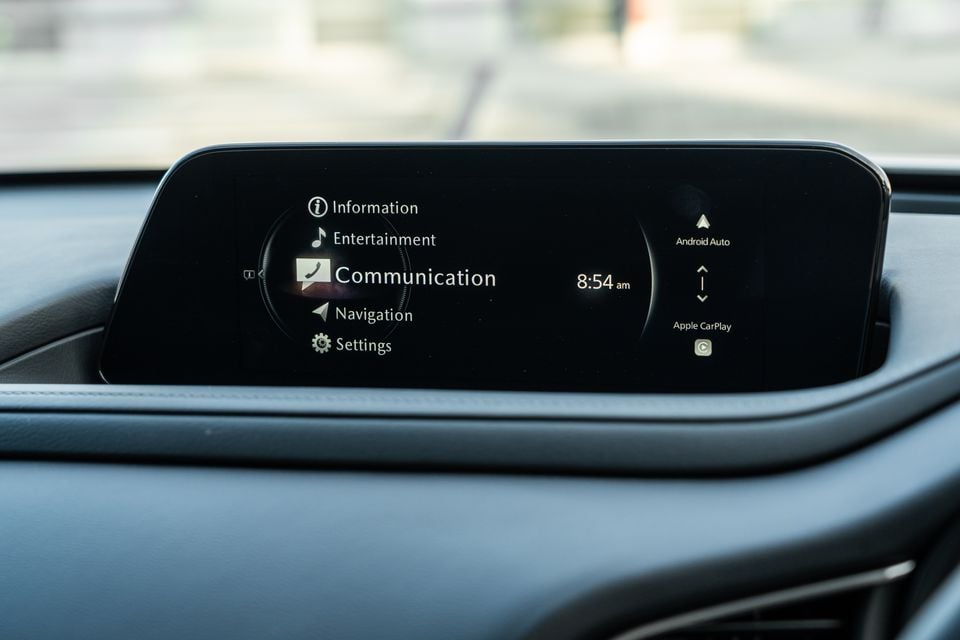
There’s connected services and native navigation as standard, though smartphone mirroring is wired. I couldn’t tell you the last time I had to plug my phone into a test vehicle for Apple CarPlay – #FirstWorldProblems…
Another aspect some may find annoying is the heavy reliance on the rotary controller, which for smartphone mirroring and entering destinations is quite a pain even with the ability to use Siri voice commands. It’s liveable, but touch inputs would be quicker.
Thankfully, the tactile track and volume controls on the steering wheel and centre console save you from having to dive through menus with the rotary dial, and there are physical shortcut buttons around said controller too. If the display was larger and/or closer to the driver, however, I’d argue you could still do many things a bit quicker with touch inputs.
The standard eight-speaker unbranded audio system is actually pretty good, and there are AM/FM and DAB radio tuners in addition to Bluetooth audio streaming.
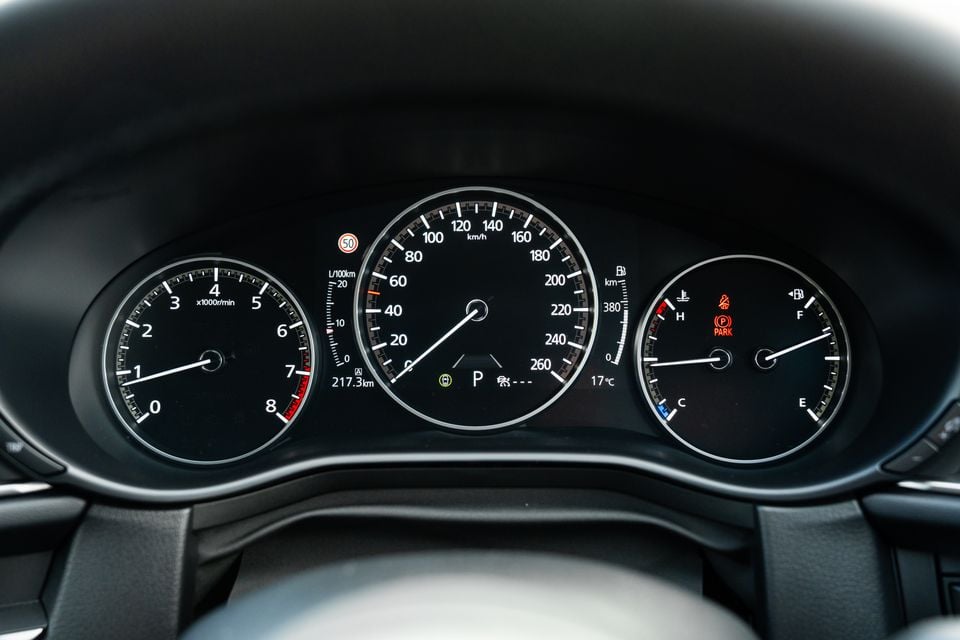
Ahead of the driver, the partially digital instrument cluster with its 7.0-inch digital speedometer readout remains a clean and attractive interface, augmented by the handy head-up display which projects key driving information like speed and assistance prompts right into the driver’s line of sight.
Rounding out the highlights in the first row are handy storage cubbies ahead of the shifter and under the front armrest, with a phone-sized shelf residing under the dash where the wireless phone charger lives in higher grades, while the storage bin under the big padded centre armrest offers more than enough space for keys, wallets and the like.
The nicely trimmed door cards are home to well-sized bins further down with space for bottles and other trinkets, while the large toothed cupholders between the shifter and aforementioned shelf are ergonomically placed and shaped to accommodate a variety of cup and bottle sizes.
While the front row is a pretty positive experience all round – keeping the price and positioning in mind – the second row and boot bring less favourable returns.
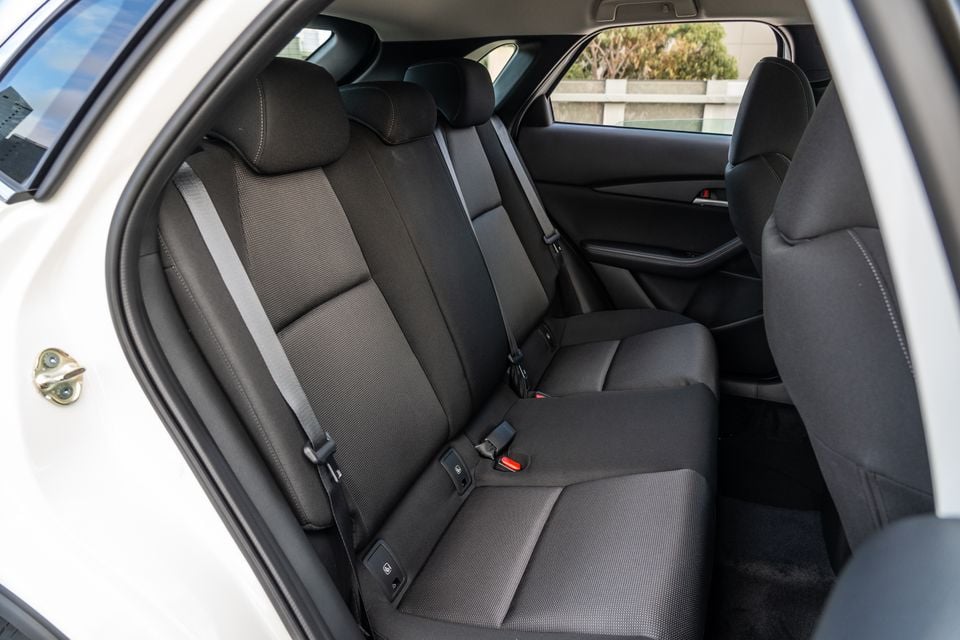
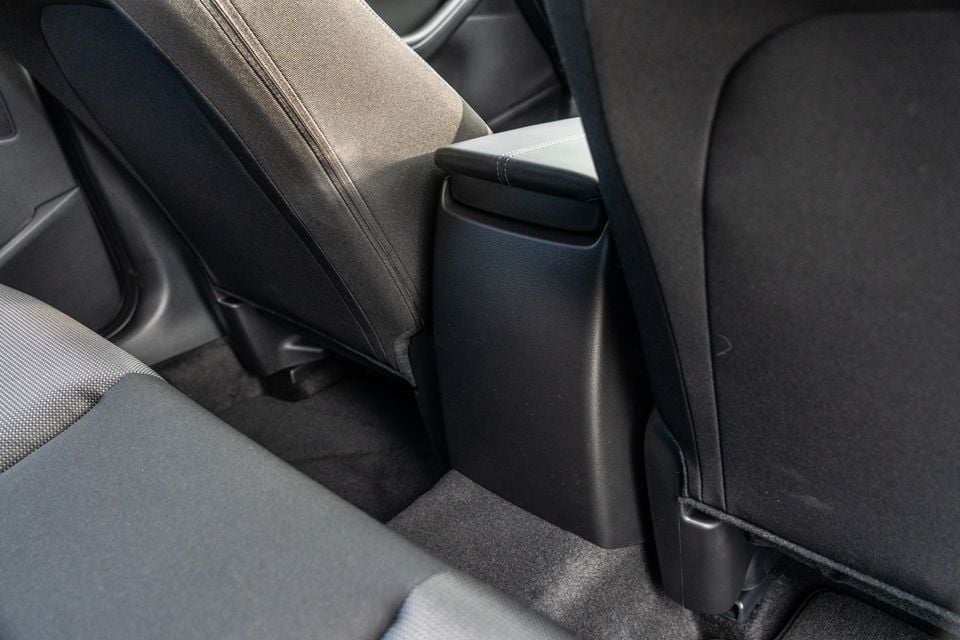
At 6’1″ tall, I’m a snug fit behind my own driving position, though kids and smaller adults should be okay if they’re not concerned about the high windowline – not great for the nausea-prone.
The base grade misses out on the directional rear air vents and fold-down centre armrest with cupholders available in higher grades, though if you’re planning on carting about smaller children you do get ISOFIX and top-tether points for child seats, as you’d expect.
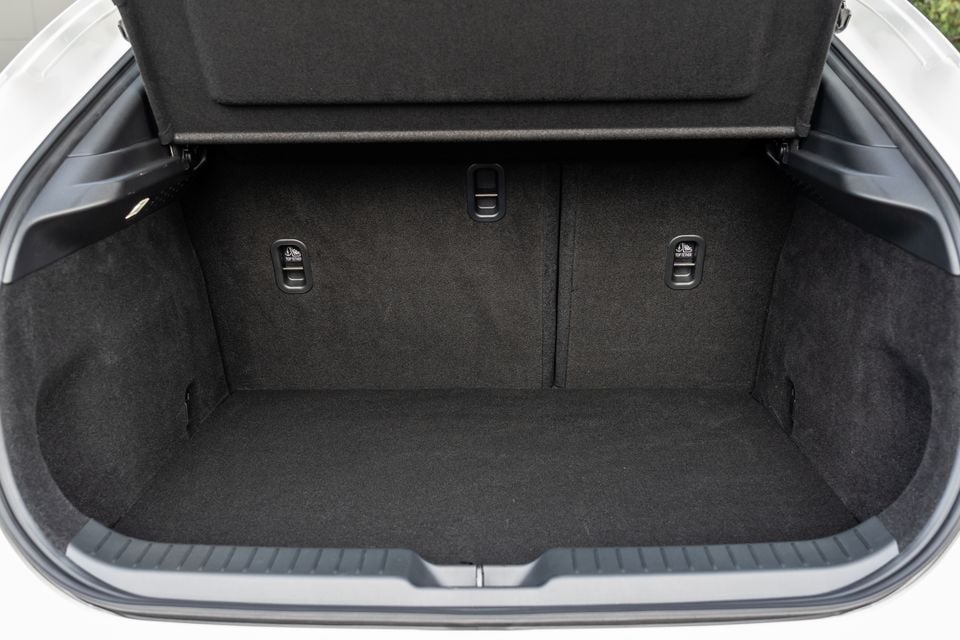
Luggage capacity isn’t really a CX-30 strong point, either – there’s 317 litres of space with the rear seats in play, which is a bit off the pace with class-leaders which offer well over 400L. Mazda doesn’t quote a cargo volume figure with the rear seatbacks folded down, but they do drop almost flat and don’t produce an annoying hump between the boot floor and rear seatbacks.
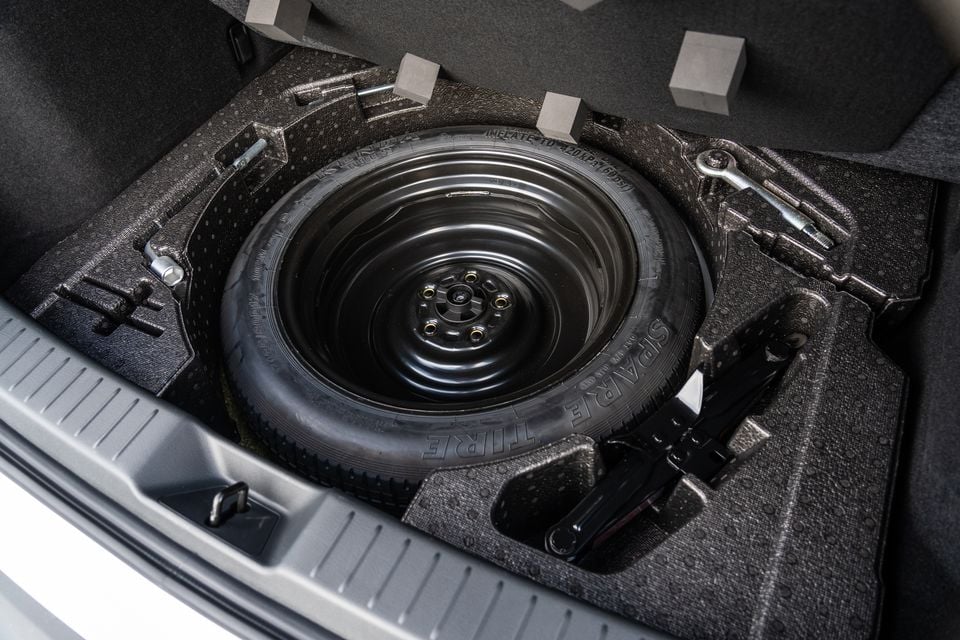
The chunky rear bumper and high load lip may also be challenging for those stowing heavier items or bulky things like prams, and there’s a space-saver spare under the boot floor.
|
Dimensions |
Mazda CX-30 G20 Pure |
|---|---|
|
Length |
4395mm |
|
Width |
1795mm |
|
Height |
1540mm |
|
Wheelbase |
2655mm |
|
Cargo capacity |
317L |
To see how the Mazda CX-30 lines up against the competition, check out our comparison tool
What’s under the bonnet?
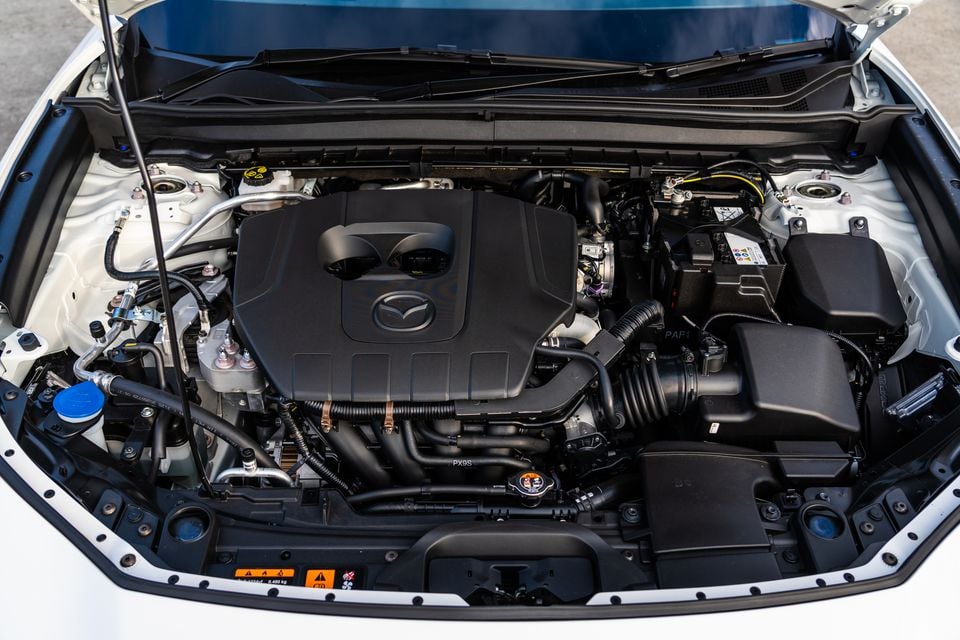
‘G20’ versions of the Mazda CX-30 utilise a 2.0-litre naturally aspirated four-cylinder petrol engine driving the front wheels via a six-speed automatic transmission.
|
Specifications |
Mazda CX-30 G20 Pure |
|---|---|
|
Engine |
2.0L 4cyl petrol |
|
Power |
114kW at 6000rpm |
|
Torque |
200Nm at 4000rpm |
|
Transmission |
6-speed automatic |
|
Drive type |
Front-wheel drive |
|
Kerb weight |
1468kg |
|
Fuel economy (claimed) |
6.3L/100km |
|
Fuel economy (as tested) |
8.1L/100km |
|
Fuel tank capacity |
51L |
|
Fuel requirement |
91-octane regular unleaded |
|
CO2 emissions |
147g/km |
|
Emissions standard |
Euro 5 |
|
Unbraked tow capacity |
600kg |
|
Braked tow capacity |
1200kg |
Running changes for the 2024 model year brought in cylinder deactivation technology for the G20 engine, which allows the CX-30 to run on two cylinders under low loads to reduce fuel consumption. Mazda also cited “other improvements to the combustion process” without going into much more detail, which helps the updated engine to claim fuel efficiency and CO2 emissions identical to the outgoing G20e mild-hybrid, which was subsequently discontinued in the Australian market.
The CX-30 also previously offered the ‘X20’ 2.0-litre petrol engine, featuring the brand’s compression-ignition combustion technology as well as supercharging and 24V mild-hybrid tech. This was only offered with flagship Astina versions, however, and has since been discontinued.
In the Japanese domestic market, the CX-30 offers 2.0L petrol 24V mild-hybrid and 1.8-litre turbo-diesel engines, both available in front-wheel drive and all-wheel drive configurations.
According to Japanese WLTC figures, the e-Skyactiv 2.0 MHEV petrol engine uses 6.1-6.4L/100km on the combined cycle, while the Skyactiv-D 1.8 oiler drops that to 4.9-5.2L/100km. Mazda’s home market also demands emissions control systems largely in line with Euro 6b emissions standards.
In China, there’s also an all-electric version of the CX-30 built by the Changan-Mazda joint venture.
To see how the Mazda CX-30 lines up against the competition, check out our comparison tool
How does the Mazda CX-30 drive?
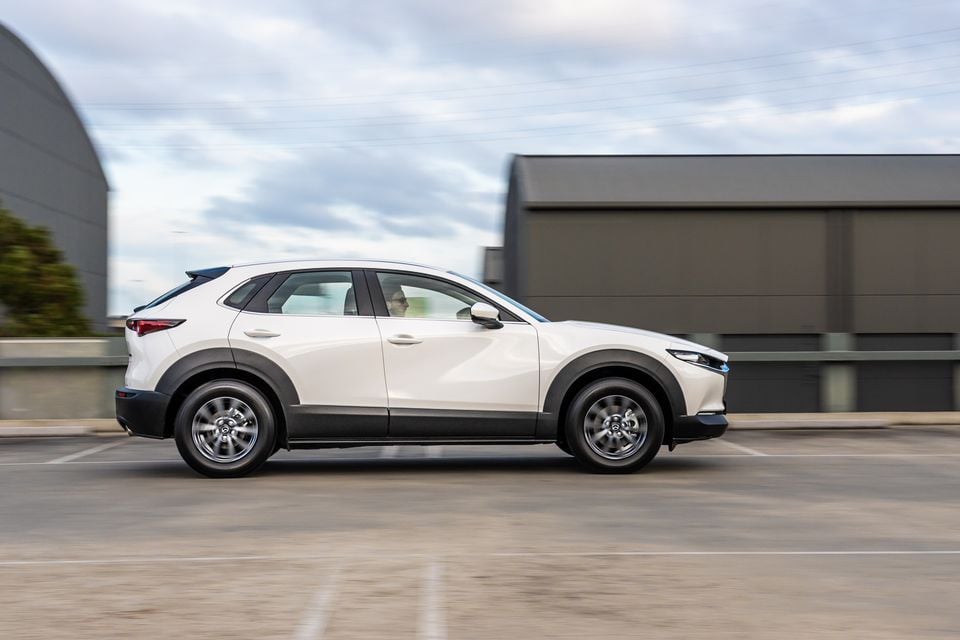
In an industry where things seem to change on a whim, the Mazda CX-30’s on-road experience has remained the same for quite some time – for better or for worse, depending on your point of view.
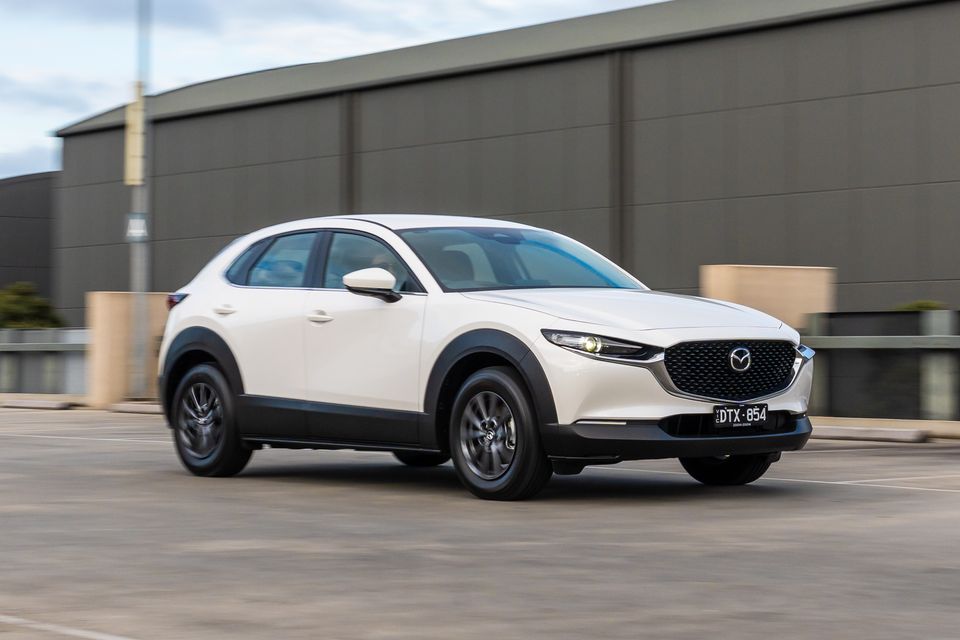
Mazda’s ‘Skyactiv’ engine family is quite well-known for its free-revving nature and distinctive high-pitched engine note, and the CX-30 Pure is on-brand on these fronts.
Linear acceleration response and a generally sharp-shifting six-speed automatic make for responsive performance off the line, though the fact the G20 engine’s 200Nm of peak torque doesn’t come on song until 4000rpm means you have to work it a bit to get anywhere quickly.
Mazda Australia’s refusal to turbocharge its smaller models makes for a charming and rev-happy drive, but this can be to the detriment of refinement, and of course fuel-efficiency.
That buzzy engine note is generally fine, but under load it gets a little loud and laboured, particularly the 2.0-litre motor tested here. The ‘G25’ 2.5L powerplant has a little extra muscle across its rev range, making it feel a bit more effortless.
Perhaps more annoying is the transmission’s habit of being caught out in a gear one or two cogs too high, and being slow to react given the petrol engine’s torque hole down low.
Several times while trying to make a gap in traffic I experienced a moment of hesitation, prompting a further press of the throttle, which then made it almost overreact and thrash the engine harder than I’d have liked. Exercising a bit of patience is advised if you’re getting into one of these.
What’s puzzling to me is that I haven’t experienced this issue to the same extent in the related Mazda 3 with the same engine. There’s no confirmed difference in shift pattern or throttle calibration, and the CX-30 G20 Pure is only 50kg heavier than the equivalent Mazda 3 G20 Pure, which is equivalent to a large child or very small adult.
Anyway, performance is just adequate even in a class with low-powered and hybrid competition. It’s a similar story at freeway speeds in that you don’t get to triple figures all that quickly, and if you’re planning a quick overtake it requires planning and patience.
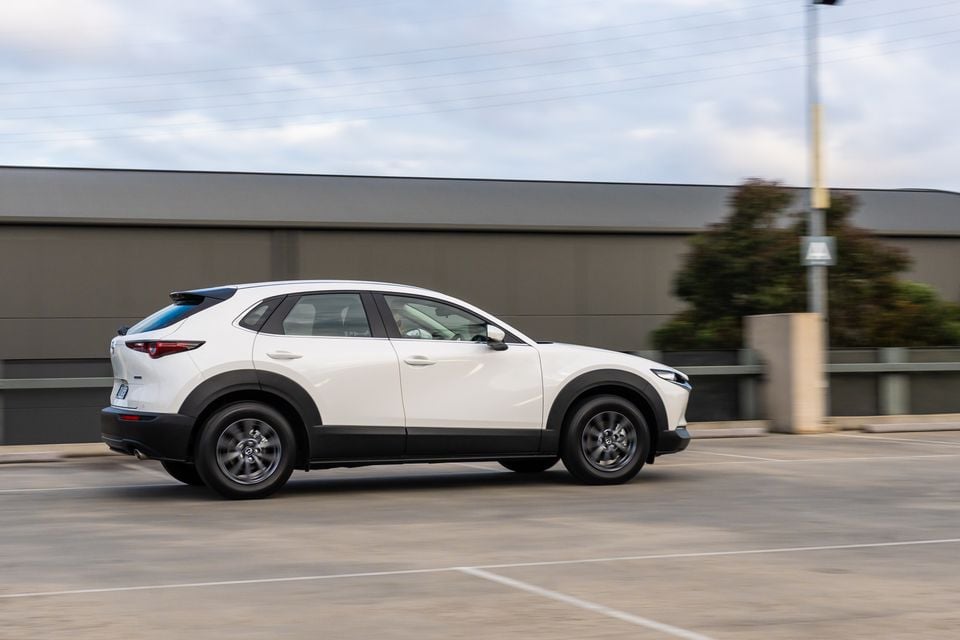
You’d think that a small, low-output petrol engine would translate to decent fuel economy. Well, you’d be wrong – we saw an indicated average of 8.1L/100km after a week of mixed driving, with peak-hour driving to and from the office being the main task, which for me includes a long freeway stint combined with inner-city traffic.
When plenty of other brands offer mild-hybrid or full-hybrid alternatives that can basically halve this kind of fuel use in similar conditions, it makes you think twice about going petrol-only especially at a time when fuel prices are so volatile.
The CX-30’s idle-stop system (named ‘i-Stop’) does a decent job of stopping that indicated figure going higher, but if the air-con is on even at a minimal setting you’ll find the Mazda will fire its engine back up after 45-60 seconds, and that’s in winter.
Mazda introduced cylinder deactivation tech with a recent update, which basically brings the combined consumption figure down to the level of the previous mild-hybrid. However, I can’t help but think this engine with Mazda’s mild 24V MHEV system could bring another 10-20 per cent efficiency improvement, particularly in urban driving.
From expert reviews to the right deal
CarExpert brings together reviews, research tools and trusted buying support, guiding you from research to delivery with confidence.
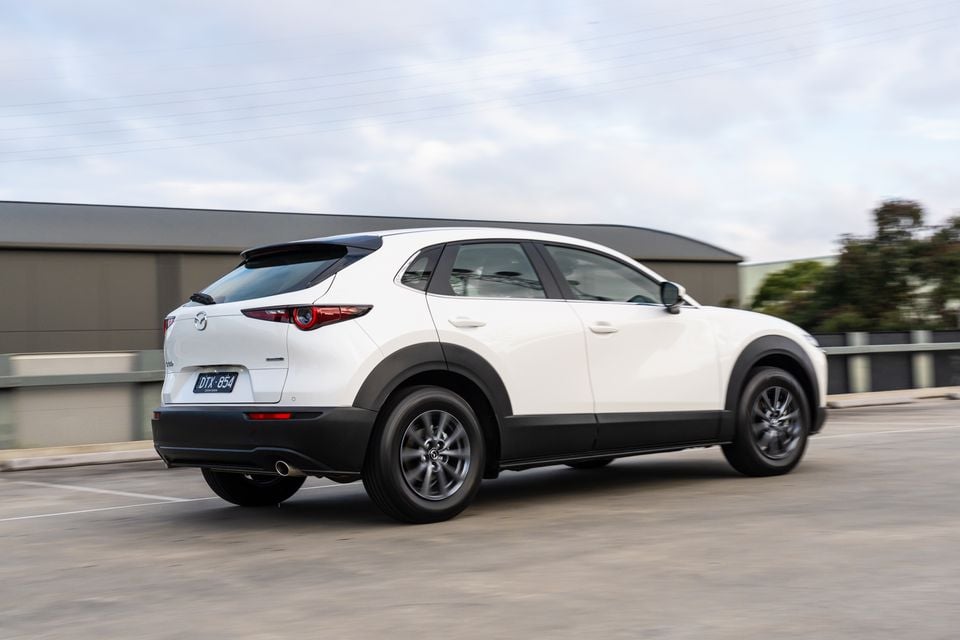
Otherwise, the CX-30’s core likeable traits remain. The ride in both urban and highway scenarios is a nice balance of comfortable and engaging, with a dash of that Zoom-Zoom zest sprinkled in, save for the occasionally sharp rebound at the rear thanks to the torsion beam suspension setup.
The beautifully fluid steering rack offers good response and feedback, while the measured body control allows the same sort of playful lean in corners that we love about the MX-5 sports car. Road noise is nicely suppressed for the segment, too, particularly on the Pure’s smaller 16-inch alloys and chubbier 65-profile rubber.
Mazda’s assistance systems in the base CX-30 are generally well calibrated and intuitive, with even the loud bongs from the blind-spot monitoring system is one of the less annoying audible alerts in the industry.
The standard adaptive cruise control is a bit conservative and hesitant on highly-trafficked highways, while the magnified driver side mirror can be a little restrictive in terms of the field of view. The base reversing camera is fine, but given the CX-30’s chunky rear sheetmetal and rising window-line, this is not a conventional SUV in terms of outward visibility.
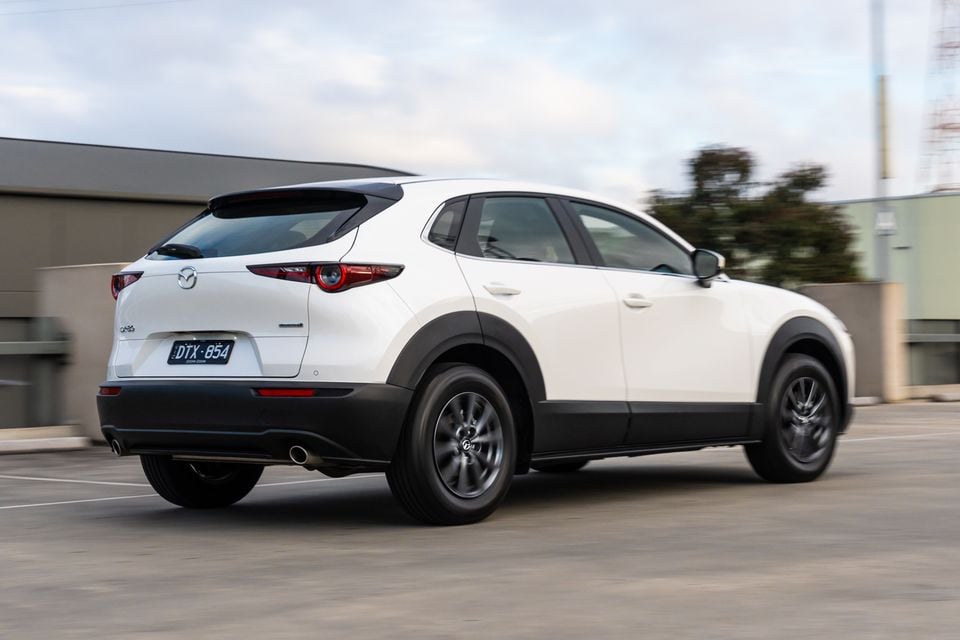
For an extra $2000 you can add the Vision Technology Package which brings niceties like Cruising & Traffic Support – Mazda’s proper semi-autonomous highway assistant – in addition to front cross-traffic alert, front parking sensors, and a surround-view camera.
It’s unusual for a mainstream brand to offer its full suite of driver assists as an option on an entry-level model, and I think it’s an option box well worth ticking – it wasn’t fitted in our test car, sadly.
To see how the Mazda CX-30 lines up against the competition, check out our comparison tool
What do you get?
The Pure sits on the lowest rung of the CX-30 ladder, though it’s still pretty well equipped.
2026 Mazda CX-30 Pure equipment highlights:
- 16-inch alloy wheels
- Space-saver spare wheel
- Automatic LED headlights
- Automatic high-beam
- Rain-sensing wipers
- Automatic power-folding side mirrors
- 7.0-inch digital instrument cluster
- 8.8-inch infotainment system
- Head-up display
- Wired Apple CarPlay, Android Auto
- 2 x USB-C ports (replaces USB-A)
- Satellite navigation
- DAB+ digital radio
- Eight-speaker sound system
- Push-button start
- Leather-wrapped shifter
- Leather-wrapped steering wheel
- Fabric upholstery
- Mazda Connected Services
-
- Vehicle locator
- Geofencing
- Flashing lights feature
- Curfew notifications
- Remote locking
- Vehicle health
- Status reports
- Stolen vehicle tracking assistance
2026 Mazda CX-30 Evolve adds:
- 18-inch silver alloy wheels
- Paddle shifters
- Dual-zone climate control
- Wireless Apple CarPlay, Android Auto
- Wireless phone charger
- Overhead sunglass storage
- Rear fold-down centre armrest
2026 Mazda CX-30 Touring adds:
- Front parking sensors
- Auto-dimming driver’s side mirror
- Reverse tilt-down driver’s side mirror
- Side mirror memory
- Keyless entry
- Illuminated front vanity mirrors
- Black leather upholstery
- 10-way power driver’s seat
- 2-position driver memory
2026 Mazda CX-30 Touring LE adds:
- 18-inch alloy wheels – Black
- Black grille
- Signature spoiler
- Black mirror caps
- Terracotta ‘Maztex’ and suede upholstery
- Terracotta armrest, centre console, door card and dashboard contrast stitching
- Vision Technology package
-
- Front cross-traffic alert
- Cruising & Traffic Support
- Driver monitoring system
- Surround-view monitor
- 10.25-inch infotainment system
2026 Mazda CX-30 GT SP adds – over Touring:
- 18-inch black alloy wheels
- Power tilt and slide glass sunroof
- Gloss-black grille
- Gloss-black side mirrors
- 10.25-inch infotainment system
- Heated steering wheel
- Heated front seats
- Burgundy leather upholstery
2026 Mazda CX-30 Astina adds:
- 18-inch silver alloy wheels
- Adaptive LED headlights
- Power tailgate
- 12-speaker Bose premium sound system
- Frameless rear-view mirror
- Black leather upholstery
- Front cross-traffic alert
- Cruising & Traffic Support
- Driver monitoring
- Surround-view camera
To see how the Mazda CX-30 lines up against the competition, check out our comparison tool
Options
All CX-30 variants bar the flagship Astina (which includes it as standard) offer the Vision Technology Package, bringing a suite of desirable features for not a whole lot of money.
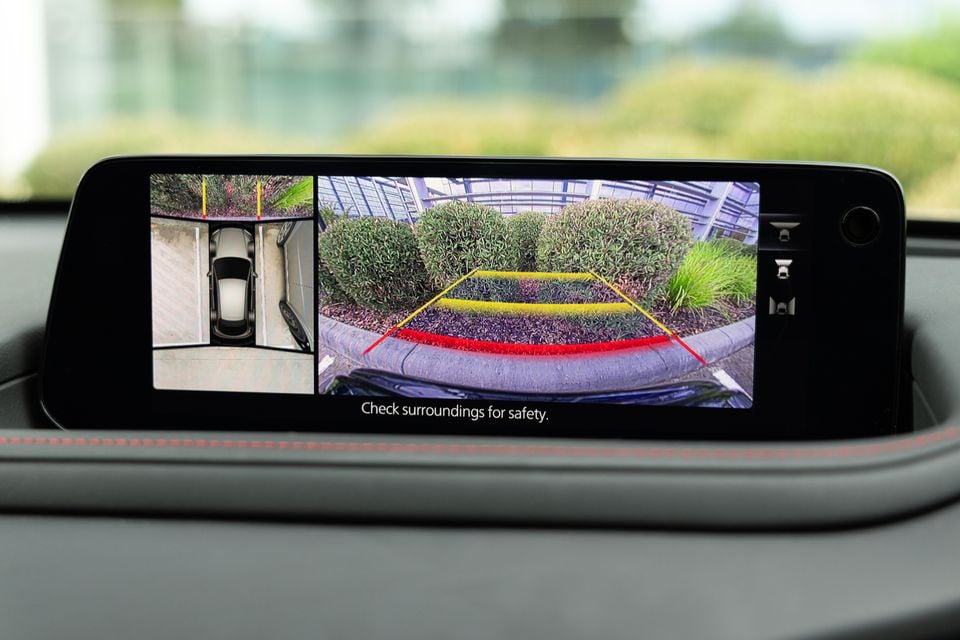
Vision Technology Package – Pure + Evolve: $2000
- 10.25-inch Mazda Connect infotainment system
- 360-degree cameras
- Cruising & Traffic Support – Adaptive cruise + lane-centring
- Driver monitoring
- Front cross-traffic alert
- Front parking sensors
To see how the Mazda CX-30 lines up against the competition, check out our comparison tool
Is the Mazda CX-30 safe?
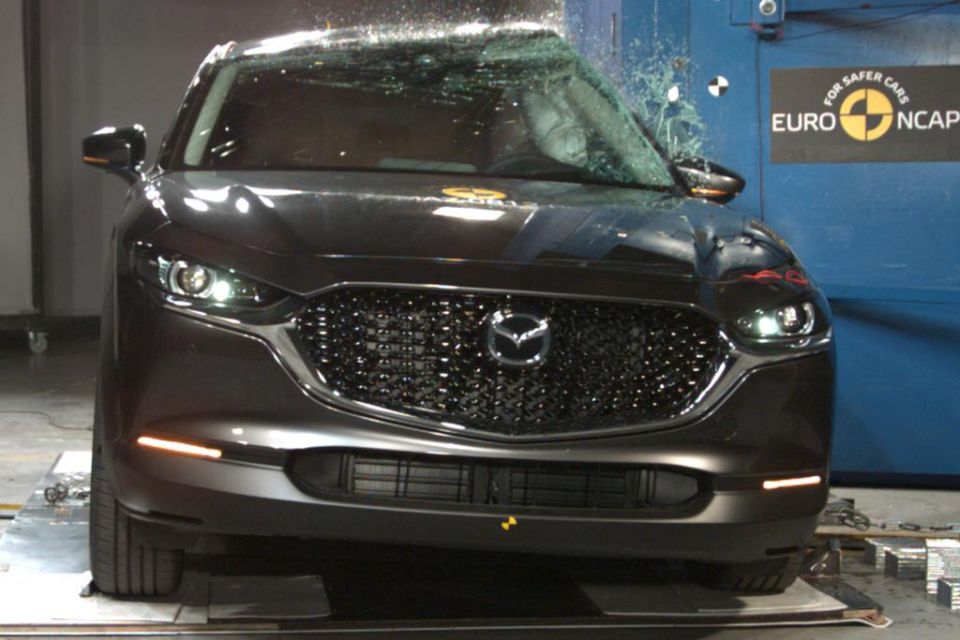
The Mazda CX-30 scored top marks when it was tested in 2019, but from January 1, 2026 it is unrated because its original ANCAP and Euro NCAP score has now expired.
|
Category |
Mazda CX-30* |
|---|---|
|
Adult occupant protection |
99 per cent |
|
Child occupant protection |
88 per cent |
|
Vulnerable road user protection |
80 per cent |
|
Safety assist |
76 per cent |
*Applies to vehicles built before January 1, 2026
Standard safety equipment includes:
- Autonomous emergency braking (AEB)
-
- Pedestrian detection
- Cyclist detection
- Rear AEB
- Blind-spot monitoring
- Rear cross-traffic alert
- Lane-keep assist
- Lane departure warning
- Driver attention alert
- Traffic sign recognition
- Rear parking sensors
- Reversing camera
- Tyre pressure monitoring
CX-30 Touring models add:
CX-30 Touring LE + Astina add:
- Front cross-traffic alert
- Cruising & Traffic Support
- Driver monitoring system
- Surround-view monitor
To see how the Mazda CX-30 lines up against the competition, check out our comparison tool
How much does the Mazda CX-30 cost to run?
The CX-30 is covered by Mazda Australia’s five-year, unlimited-kilometre new-vehicle warranty, backed by five years of roadside assistance and up to seven years of capped-price servicing.
|
Servicing and Warranty |
Mazda CX-30 |
|---|---|
|
Warranty |
5 years, unlimited kilometres |
|
Roadside assistance |
5 years |
|
Service intervals |
12 months or 15,000km |
|
Capped-price servicing |
Up to 7 years |
|
Total capped-price service cost* |
$2311 – 5 years $3324 – 7 years |
*Estimated costs as quoted on the Mazda Australia website
Mazda’s service price estimate for the G20 Pure works out to an annual average of $462 for the first five years of ownership, and increases to $664 per annum if you add the sixth and seventh years.
That’s not the most expensive in the market, but it’s a far cry from the likes of Honda and Toyota which offer $199 and $275 services for the first five visits, respectively.
To see how the Mazda CX-30 lines up against the competition, check out our comparison tool
CarExpert’s Take on the Mazda CX-30 G20 Pure
The sharp drive-away offer currently makes the base CX-30 perhaps the best-value variant – though I’d shell out the extra $2000 for the Vision Technology Package.
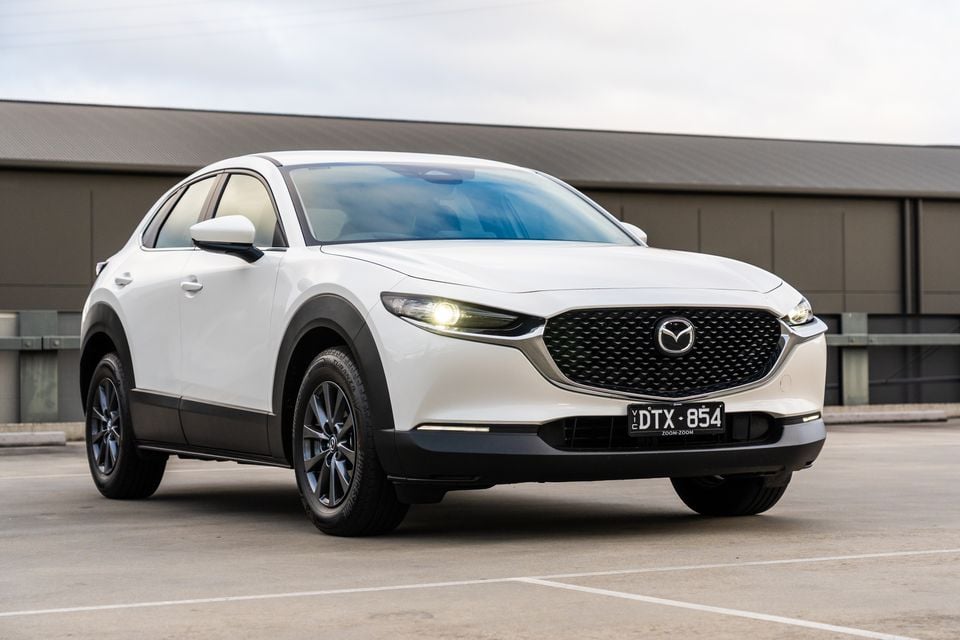
With said optional pack, the CX-30 Pure offers the full suite of assistance, infotainment and safety technology on offer from the nameplate (minus wireless smartphone mirroring), and the base grade also rides on the more compliant entry-level wheel and tyre package, which is cushier and better suited to pothole-prone cities like Melbourne.
It’s affordable, simple to run and has the backing of one of Australia’s most popular car brands. A broad dealer support network and solid aftersales program also help make this an easy vehicle to buy and own.
That’s not to say there aren’t several areas ripe for improvement – namely the lack of turbocharging and electrification, which translates to high real-world fuel consumption and average engine performance. The CX-30’s tight rear seats, small boot and limited rear vision are also chinks in its armour.
But what this little Mazda lacks on a spec sheet compared to say, a Chery Tiggo 4 or Jaecoo J5, it more than makes up for in classy design, seamless tech integration, and the sort of engaging and cohesive driving experience that none of its Chinese competitors can match at this point in time.
CarExpert can save you thousands on a new Mazda CX-30. Click here to get a great deal.
Click the images for the full gallery
MORE: Explore the Mazda CX-30 showroom

