
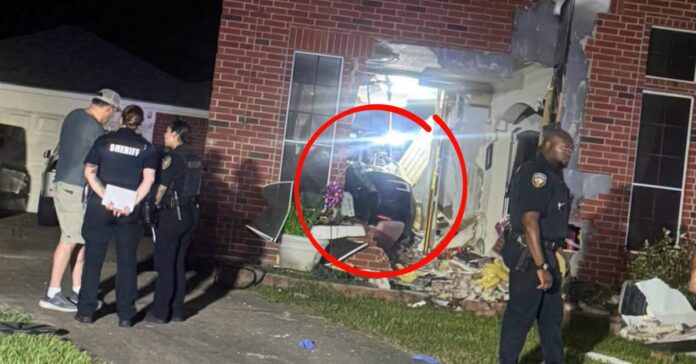
A driver told Harris County investigators that his Tesla was on Autopilot before it left a residential road in Katy, Texas, crashed through the brick wall of a home, and killed a 76-year-old woman inside.
The crash happened around 8 p.m. Friday in the 21300 block of Rose Hollow Lane, according to the Harris County Precinct 5 Constable’s Office and the Harris County Sheriff’s Office.
What investigators have confirmed
According to the Harris County Sheriff’s Office, the Tesla failed to make a right turn at an intersection and continued forward at a high rate of speed before crashing directly into the front room of the residence.
A 76-year-old woman was standing inside that room when the vehicle entered the home and struck her. She was flown by Life Flight to Memorial Hermann hospital, where she was later pronounced dead.
The driver, identified by authorities only as a 44-year-old man, was taken to a hospital by ambulance. Investigators said he showed no signs of intoxication and has been cooperating with officers. No charges had been filed as of Saturday afternoon, and the investigation is ongoing.
The Precinct 5 Constable’s Office, led by Constable Terry Allbritton, said the driver told deputies he had the Tesla on Autopilot at the time of the crash. That detail is the driver’s account — it has not been independently confirmed by investigators.
Investigators are probing the role of Tesla’s technology
Harris County Sheriff’s Office Sgt. Alex Turman, an accident investigator and public information officer, told Covering Katy News that the cause of the crash has not been determined.
“We’re digging into that. That’s a line of investigation for sure,” Turman said when asked whether the vehicle’s automated driving features were in use.
Turman added that investigators are working with people familiar with Tesla vehicles and with the driver to determine “what role the driver’s control over the car played in this crash.”
It’s important to be precise here: neither the constable’s office nor the sheriff’s office has specified whether the system the driver referred to was Autopilot, Tesla’s basic driver-assistance package, or the more capable “Full Self-Driving” (Supervised) software. Both require an attentive driver ready to take over at all times, and neither makes a Tesla autonomous.
A system already under federal scrutiny
The crash lands as Tesla’s driver-assistance systems face mounting regulatory pressure. In October 2025, NHTSA opened an investigation into roughly 2.9 million Tesla vehicles over “Full Self-Driving” running red lights and driving the wrong way, and the agency upgraded that probe in March 2026 to an engineering analysis — the last step before a potential recall.
Tesla is also under a separate NHTSA probe for failing to properly report crashes involving Autopilot and FSD, and the company’s record on these systems has repeatedly come up in court. A Tesla engineer admitted last year that the company didn’t maintain Autopilot crash records for the first three years after launching the system.
Electrek’s Take
First, the human cost. A 76-year-old woman was killed in her own home, in what should have been the safest place in her life. Nothing about the technology debate should obscure that. Our thoughts are with her family.
Now, the part we can’t ignore. We don’t yet know whether Autopilot or FSD was actually engaged — that’s the driver’s claim, and investigators are right to verify it rather than take it at face value. But if it turns out the car was running one of Tesla’s driver-assistance systems, this looks like another tragic case of the same failure mode we keep documenting: a driver becoming too complacent with a system that is good enough to lull you, but nowhere near good enough to trust unsupervised.
I’ve written candidly about how FSD v14 is so smooth it’s making me dangerously complacent, and I’m far from alone — even a former Uber self-driving chief got conditioned into complacency and crashed. This is a known, studied problem, and Tesla isn’t doing enough to limit it. The driver-monitoring is too easy to game, the marketing oversells the capability, and the names “Autopilot” and “Full Self-Driving” do real work convincing people they can disengage.
If a 44-year-old driver genuinely believed his car would make that turn for him, that belief didn’t come from nowhere. And this time, someone who wasn’t even in the car paid for it. That’s the line Tesla still hasn’t reckoned with: the cost of overpromising isn’t just borne by the people who buy in — it’s borne by whoever happens to be standing in the front room.
If you’re a Tesla owner, powering your EV with home solar is one of the smartest ways to lock in low fuel costs. With electricity rates climbing nearly 10% last year, home solar protects you against future rate increases. And with lease and PPA options, you can go solar with zero upfront cost and start saving immediately. If you want to find the best deal, check out EnergySage. It’s a free service with hundreds of pre-vetted installers competing for your business, so you save 20 to 30% compared to going it alone. No sales calls until you pick an installer. Get your free quotes here.


FTC: We use income earning auto affiliate links. More.

