
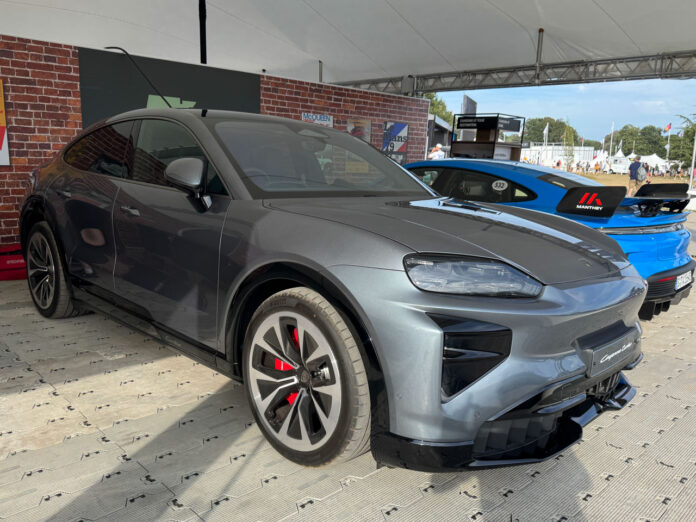
Following its world debut at Auto China 2026, the Porsche Cayenne Coupe Electric was displayed at the 2026 Goodwood Festival of Speed. We had a chance to experience the new electric SUV-coupe at the British motoring event, and here is what it offers:
Design

The Porsche Cayenne Coupe Electric relates to its SUV counterpart much like the ICE-powered Cayenne Coupe does to the ICE-powered Cayenne. It looks noticeably sleeker and more athletic than the Cayenne Coupe gas model, with a more streamlined silhouette that gives it a stronger four-door coupe-like character.
The Cayenne Coupe Electric has a familiar look at the front and, to some extent, along the sides. The key design changes become apparent behind the A-pillar, where the roofline tapers more strongly and flows seamlessly into the sharply raked tailgate, forming a continuous arc.


Unlike the gas-engined Cayenne Coupe, the electric model has a clearly defined rear deck-like section behind the greenhouse. This gives it a subtle notchback or three-box-like impression, closer to a high-riding fastback sedan or conventional four-door coupe.
Porsche uses this space on the Cayenne Coupe Electric to house an adaptive rear spoiler. The company says the SUV-coupe sits 0.9 in. lower than the SUV and has a drag coefficient of 0.23 Cd, as compared to the latter’s 0.25 Cd.
Interior


The interior of the Porsche Cayenne Coupe Electric mimics the SUV, featuring a sporty and driver-focused design. The elegant dashboard features vertical AC vents on the outer edges and sleek horizontal AC vents in the center. It also integrates a 14.25-inch OLED curved driver information display.
A vertically curved OLED display connects the dashboard to the center console and serves as the operating touchscreen for the infotainment system. Porsche offers a 14.9-inch touchscreen on the passenger side and an AR-HUD with an 87-inch projection area as options.
Experience in the Cayenne Coupe Electric
I spent time in the Porsche Cayenne Coupe Electric, and its front-seat experience is identical to that of the standard-roof Cayenne Electric. Getting into the driver’s seat was easy for my 6-foot frame, and the straightforward door handles were refreshingly simple.
The front seats offer good back support and excellent under-thigh support, helped by electrically adjustable thigh extenders. The seats provide a wide range of electric adjustment, so finding a comfortable driving position is easy.

Shoulder support is only alright, but the adjustable headrests move forward and backward and provide useful head and neck support. Headroom is good, while all-around visibility is acceptable, although the Cayenne feels noticeably wide from the driver’s seat.
The center console has a clean, closed appearance, with most of its storage hidden beneath sliding covers. Inside, I found cupholders, wireless phone charging, USB ports, and a 12-volt outlet. The vertically curved central touchscreen looks distinctive, while the digital display arrangement stretches toward the outer edge of the dashboard.
The Coupe’s differences become more apparent in the rear. The roofline slopes downward noticeably, and the rear doors are slightly smaller than those of the standard Cayenne Electric. Even so, entry was manageable. With the front seat set to my driving position, I had around 3.1 inches of knee room, and my size 12 shoes slid beneath the front seat.
Rear headroom measured approximately 2.4 inches for my 6-foot frame. That is less than in the standard-roof model, but I did not find it overly restrictive.


The seats are slightly firm, with good back support, acceptable head and neck support, and only average under-thigh support. The rear backrests do not recline, although their fixed angle felt comfortable enough.
The floor is not flat, so fitting three adults abreast would be hard. Two adults and a child would be more realistic. Rear passengers also get three adjustable headrests and a fold-down center armrest with two cupholders.
Specifications
Porsche developed the Cayenne Coupe Electric on the PPE platform and has launched it in the U.S. in standard, S, and Turbo dual-motor AWD variants. The all-electric SUV-coupe is 196.3 in. (S: 196.5 in.) long, 78.0 in. wide, and 65.0 in. tall and has a 119.0 in. wheelbase.
The Cayenne Coupe Electric offers 18.9 cu. ft. of cargo space in the standard and S variants, expandable to 47.6 cu. ft. by folding the rear seats. These capacities reduce to 17.7 cu. ft. and 46.4 cu. ft. in the Turbo variant. All three variants feature a frunk with 3.2 cu. ft. of extra luggage space.
The standard variant packs 402 hp (435 hp with Overboost and Launch Control) and 615 lb-ft (with Launch Control) of torque, accelerates from 0 to 60 mph in 4.5 seconds, and reaches a top speed of 143 mph.

The Cayenne S Coupe Electric, with 536 hp (657 hp with Overboost and Launch Control) and 796 lb-ft (with Launch Control) of torque, cuts the 0-60 mph acceleration time to 3.6 seconds and increases the top speed to 155 mph.
The Turbo variant further raises the power to 844 hp and (1,139 hp with Overboost and Launch Control) and the torque to 1,106 lb-ft (with Launch Control). It accelerates from 0 to 60 mph in just 2.4 seconds and achieves a top speed of 162 mph.
The Cayenne Coupe Electric has a 113 kWh battery pack that supports charging at up to 390 kW and takes as little as 16 minutes for a 10-80% charging session. The EPA has yet to reveal the range figures, but we expect them to be around 330 miles for the standard and S variants and around 315 miles for the Turbo variant.
Price & Release Date

The Porsche Cayenne Coupe Electric costs USD 113,800 for the standard variant, USD 131,200 for the S variant, and USD 168,000 for the Turbo variant, all excluding a USD 2,350 DPH fee.
Porsche plans to commence deliveries of the Cayenne Coupe Electric in the U.S. at the end of summer 2026.

An automobile engineer by training, I’ve analyzed the global car market since 2005, with a keen focus on EVs since 2008. My journey in online automotive publishing spans 17 years, during which I have reviewed cutting-edge automotive technologies and interviewed leading global CEOs and vehicle developers.

