
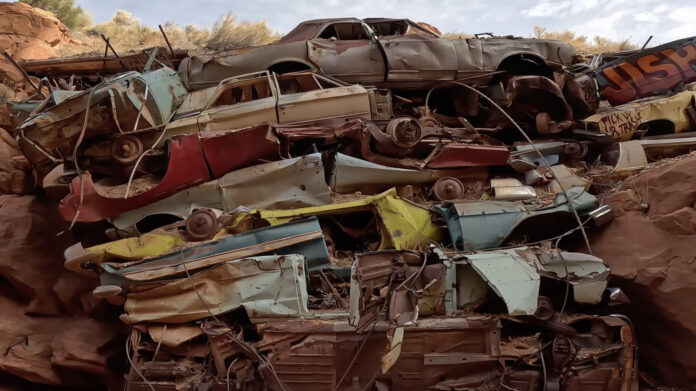
Tucked below the road in a narrow sandstone wash off Highway 89 in Southern Utah is a wall of stacked, crushed classic American cars that’s been sitting for roughly sixty years. No, it’s not art, nor is it vandalism. At one point, it was a genuine engineering solution — and it worked well enough that nobody bothered to remove it.
The technical name for this one-of-a-kind feat is riprap — a term used by engineers and geologists alike to describe any material placed along a bank or embankment to resist erosion. Your typical riprap entails rock, concrete, or a similarly hard material. But in the 1960s, when engineers were cutting Highway 89 through Catstair Canyon, junked cars filled with gravel were considered a practical substitute to stabilize the embankment while preventing loose sand from washing away. A similar “Detroit riprap” was applied along Nebraska’s Loup River for erosion control.
The reasoning wasn’t as bizarre as it sounds. Junkyards in the ’60s were full of old vehicles that weren’t worth scrapping for metal, and the cars were thought to be as resistant to erosion as stone — especially given their size and ability to be stacked tightly together. Highway engineers stacked the canyon full of crushed vehicles before covering them in dirt and building a road atop all of it. This feat easily makes Catstair Canyon one of the most unique remnants of the golden age of American roadway expansion, which culminated with the interstate highway system.
What’s left of Catstair Canyon today
Though riprap fell out of use by the early 1970s, the cars never left. Preserved by the dry desert air, the wall still remains today much as it did when it was first constructed. The only difference now is that it’s supported the weight of six decades of traffic — compressing the vehicles into a solid mass of rusted steel with a cheeky “Trucks Enter Here” sign as the cherry on top.
Visitors who make the short half-mile hike down into the wash find themselves standing in front of stacks tall enough to climb, facing bumpers, headlights, and body panels from popular 1960s American cars. There are actually two separate stacks of cars in the canyon. Both are accessible from a small dirt pullout just past the House Rock Valley Road turnoff, right on a blind curve that requires some care when pulling off.
The hike requires only minor scrambling and shouldn’t take more than an hour. The cars have been there since before most of the people visiting them were born, and given how thoroughly they’re embedded in the hillside, they might just outlast the oldest roads in the country.

